Clear Sky Science · en
Giant topological magneto-optical effect in noncoplanar antiferromagnet
Light and hidden magnetism
Many modern technologies, from hard drives to sensors, rely on magnets that respond strongly to both electric currents and light. This research explores a very different kind of magnet, one that has almost no ordinary magnetic pull yet twists the polarization of light as strongly as common ferromagnets. Understanding how such “quiet” magnets talk to light could inspire faster, more compact ways to store and read information using beams instead of wires.
A crystal with a special spin pattern
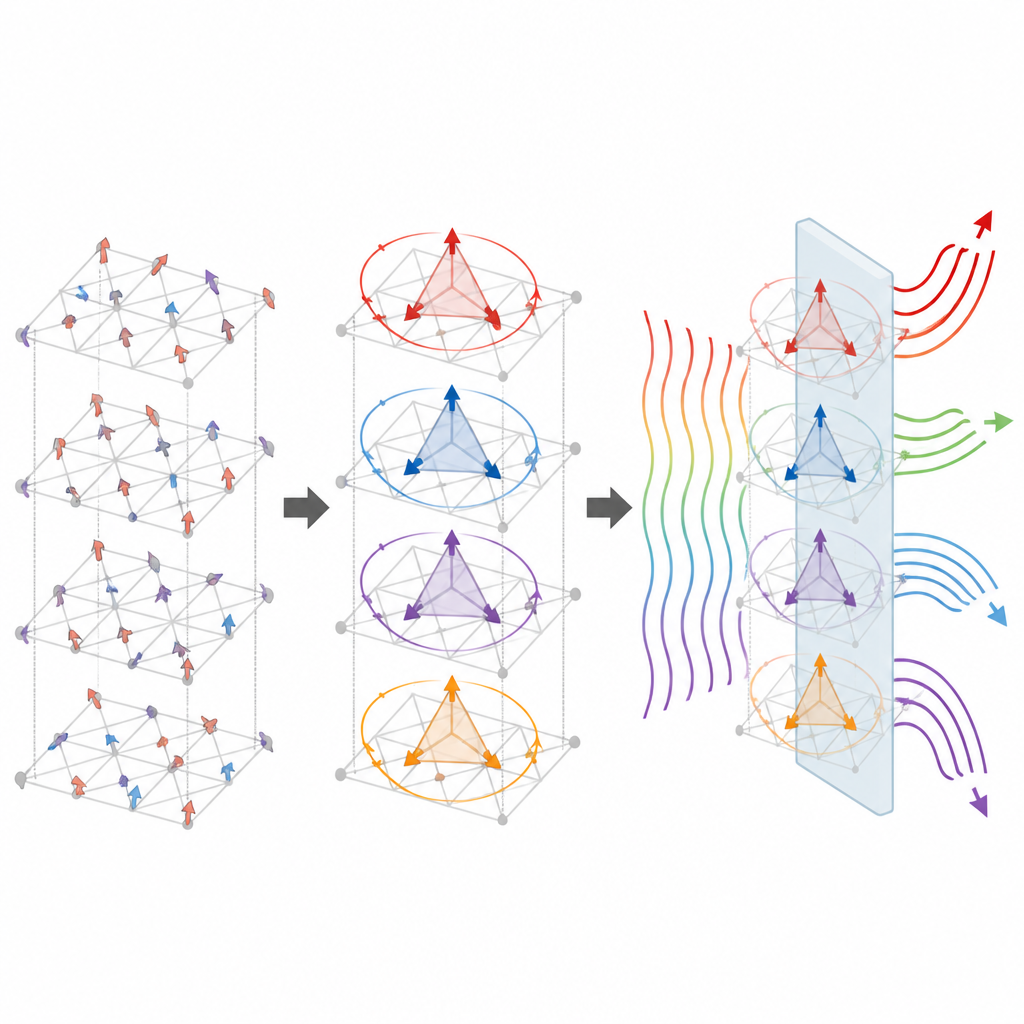
The study focuses on a compound called CoNb3S6, built from flat, stacked layers. Within certain layers, cobalt atoms sit on a triangular grid. Each cobalt atom carries a tiny magnetic moment, or spin. Instead of lining up like in a bar magnet, the spins in this material arrange in a noncoplanar all-in-all-out pattern on small tetrahedral units: in one unit, the spins point mostly toward the center, while in the neighboring unit they point outward. This repeating pattern appears below about 27.5 kelvin, forming an antiferromagnetic state that breaks time-reversal symmetry while keeping the overall magnetization extremely small.
When spin texture acts like a hidden field
The three-dimensional spin pattern on each tetrahedron has a handedness, often called spin chirality. In effect, this chirality acts on moving electrons as if there were a powerful internal magnetic field, even though an external magnet barely detects it. Earlier work on CoNb3S6 and its relatives had already revealed a large topological Hall effect, where electric current flowing through the crystal is deflected sideways because of this hidden field. The new question tackled here is how the same chiral spin texture affects light, and whether that influence can be separated from the usual effects tied to net magnetization and spin-orbit coupling.
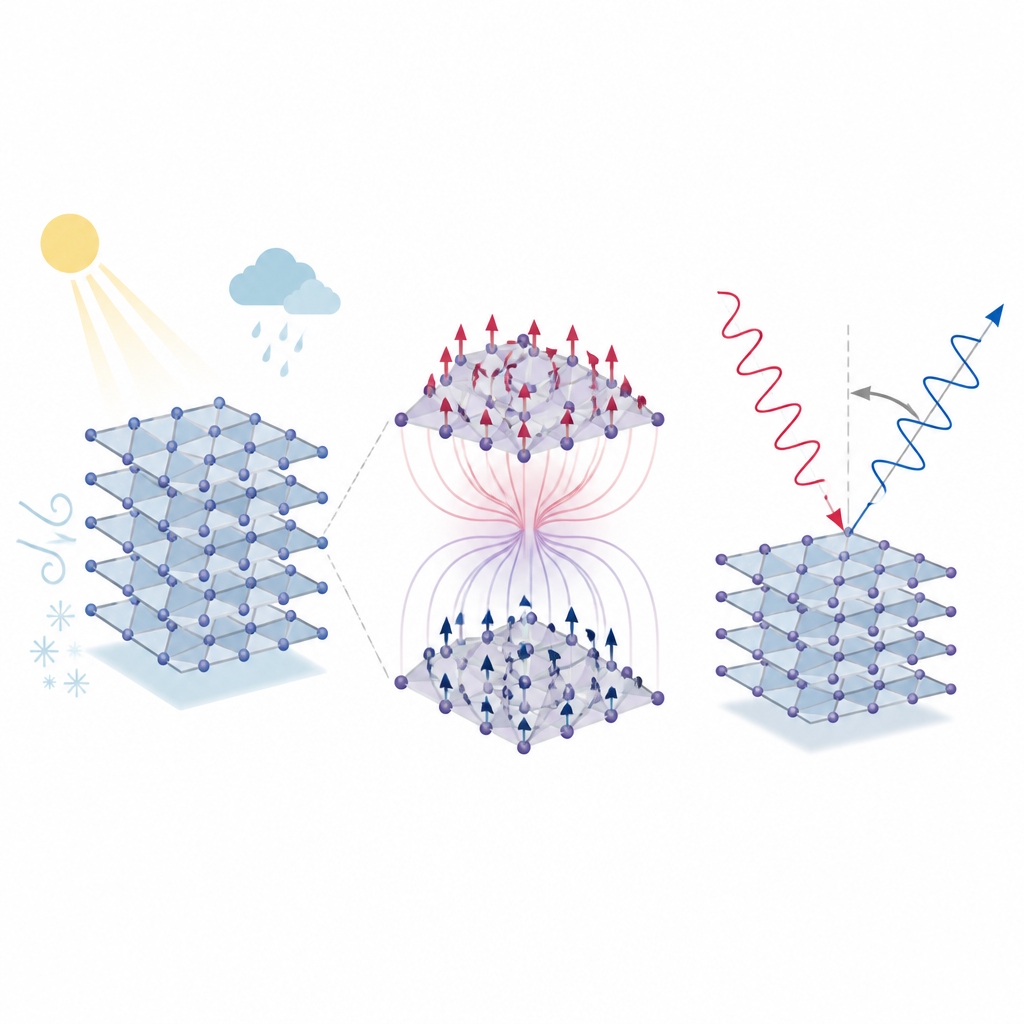
Light reflection that remembers domain choice
To answer this, the authors used magneto-optical Kerr effect measurements, in which linearly polarized light reflects from the sample and its polarization plane rotates or becomes slightly elliptical. Two approaches were combined: direct imaging with a camera at a fixed wavelength near 1000 nanometers, and broadband spectroscopy from the far-infrared to visible light. After cooling the sample without a field, the images revealed patchy domains where the Kerr rotation was either positive or negative, even though the net magnetization remained almost zero. By cooling in a small positive or negative field, they could select a single domain, flipping the sign of the rotation while keeping its size, showing that the effect tracks which of the two time-reversed spin patterns, all-in-all-out or all-out-all-in, is present.
A giant optical twist from almost no magnetization
Spectroscopy of a single domain revealed several resonances in both Kerr rotation and Kerr ellipticity between about 0.1 and 2 electronvolts. The largest rotation reached roughly four milliradians around 1.2 electronvolts, a value comparable to that of many strong ferromagnets. Yet careful comparison with magnetization data showed that the conventional contribution linked to net magnetization is less than one percent of the total signal at typical energies. By sweeping the magnetic field, the Kerr response simply flipped sign at the same fields where the topological Hall signal switched, without following the small gradual change in magnetization. This firmly identifies the observed Kerr effect as topological in origin, governed by spin chirality rather than by ordinary magnetic order.
Connecting optical response to electronic structure
From the Kerr data and independent measurements of how the crystal reflects light, the researchers reconstructed the complex optical Hall conductivity across a wide energy range. They found a strong low-energy resonance around 50 millielectronvolts whose spectral weight closely matches the direct current topological Hall conductivity, in agreement with basic sum rules. This behavior points to a picture in which the chiral spin pattern reconstructs the electronic bands and creates intense “Berry curvature” in momentum space, steering both electrons and light in a topological fashion. Compared with skyrmion-hosting magnets that show related effects, CoNb3S6 delivers a broader energy range and a much larger Kerr rotation per unit magnetization.
Why this matters for future devices
To a non-specialist, the key outcome is that a nearly nonmagnetic crystal can still twist light very strongly because of a subtle, chiral pattern of its internal spins. This twist, and its tight link to electronic transport, reveals that the material’s electrons experience an enormous effective magnetic field that arises purely from geometry. Such strong, label-free sensitivity of light to antiferromagnetic domains points toward optical methods for reading and perhaps even writing information in next-generation spintronic and optospintronic devices, with the promise of fast, contactless control that does not rely on large external magnets.
Citation: Okamura, Y., Hayashi, Y., Khanh, N.D. et al. Giant topological magneto-optical effect in noncoplanar antiferromagnet. Nat Commun 17, 4409 (2026). https://doi.org/10.1038/s41467-026-72889-5
Keywords: antiferromagnet, magneto-optical Kerr effect, spin chirality, topological Hall effect, spintronics