Clear Sky Science · en
Emulation of coherent absorption of Fock-state quantum light in a programmable linear photonic circuit
Why this work matters
Modern technologies that use light—such as fiber‑optic networks and quantum computers—often treat loss of light as an unwanted nuisance. This research turns that idea on its head. The authors show how carefully designed loss can be used as a tool to sculpt the behavior of individual particles of light, opening doors to new kinds of sensors, filters, and simulators for quantum technologies, all built on a compact chip.
Shaping light with loss
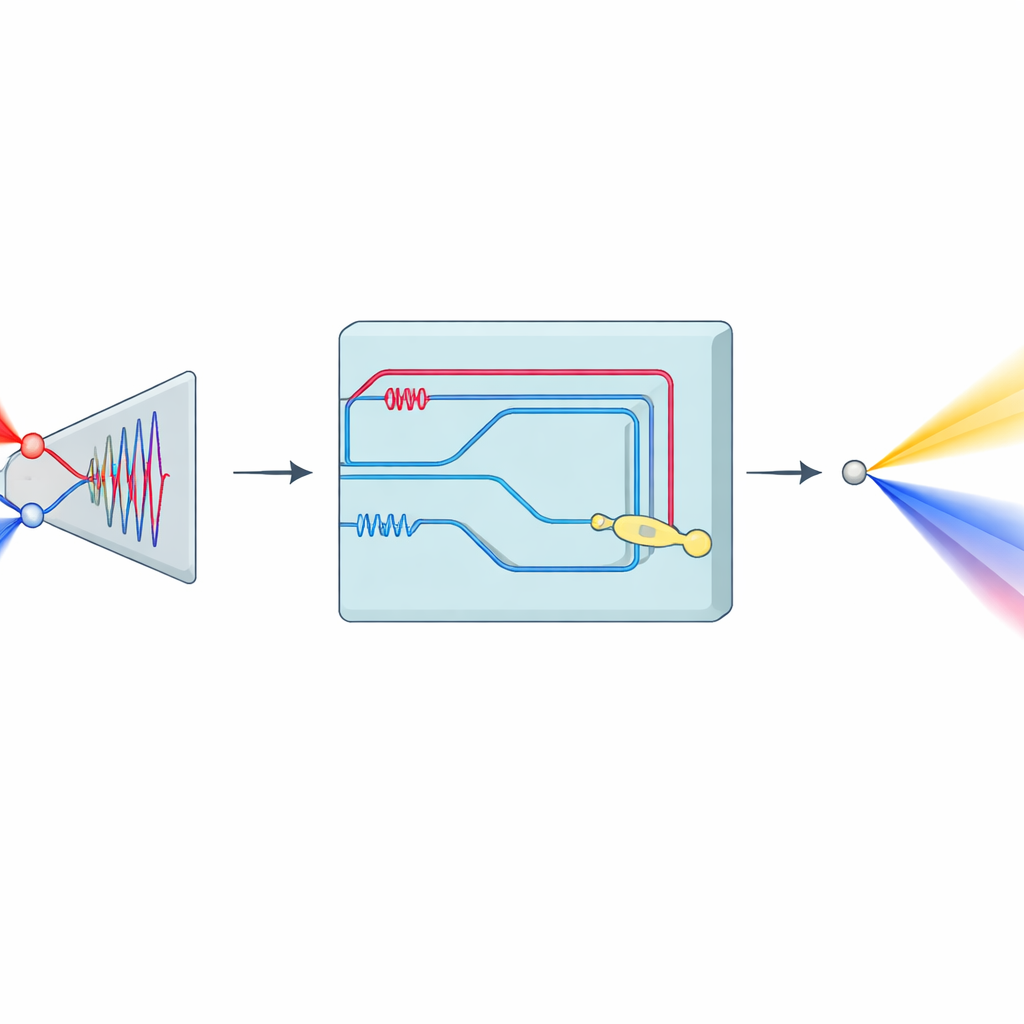
When light passes through a material, some of it is usually absorbed and turns into heat. If two light beams meet the same absorber from opposite sides, their ripples can add or cancel in space, creating bright and dark regions. Depending on how their peaks line up, the absorber can swallow almost all of the light or let most of it pass. This phenomenon, called coherent absorption, has been exploited with ordinary laser beams for switching and signal control. In this work, the authors explore what happens when the light is made of single photons and carefully prepared pairs of photons, and when the absorber is not a simple slab but a programmable optical circuit etched on a silicon chip.
A programmable optical playground on a chip
The team builds their device from an eight‑channel network of waveguides and tiny interferometers known as Mach–Zehnder interferometers. By heating specific sections of the chip, they can finely adjust the phases and splitting ratios along different paths, effectively programming the circuit. A key trick is to imitate a lossy beam splitter—a component that both transmits and reflects light while sending some into a hidden “environment.” Instead of truly destroying photons, the chip routes them into an extra output channel that plays the role of an ancilla, or helper mode. This approach embeds an irreversible process (loss) inside a larger, reversible evolution, allowing the researchers to implement arbitrary non‑unitary transformations while still accounting for every photon.
Single photons: steering between loss and survival
To test the circuit, the authors first send in one photon that is split into a balanced superposition of two paths. By adjusting the relative phase between these paths, they can choose whether that photon behaves like a “bright” mode that couples strongly to the effective absorber, or a “dark” mode that bypasses it. In measurements, they see the photon count in the ancilla channel rise and fall smoothly as they tune this phase, with nearly perfect absorption at specific settings. At the same time, the remaining light in the two main outputs shows interference fringes whose visibility and relative phase depend on how strongly the effective absorber is engaged. From the statistics of many detection events, the authors compute the classical Fisher information, a measure of how sensitively the setup responds to tiny phase changes, and find that with single photons the phase sensitivity can reach the fundamental limit expected for such a probe.
Entangled photon pairs: enhanced sensing and exotic interference
The experiment becomes richer when the input is a two‑photon NOON state, a special form of entangled light where both photons travel together in one path or the other. This state accumulates phase twice as fast as a single photon, and the resulting detection fringes repeat twice as often. Within the same chip, the researchers observe regimes where exactly one photon is always lost to the ancilla while its partner exits through the main outputs, and other regimes where both photons are jointly absorbed with high probability. They also witness bunching and anti‑bunching effects, where photons prefer to leave together in one port or are forced to separate into different ports, depending on the programmed loss pattern. Comparing measurements to detailed theory, they find very high agreement, showing that the chip accurately realizes the desired transformations. Crucially, for these entangled inputs the total Fisher information reaches about 3.4—higher than the standard shot‑noise limit for two independent photons and close to the ultimate quantum limit for two‑photon phase measurements.
From quantum filters to smarter sensors
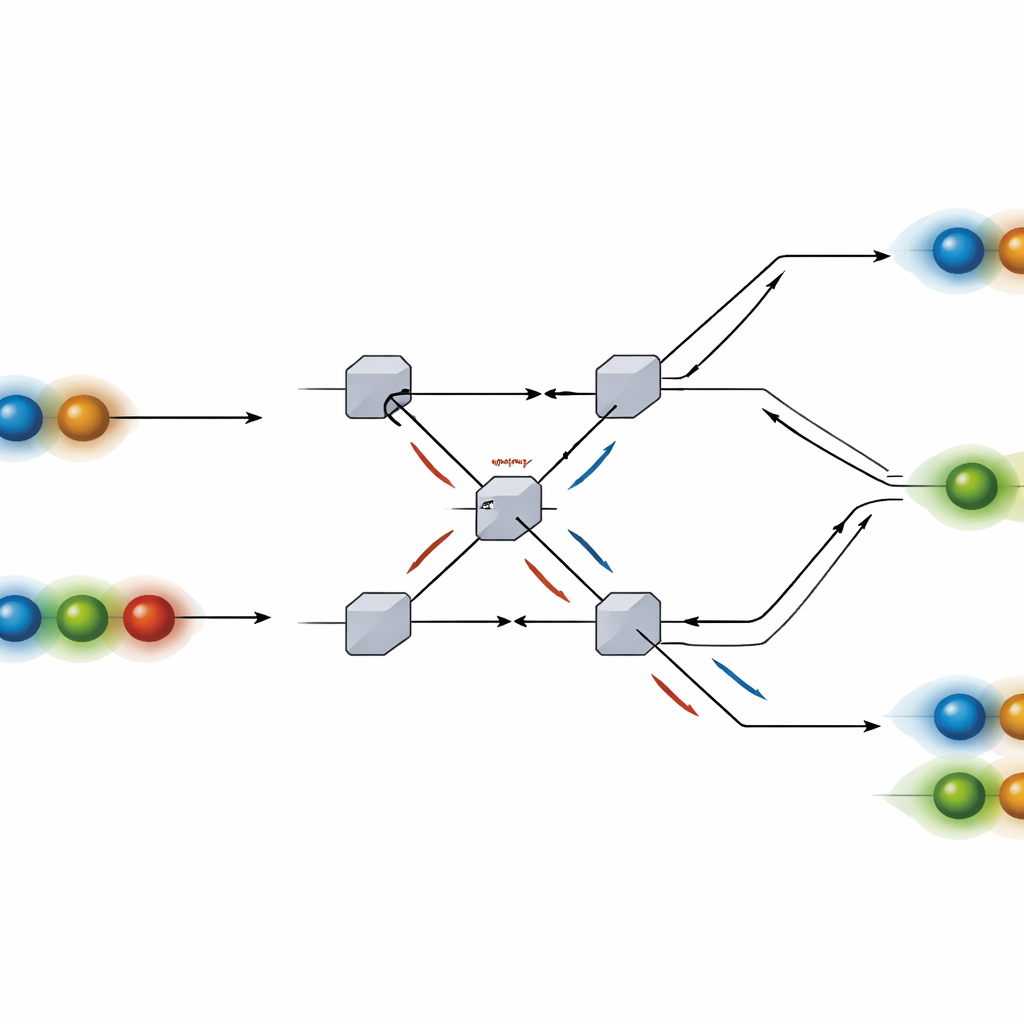
Beyond demonstrating fine control of photon absorption, this work offers a versatile building block for future quantum photonic systems. Because loss is emulated by routing light into a separate mode rather than destroying it, the “lost” photons can in principle be measured or recycled later. This makes the same chip suitable for tasks such as quantum state filtering, where only certain superpositions are removed, as well as for simulating open quantum systems in which particles exchange energy with their surroundings. The ability to program how phase information is distributed among different output patterns suggests new strategies for adaptive and multiplexed quantum sensing, where several detectors share the task of reading out a delicate signal. In short, the authors show that carefully engineered loss, implemented in a programmable chip, can become a powerful resource rather than a drawback in the quest for practical quantum technologies.
Citation: Krishna, G., Gao, J., O’Brien, S. et al. Emulation of coherent absorption of Fock-state quantum light in a programmable linear photonic circuit. Nat Commun 17, 4211 (2026). https://doi.org/10.1038/s41467-026-72850-6
Keywords: quantum photonics, coherent absorption, integrated photonic circuits, NOON states, quantum sensing