Clear Sky Science · en
Fermi-surface diagnosis for topological superconductivity with s-wave-like pairing symmetries
Why this hidden property of superconductors matters
Superconductors are materials that can carry electric current without resistance, a feature at the heart of future low-power electronics and quantum technologies. A particularly intriguing subset, called topological superconductors, can host exotic boundary states that may be useful for robust quantum bits. Yet these phases are extremely hard to find in real materials. This work introduces a practical shortcut: a way to tell, from a small amount of data about electrons in a material, whether its superconducting state is likely to be topological.
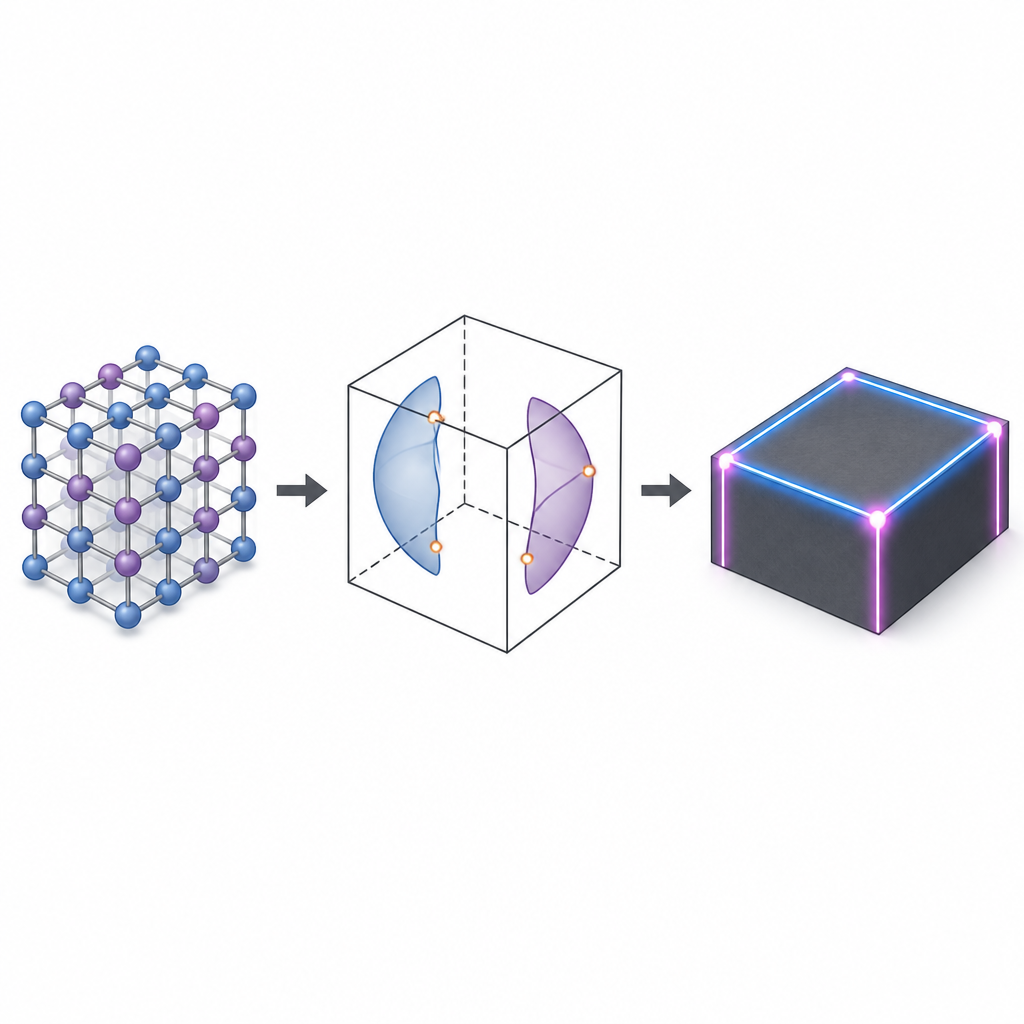
From rare oddballs to common materials
For years, most theoretical proposals for topological superconductors focused on rare and fragile forms of pairing, where electrons combine in unconventional patterns such as p-wave or d-wave states. However, most known superconductors pair electrons in a more ordinary fashion often described as s-wave-like. Surprisingly, recent classification work showed that topological superconductivity can in fact coexist with these common pairing patterns in the vast majority of crystal structures. The challenge then shifted: not to prove such phases exist in principle, but to identify them efficiently in real compounds where full microscopic information is rarely available.
A shortcut that reads only the important points
The authors develop a set of “Fermi-surface formulas” that diagnose topological behavior using very limited information. Instead of tracking the entire sea of electrons in a solid, the method looks only at special points where the electronic energy exactly matches the Fermi level, the energy that separates filled from empty states. Along a few symmetry-related lines in momentum space, the researchers consider the sign of the superconducting pairing and the direction of the electron velocity at each such Fermi point. From these signs alone, they build integer counters that act as topological markers, signaling whether the material must host robust gapless states on its surfaces, edges, or even corners.
Covering many crystal families with one recipe
Crystals are organized into 230 possible space groups, describing all distinct ways atoms can repeat in three dimensions. The new formulas work for time-reversal-symmetric superconductors with s-wave-like pairing in all of these groups, and in their two-dimensional counterparts that describe thin films. For 159 space groups, the method can fully diagnose both fully gapped and stable gapless topological phases. In the remaining 71, it still captures a large subset of possibilities and even tracks reduced versions of more complex three-dimensional winding numbers. Crucially, the approach also handles cases where symmetry forces degeneracies in the electronic structure, situations where earlier formulas break down.
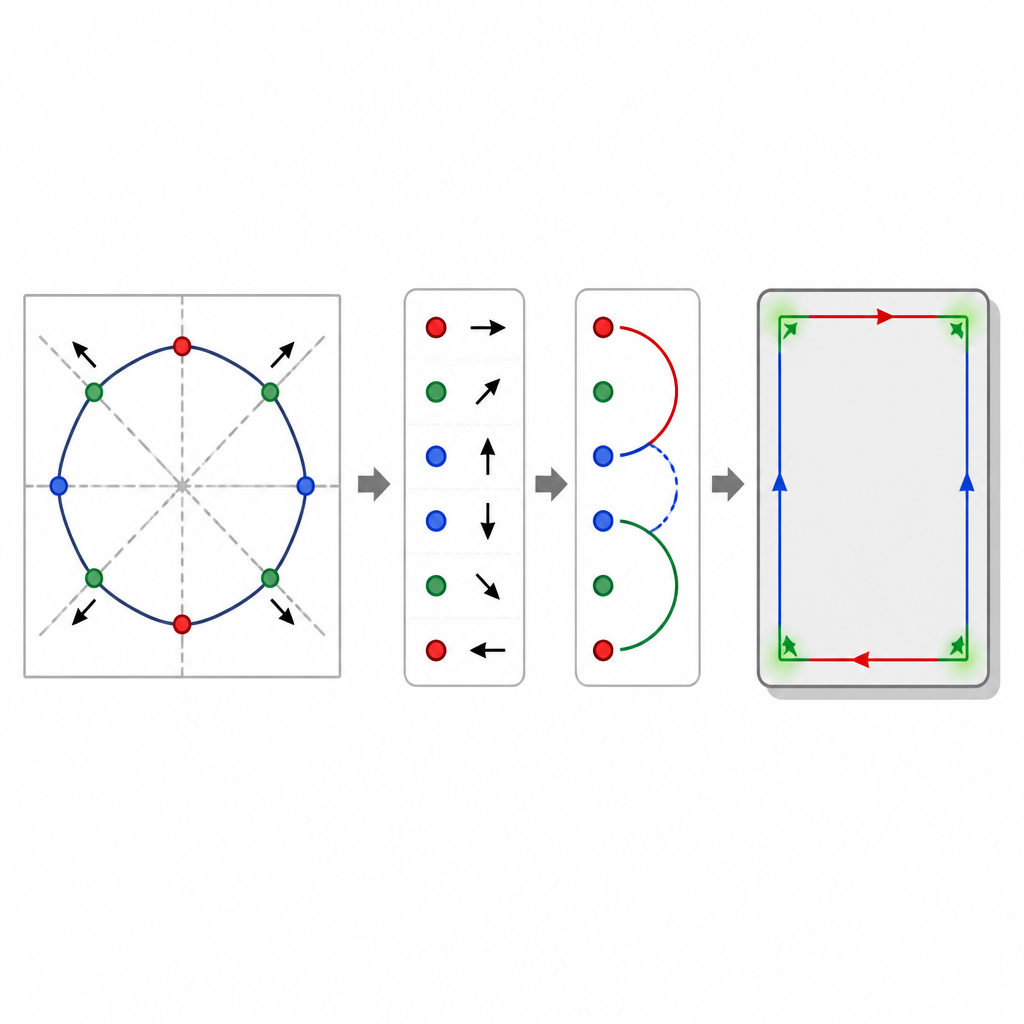
Testing the method on models and a real material
To illustrate how their scheme works in practice, the authors first apply it to several theoretical lattice models that realize different types of topological superconducting behavior, including systems with mirror, glide, and screw symmetries. In each case, the simple sign-based counting correctly predicts whether gapless points or protected surface states must appear. They then turn to a realistic iron-based compound, CaFeAs₂, whose electronic structure is known from detailed computer calculations. By exploring different possible patterns for how the superconducting gap might change sign between its Fermi pockets, they identify several configurations that would realize higher-order topological phases, with Majorana-like modes confined to sample corners or hinges.
What this means for the search for new quantum materials
This work shows that one can often decide whether a superconducting phase is topological without solving the full, complicated equations that describe it. Instead, knowing the band structure from standard electronic-structure calculations and a coarse picture of how the superconducting gap changes sign is enough to evaluate the new formulas. For the many materials that fall into the s-wave-like category, this offers a realistic route to scanning large databases and focusing experiments on the most promising candidates. In simple terms, the authors provide a compact checklist that links a few key features of electrons at the Fermi level to the presence of protected boundary states, bringing the discovery of practical topological superconductors closer to reach.
Citation: Zhang, Z., Shiozaki, K., Fang, C. et al. Fermi-surface diagnosis for topological superconductivity with s-wave-like pairing symmetries. Nat Commun 17, 4413 (2026). https://doi.org/10.1038/s41467-026-72811-z
Keywords: topological superconductivity, Fermi surface, s-wave pairing, Majorana modes, quantum materials