Clear Sky Science · en
Superconductivity in kagome metals due to soft loop-current fluctuations
Why this strange metal matters
Superconductors, materials that carry electric current without resistance, are key to future technologies like efficient power lines and powerful magnets. A new family of metals built on a kagome lattice, a pattern of corner-sharing triangles, has fascinated researchers because they show both superconductivity and intricate charge patterns that may host tiny circulating currents. This paper explores whether gentle fluctuations of these loop-like currents can actually be the glue that binds electrons into superconducting pairs, and why experiments see more than one kind of superconducting state as pressure is increased.
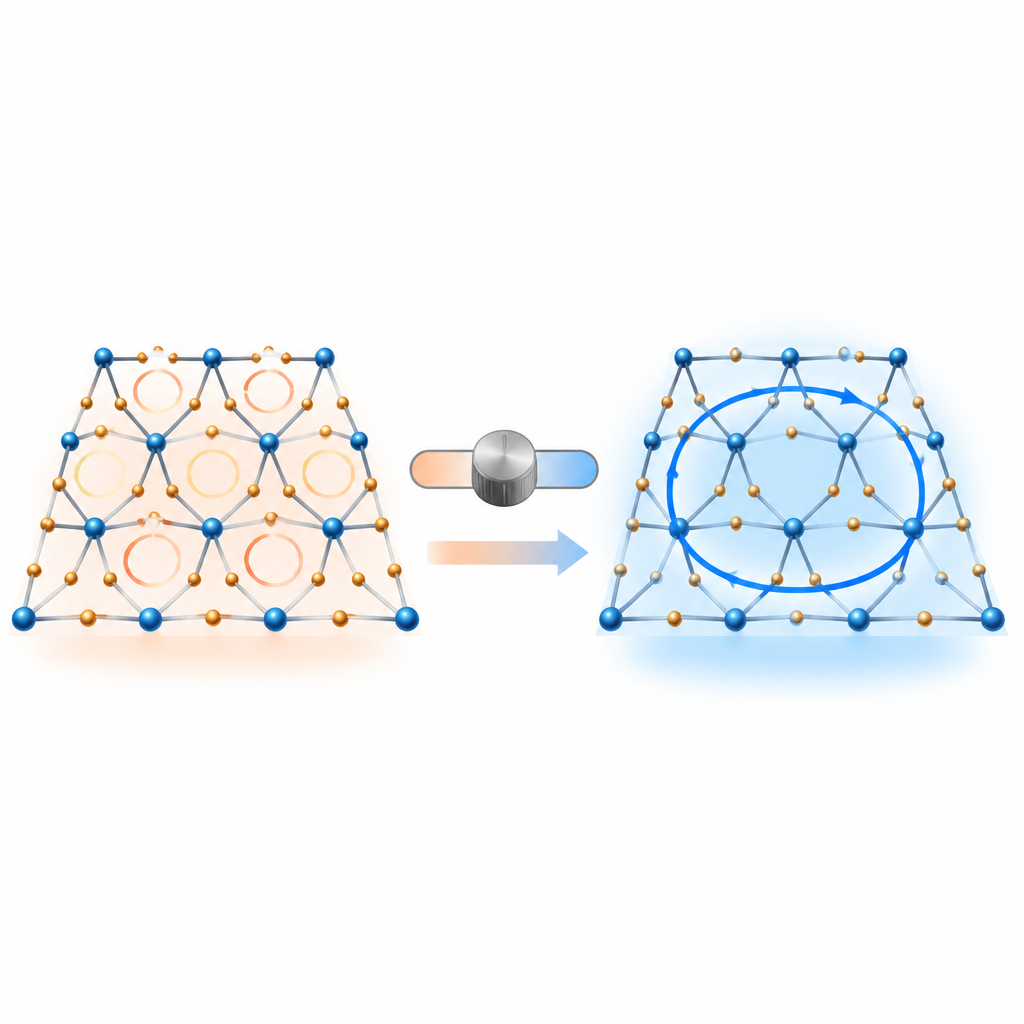
The triangular web of atoms
The materials studied, called AV3Sb5, stack layers of vanadium and antimony atoms into a kagome network. Within each unit cell there are many electronic orbitals, mainly from vanadium 3d and antimony 5p states, that combine to form several energy bands. Electrons near certain special points in momentum space, known as saddle points, are largely made of vanadium states and are strongly linked to charge density waves, ordered patterns where the electronic charge modulates in space. In contrast, a nearly circular pocket of states near the center of momentum space comes mostly from planar antimony atoms and appears to be crucial for superconductivity, since its disappearance under pressure coincides with the loss of the first superconducting phase.
Tiny circulating currents that do not quite freeze
Experiments suggest that these kagome metals host loop currents, in which electrons circulate around small loops and subtly break time-reversal symmetry without producing a large overall magnetization. It is not yet clear if these loop currents settle into a rigid pattern or remain soft, fluctuating excitations down to low temperatures. The authors assume a regime where no long-range loop-current order is present, but the fluctuations are slow and intense enough to influence electrons. They classify all possible loop-current patterns that fit within a doubled unit cell, and distinguish those confined to vanadium-vanadium bonds from those that also involve paths between vanadium and planar antimony atoms.
How fluctuating currents bind electrons
In this framework, the loop-current fluctuations behave like a collective boson that mediates an effective interaction between electrons. Because these currents break time-reversal symmetry, they generate a repulsive interaction in the usual singlet pairing channel, so electrons can only form pairs if the superconducting gap changes sign between different regions of the Fermi surface. Using a realistic multi-orbital tight-binding model with 30 bands and focusing on the most relevant 13 orbitals, the authors compute how these fluctuations scatter electrons on the Fermi surface and solve the corresponding gap equation to find the most likely pairing patterns.
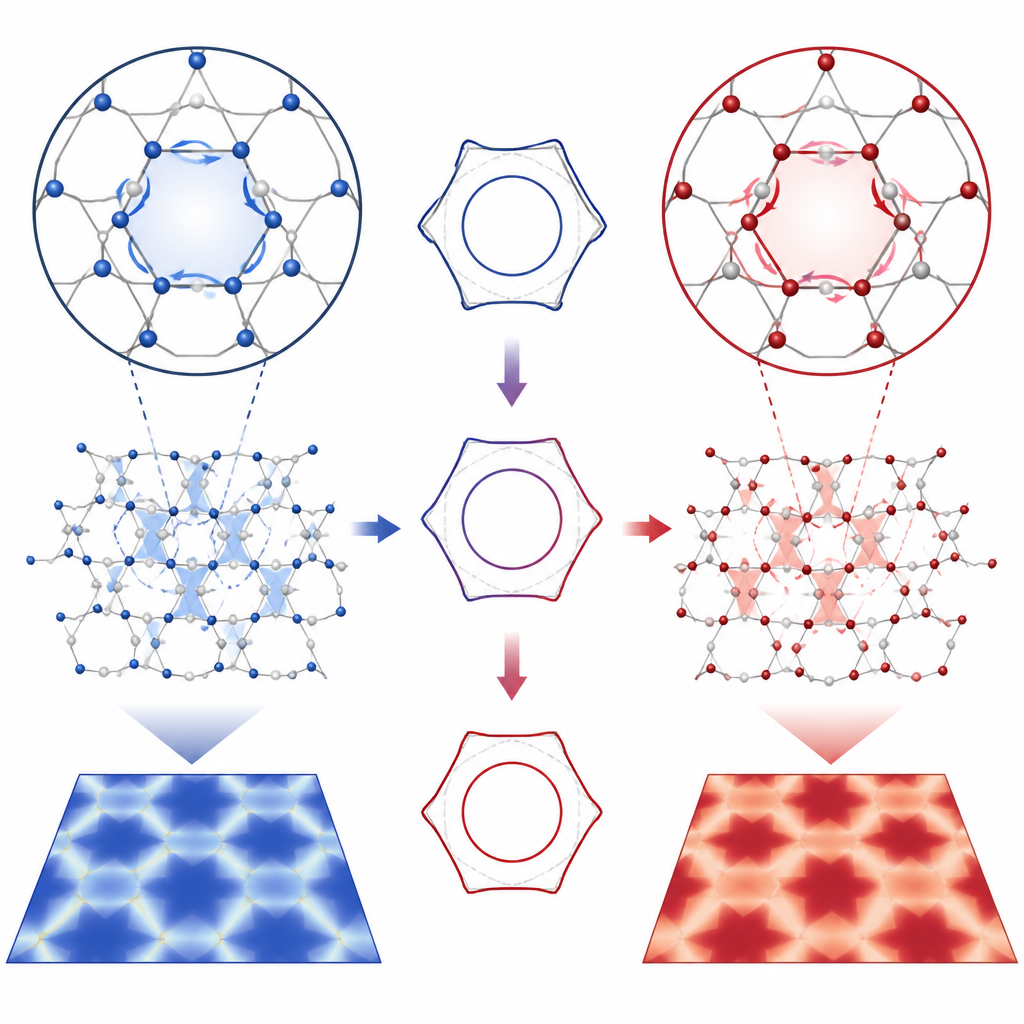
Two distinct superconducting states
The calculations show that the detailed “pathway” of the loop currents is decisive. When the currents circulate only among vanadium sites, the strongest pairing channel has the structure of a chiral d + id state, in which two different d-wave components combine to produce a fully gapped superconducting state that breaks time-reversal symmetry. When the currents also run between vanadium and planar antimony sites, the interaction strongly links the outer Fermi-surface sheets to the antimony pocket near the center. The resulting state has what is called s± symmetry: the superconducting gap keeps a similar magnitude but switches sign between the antimony pocket and the rest of the Fermi surface, remaining fully gapped but with an internal sign structure.
Pressure, disappearing pockets, and phase changes
By gradually shifting the energy of the antimony-derived band, the authors mimic the effect of pressure that experimentally drives a Lifshitz transition, where the central Fermi pocket disappears. Their model shows that the s± superconducting state collapses at this point, because it relies on strong coupling between the loop currents and electrons on the antimony pocket. Once that pocket is gone, the dominant pairing channel reverts to the chiral d + id state favored by vanadium-only current paths. This theoretical picture naturally explains why CsV3Sb5 displays one superconducting dome that vanishes when the antimony pocket disappears, and a second dome at higher pressure where only vanadium-based states remain important.
Big-picture takeaway
For a lay reader, the core message is that delicate, fluctuating loops of current in a geometrically frustrated metal can act as an unusual glue for superconductivity. Depending on whether these loops stay within the vanadium network or also include antimony atoms, the electrons pair up in two distinct ways that match the two superconducting phases seen under pressure. This work links the microscopic motion of electrons on different atomic sites to the macroscopic superconducting behavior, suggesting that controlling orbital pathways and loop-current fluctuations may be a powerful route to designing new superconductors.
Citation: Schultz, D.J., Palle, G., Mitra, A. et al. Superconductivity in kagome metals due to soft loop-current fluctuations. Nat Commun 17, 4557 (2026). https://doi.org/10.1038/s41467-026-72806-w
Keywords: kagome superconductivity, loop currents, unconventional pairing, multi-orbital metals, pressure-induced phases