Clear Sky Science · en
Dual site targeting of the bacterial 70S ribosome by tetracyclines
Why this matters for everyday health
Doctors rely on tetracycline antibiotics to treat a wide range of infections, from acne and pneumonia to Lyme disease. Yet bacteria are steadily learning how to evade these medicines. This study reveals that tetracyclines do not attack bacteria in just one way, as long assumed, but instead latch onto two crucial spots in the bacterial protein factory. Understanding this hidden second grip helps explain why some drugs in this family work better than others and offers a roadmap for designing future antibiotics that are tougher for bacteria to resist. 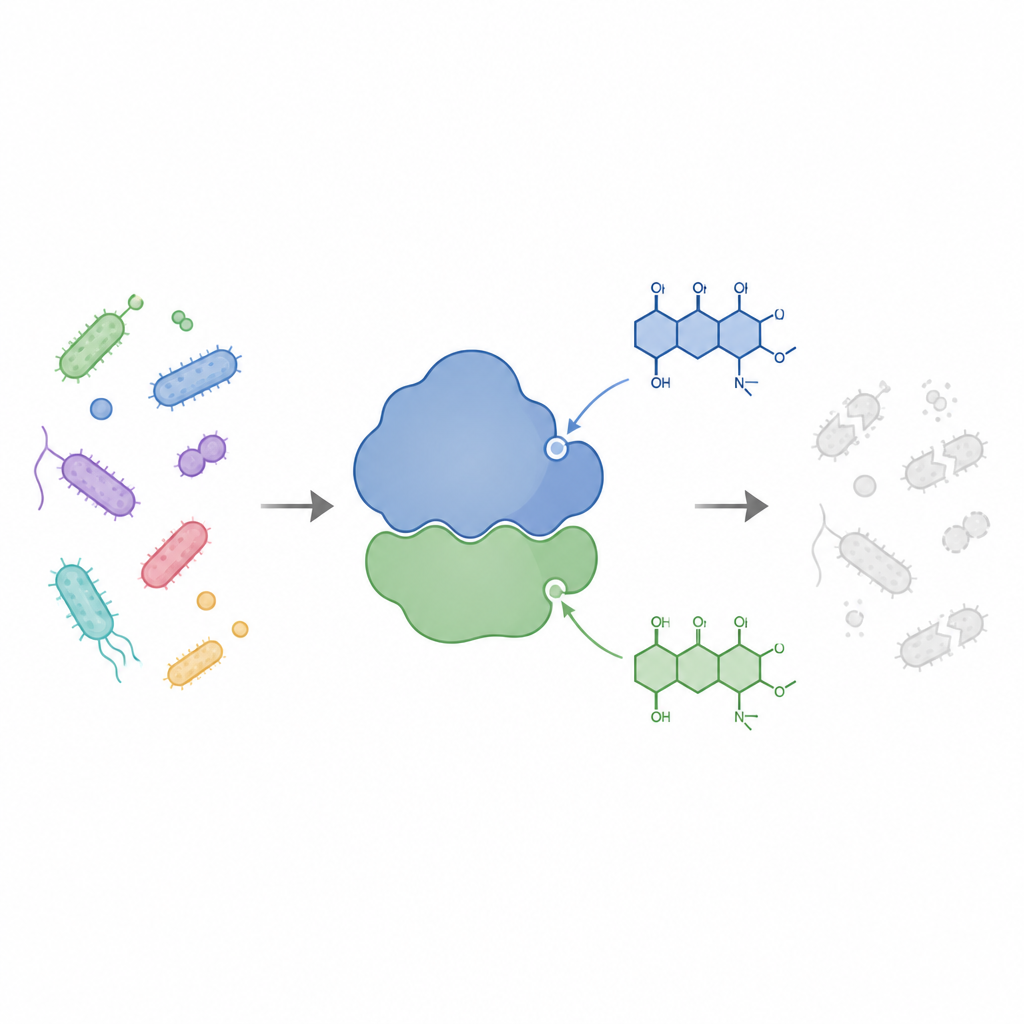
How bacteria build their tools of survival
Bacteria survive by constantly making new proteins on large molecular machines called ribosomes. These machines read genetic messages and stitch together amino acids into growing protein chains that exit through a narrow tunnel. If this assembly line is slowed or blocked, the bacterium cannot grow or divide. Tetracyclines have long been thought to work mainly by sitting in the message-reading center of the ribosome, where they interfere with the arrival of the next building block. The new work shows that this story is only half complete.
Antibiotics gripping the protein factory in two places
Using high-resolution cryo-electron microscopy, the researchers visualized how three widely used tetracyclines – doxycycline, minocycline, and sarecycline – bind to ribosomes from two different bacteria: Escherichia coli, a common lab model and gut bacterium, and Cutibacterium acnes, which is linked to acne. In all cases, the drugs grabbed onto the known site in the smaller half of the ribosome, where genetic messages are read. But they also bound at a second site deep in the exit tunnel of the larger half, very close to the chemical center that forms new bonds between amino acids. By occupying both the decoding center and the tunnel, these antibiotics can interfere with protein production at two critical stages. 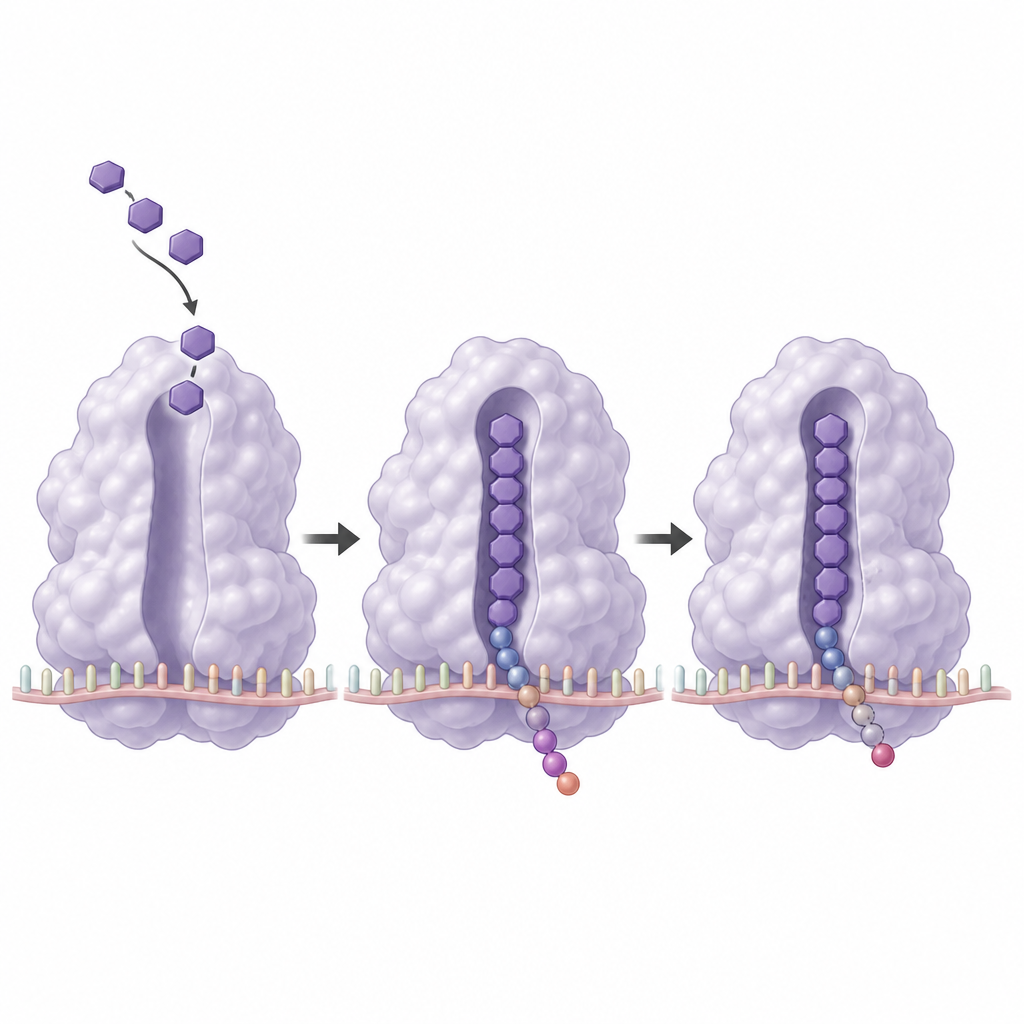
A special role for doxycycline and species differences
Doxycycline showed a particularly striking behavior: at higher concentrations it formed pairs that stacked inside the exit tunnel, creating a multilevel plug. Two doxycycline dimers wedged into different parts of the tunnel, bumping into the path of the emerging protein chain and interacting with key ribosomal components needed for proper folding and delivery of proteins. This multi-pronged blockade helps explain why doxycycline becomes especially potent as its local concentration rises. The study also found that subtle structural differences between ribosomes from different bacteria, and small chemical tweaks on each drug, shifted how tightly and in what orientation the drugs sat in the tunnel, hinting that carefully tailored modifications could favor some bacterial species over others.
What drug concentration and resistance reveal
The team tested how well the three drugs blocked protein production at different concentrations and measured how fully each one occupied the two ribosomal sites. The tunnel site turned out to be weaker than the classic decoding site and became heavily used only at higher drug levels. Doxycycline filled this tunnel site most strongly, minocycline somewhat less, and sarecycline the least, matching their relative strengths in functional tests. They also studied bacterial strains with mutations that disrupt the known decoding site. In these mutants, minocycline and doxycycline still slowed growth, whereas sarecycline was much less effective. This suggests that the tunnel site can meaningfully contribute to antibiotic action, especially for drugs that fit it well.
Clues for designing future targeted antibiotics
The findings show that tetracyclines naturally act as dual-site inhibitors, gripping both the decoding center and the protein exit tunnel of bacterial ribosomes. Doxycycline stands out by forming stacked pairs that essentially cork the tunnel at multiple points. Because the exact shape of the tunnel and surrounding features differs between bacterial species – and even resembles a similar site in human mitochondrial ribosomes – the detailed structural maps from this work offer guidance for crafting new tetracyclines. By adjusting the size and position of chemical groups on the drug core, future antibiotics could be tuned to favor certain pathogens while avoiding others, providing narrower-spectrum treatments that help slow the spread of resistance and reduce side effects.
Citation: Devarkar, S.C., Lomakin, I.B., Wang, J. et al. Dual site targeting of the bacterial 70S ribosome by tetracyclines. Nat Commun 17, 4452 (2026). https://doi.org/10.1038/s41467-026-72788-9
Keywords: tetracycline antibiotics, bacterial ribosome, doxycycline, antibiotic resistance, protein synthesis inhibition