Clear Sky Science · en
Autonomous microfluidic experimentation for exploring reaction inference and synthesizing double perovskite nanoplatelets
Smart labs that run themselves
Imagine a chemistry lab that can plan, run, and learn from its own experiments while you sleep. This study shows how such a self-driving lab can quickly discover better recipes for tiny light emitting crystals that could one day power more efficient displays, lighting, and sensors.
Why tiny glowing crystals matter
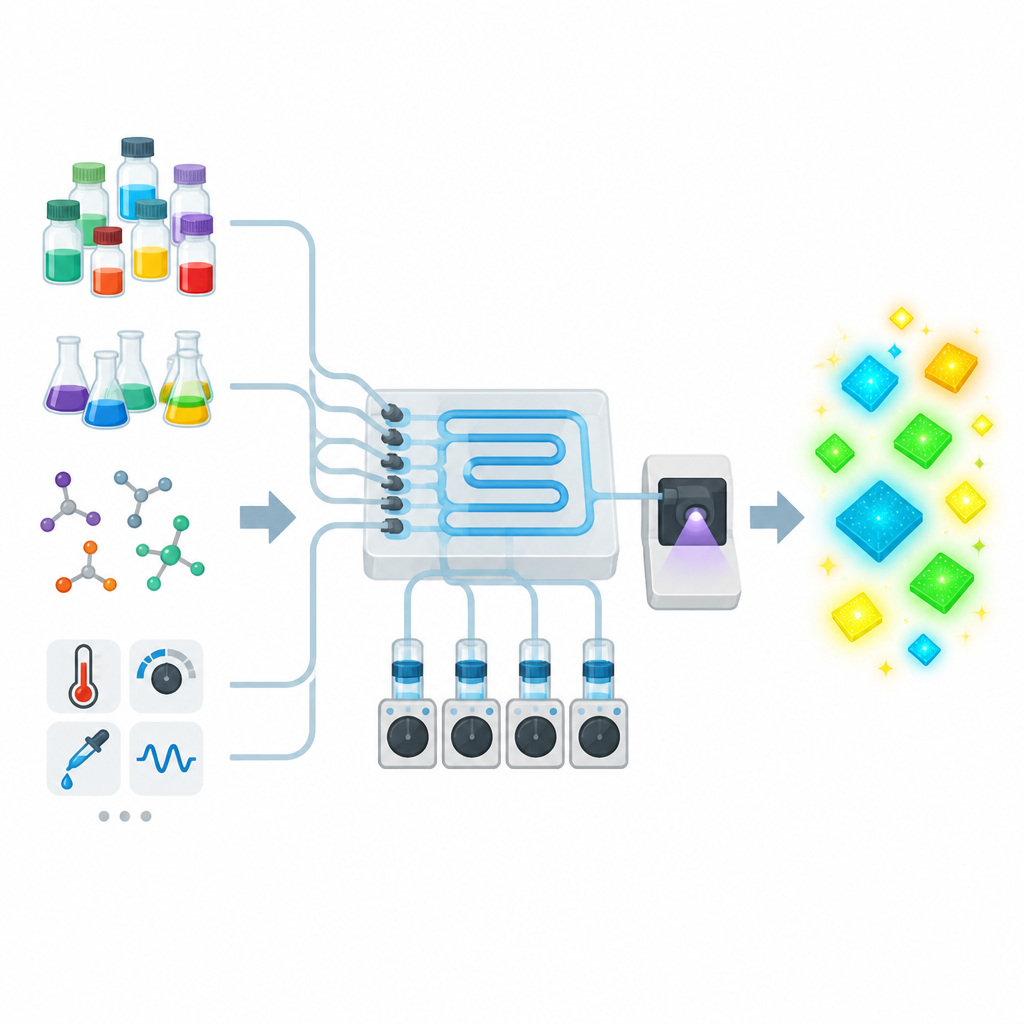
Modern screens, solar cells, and optical sensors rely on materials that can absorb and emit light in very controlled ways. Colloidal nanocrystals are ultra small particles whose color and brightness can be tuned by changing their ingredients and size. A newer family of these materials, called lead free double perovskite nanoplatelets, offers bright light emission with lower toxicity than many current options. But getting the recipe right is extremely hard because many ingredients and reaction conditions interact in complex, nonlinear ways.
The challenge of searching a huge recipe space
Traditional chemistry often changes one variable at a time, like oven temperature or salt content in a recipe. For these nanoplatelets, there are at least seven key knobs to turn, including the amounts of several metals, the solvent, and the reaction temperature. Each knob can take many values, creating a vast landscape of possible conditions. Manually exploring this space is slow and risks missing the best combinations. The authors set out to build a system that could explore this landscape automatically, learn from each trial, and steer itself toward brighter, more efficient light emitters.
A micro lab on a chip that learns
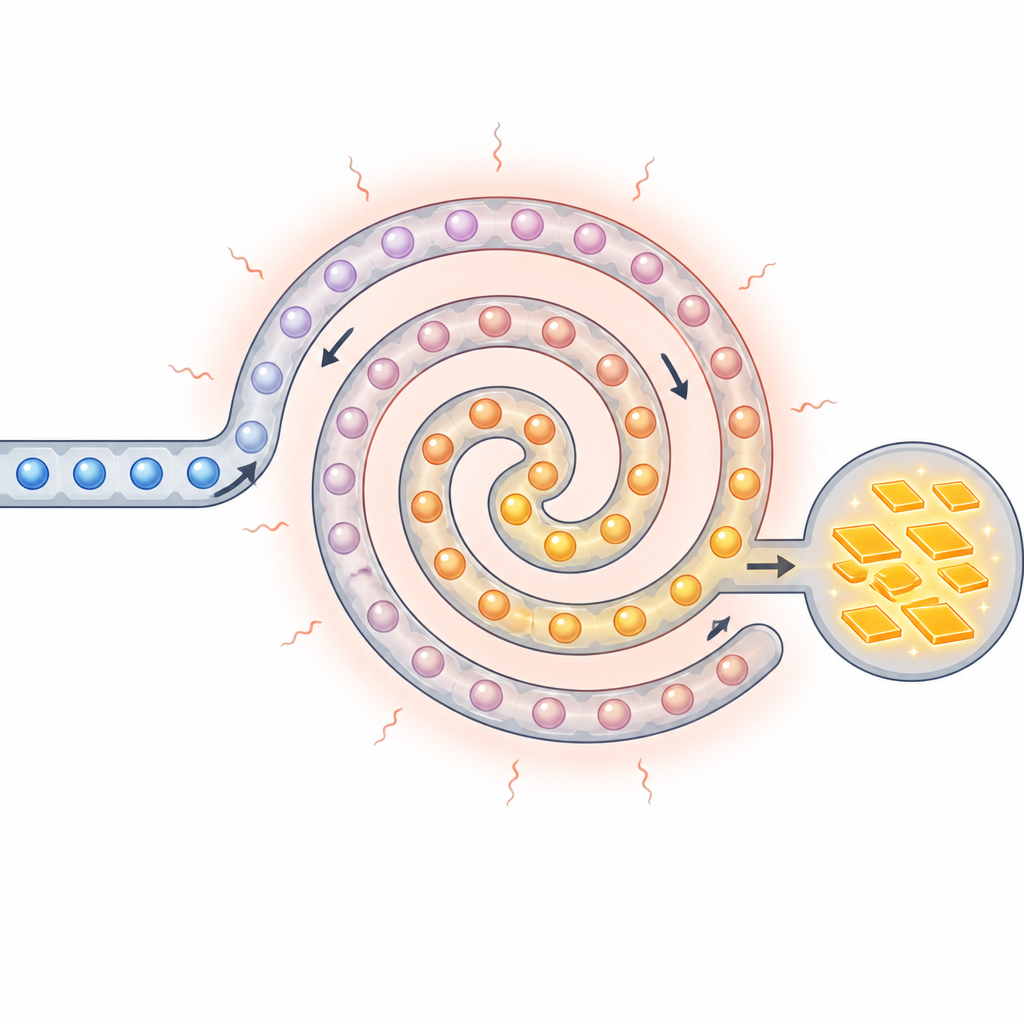
The team created PoLARIS, a microfluidic platform where reactions take place inside tiny droplets flowing through thin channels on a heated metal plate. Computer controlled pumps feed in streams of starting chemicals, which are chopped into uniform droplets by an inert carrier liquid. As these droplets race through a spiral channel, they heat up and the nanoplatelets form. Downstream, built in optical sensors record how strongly each droplet absorbs and emits light in real time, while a cloud connected computer logs every condition and result. A machine learning model uses this stream of data to predict which new conditions are likely to improve a proxy for light emission efficiency and then selects the next batch of experiments without human intervention.
Finding better light emitters fast
Starting from 80 broadly scattered initial recipes, PoLARIS ran 40 rounds of closed loop optimization, testing 120 conditions in total over about half a day. The system steadily pushed the light emission efficiency proxy from 17 percent to around 30 percent, and follow up measurements on purified samples reached 45 percent. The model also hit practical limits such as maximum safe temperature and pump ranges, showing it had fully exploited the allowed space. Importantly, conditions discovered by the self driving lab could be directly transferred to longer continuous runs, proving that the optimized recipe was stable and scalable.
Peeking inside the decision making
Beyond finding good recipes, the researchers wanted to understand why they worked. They treated the trained machine learning model as a digital twin of the reaction and used an analysis tool that ranks how much each ingredient and setting affects light output. This revealed that the cesium content, the amount of an indium plus chloride solution, and the reaction temperature were the most important levers, while other metals and the main solvent played smaller roles. To test these insights, they performed dynamic flow experiments in which they smoothly varied one ingredient while watching the light signal change in real time. Lowering cesium gradually dimmed and broadened the emission, consistent with more defects. Changing the indium plus chloride solution showed a sweet spot: too little or too much hurt performance, but a middle range led to brighter, narrower emission and fewer unwanted phases.
What this means for future materials
By combining a micro lab on a chip, real time optical readout, and learning algorithms, PoLARIS shows how self driving experiments can both discover better nanocrystal recipes and uncover why they work. The approach turned a daunting seven dimensional search into an efficient, data rich process that improved light emission and revealed which ingredients matter most. Because the same strategy can be adapted to other multi element materials, it provides a path toward smarter, faster discovery of safer and more efficient components for future energy, display, and sensing technologies.
Citation: Li, J., Delgado-Licona, F., Liu, Z. et al. Autonomous microfluidic experimentation for exploring reaction inference and synthesizing double perovskite nanoplatelets. Nat Commun 17, 4514 (2026). https://doi.org/10.1038/s41467-026-72765-2
Keywords: self-driving lab, microfluidics, perovskite nanoplatelets, materials discovery, machine learning in chemistry