Clear Sky Science · en
Readout of a solid state spin ensemble at the projection noise limit
Listening to the quietest possible magnetic whispers
Modern quantum sensors can detect magnetic fields from sources as small as single proteins or tiny electronic circuits, but they are usually limited by extra technical noise in their readout. This paper shows how to listen to the fundamental “quantum rustle” of a solid crystal sensor made of defects in diamond, pushing past a long-standing noise barrier. For readers, it is a story of turning an already exquisite microscope for magnetism into an even sharper tool that could speed up brain imaging, materials research, and diagnostics.
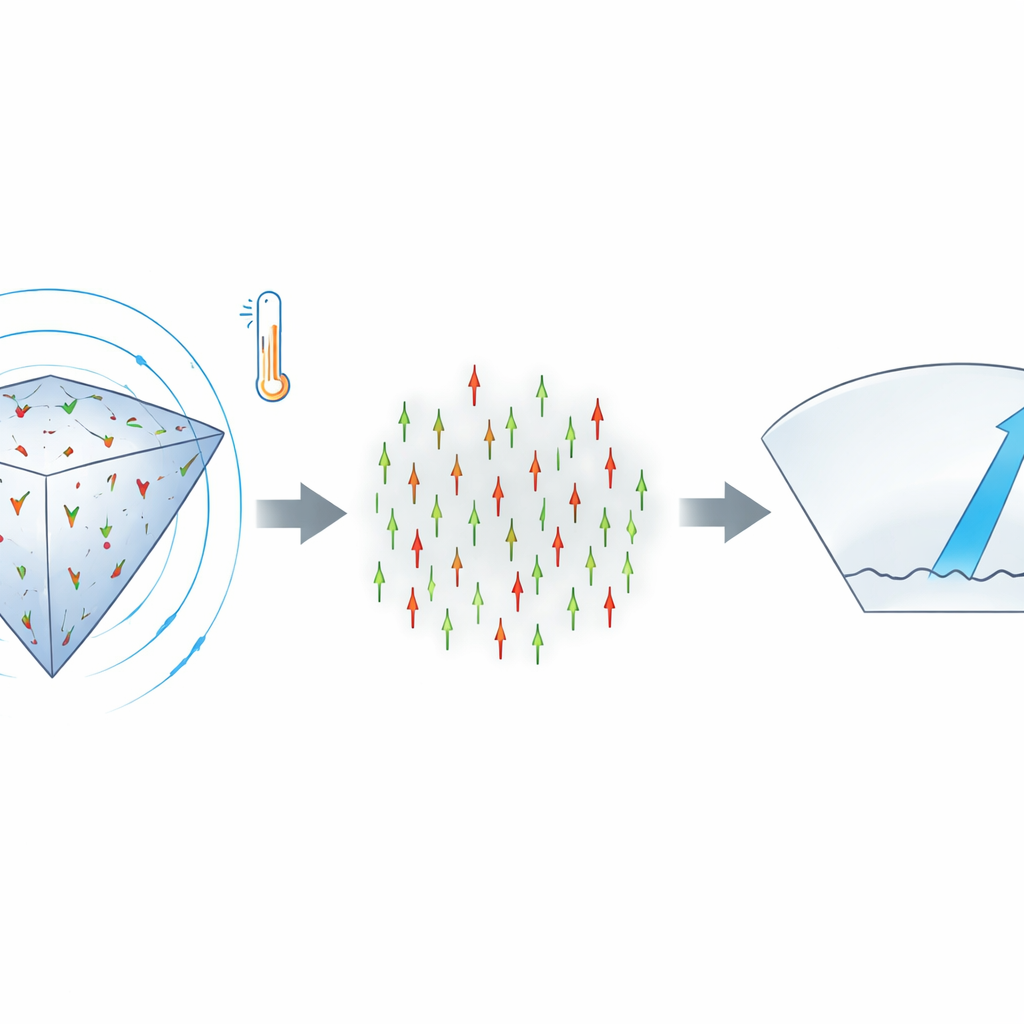
Why spins in diamond make powerful sensors
The work centers on tiny magnets called spins, hosted by nitrogen-vacancy (NV) centers in diamond. Each NV center is a defect where one carbon atom is replaced by nitrogen and a neighboring site is empty. These defects behave like quantum compass needles that can be controlled with light and microwaves, even at room temperature. When many such spins are combined into an ensemble, they act as a collective sensor used for nuclear magnetic resonance (NMR), magnetic resonance imaging (MRI), navigation, and even searches for dark matter. In principle, their ultimate performance is set by quantum “projection noise,” the unavoidable randomness that appears when measuring many quantum spins. In practice, however, experiments with solid crystals have so far been limited by a much more mundane source of randomness: the shot noise of the photons used to read out the spins.
Beating photon noise with a clever memory trick
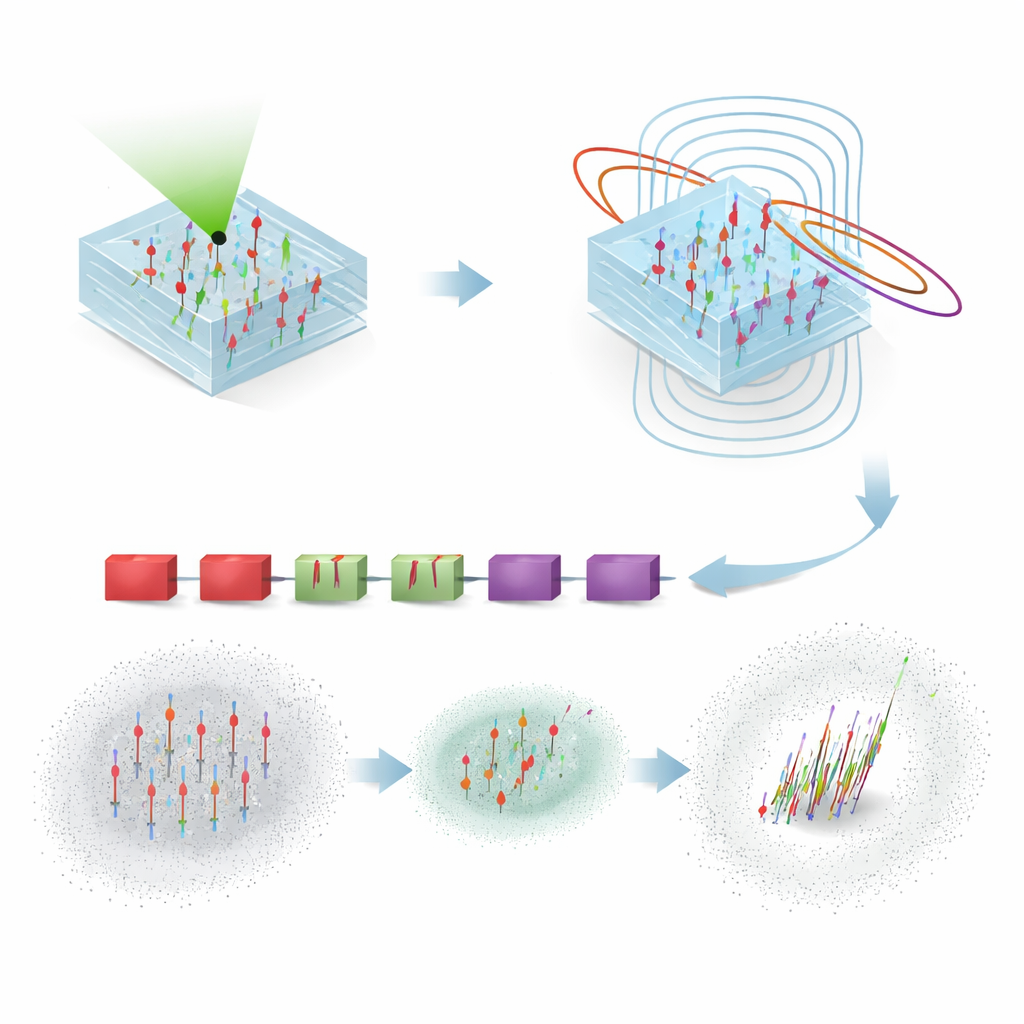
The authors overcome this limitation by borrowing a powerful trick from single-spin experiments and scaling it to a mesoscopic ensemble of NV centers. Inside each NV center sits not only an electron spin, which is easy to read out optically, but also a nitrogen nuclear spin, which acts as a long-lived quantum memory. The team repeatedly maps the nuclear spin state onto the electron spin using carefully tuned microwave and radio-frequency pulses, then reads the electron out with a short laser pulse, and repeats this cycle thousands of times. Because the nuclear spin barely changes during these weak, repeated measurements, its state can be sampled again and again, effectively averaging down the random variations in photon number. By operating at a strong magnetic field of 2.7 tesla, they extend the lifetime of this nuclear memory enough to perform over four thousand readouts on the same spins.
Seeing the true quantum jitters of a spin crowd
As the number of repeated readouts increases, the noise in the measured signal first drops with the expected photon statistics, then levels off once photon noise is no longer dominant. At that point, what remains is the intrinsic projection noise of the spins themselves. The researchers observe a noise reduction of about 3.8 decibels below the photon shot-noise level, directly entering this projection-noise-limited regime. This allows them not only to measure the average spin orientation but also to resolve the full spread of spin outcomes in the ensemble. With this sensitivity, they can watch how the collective noise changes when they drive the spins with radio waves, when the spins relax due to random motion in the crystal, and when they are exposed to artificial, spatially correlated noise sources that affect all spins in a similar way.
New ways to sense patterns in space and time
Direct access to the spin noise unlocks sensing modes that were previously out of reach for solid-state ensembles. The team demonstrates that by looking at how the noise width changes, they can distinguish between uncorrelated environmental noise, where each spin jitters independently, and correlated noise, where many spins are pushed together in a coordinated way. They also use standard pulse sequences that make the ensemble sensitive to oscillating magnetic fields at a chosen frequency, then reconstruct how the collective spin distribution spreads over different directions. This reveals not just how strongly the spins respond, but also how their fluctuations become delocalized, offering a richer picture of the surrounding environment.
From better quantum sensors to probing many-body quantum matter
Reaching the projection noise limit in a solid crystal turns a long-standing theoretical benchmark into a practical tool. For lay readers, the key result is that these diamond-based sensors can now be read with such precision that only fundamental quantum randomness remains. This, in turn, means that many sensing protocols—from nanoscale NMR and MRI to relaxometry and magnetometry—can be made faster or more sensitive by orders of magnitude, because less averaging is needed. Looking ahead, the same readout enables more exotic possibilities, such as squeezing the collective spin to beat even the quantum projection limit, mapping out spatially and temporally correlated signals across a microscope field of view, and studying complex many-body quantum states inside solid materials.
Citation: Maier, R., Ho, CI., Denisenko, A. et al. Readout of a solid state spin ensemble at the projection noise limit. Nat Commun 17, 4028 (2026). https://doi.org/10.1038/s41467-026-72721-0
Keywords: quantum sensing, nitrogen vacancy centers, spin projection noise, diamond magnetometry, solid-state quantum sensors