Clear Sky Science · en
Nicotine biosynthesis is completed by cryptic activating glucosylation
How plants make a familiar stimulant
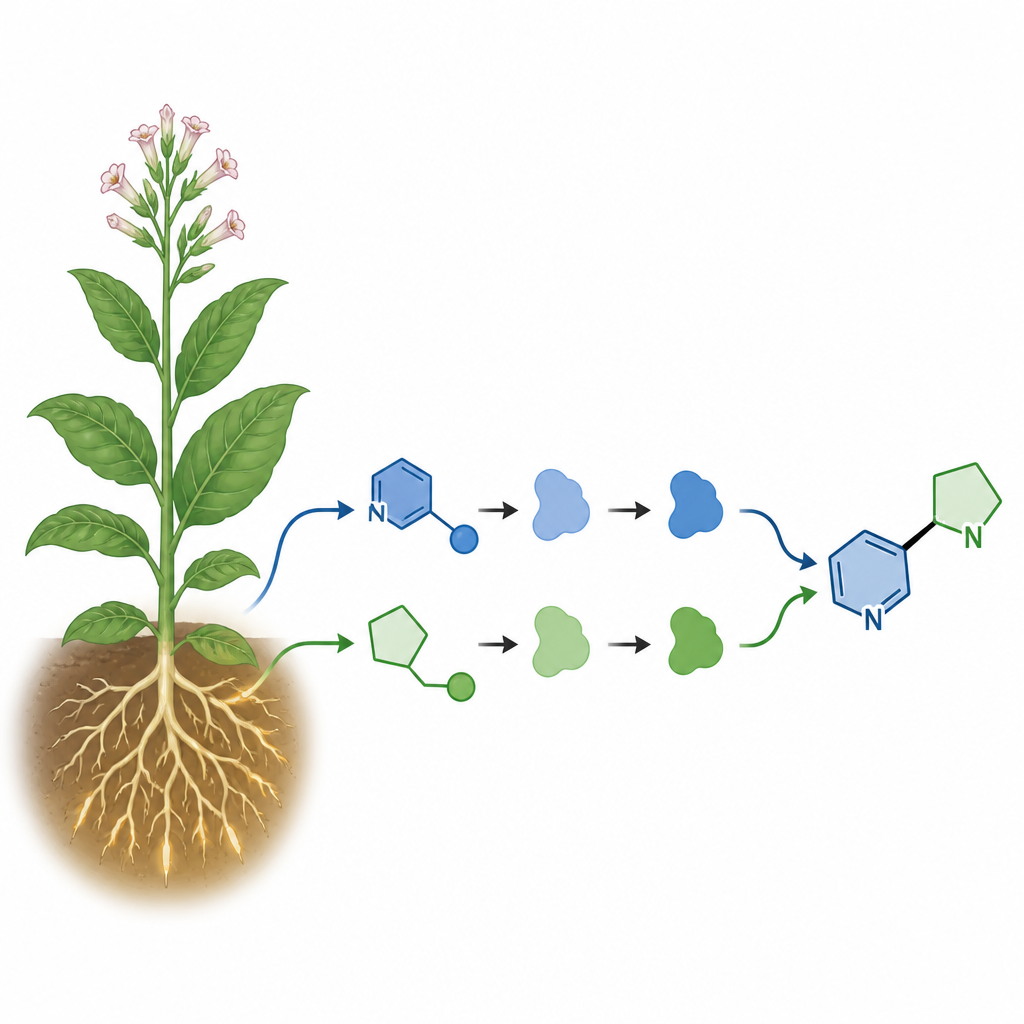
Nicotine is best known as the addictive ingredient in cigarettes, but in nature it is a chemical shield that helps tobacco plants fight off hungry insects. For nearly two centuries, scientists have known what nicotine looks like, yet they could not pin down exactly how plants build it from simpler ingredients. This study finally maps out the missing steps, revealing a hidden “sugar switch” that quietly powers the final stages of nicotine production and could be targeted to reduce or re-route nicotine in tobacco crops.
A plant’s chemical armor
Tobacco plants produce nicotine in their roots as part of their defense system. The molecule acts on nerve cells, which is why it is both toxic to insects and stimulating to humans. Biologists have long known that nicotine is assembled from two building blocks: a ring derived from vitamin-like nicotinic acid and a second ring from another small nitrogen-containing compound. Earlier work suggested that these pieces snap together in a type of bond-forming reaction common in plant alkaloids, but the exact enzymes and intermediate products involved had remained unclear despite decades of research and its large economic and health relevance.
Finding a hidden sugar step
The researchers began by scanning tobacco DNA for clusters of genes that are switched on in roots when nicotine production ramps up. Alongside known nicotine-related genes, they discovered a group that included an enzyme that attaches a glucose sugar to nicotinic acid and several enzymes that can later remove such sugars. This pattern suggested a surprising idea: before nicotinic acid can be turned into the reactive form that joins the second ring, it might first be “primed” by having a sugar added, and this sugar would later be taken off again. Because this sugar tag does not show up in the final nicotine molecule, the step had been cryptic, hiding in plain sight.
Rebuilding the pathway in a test tube
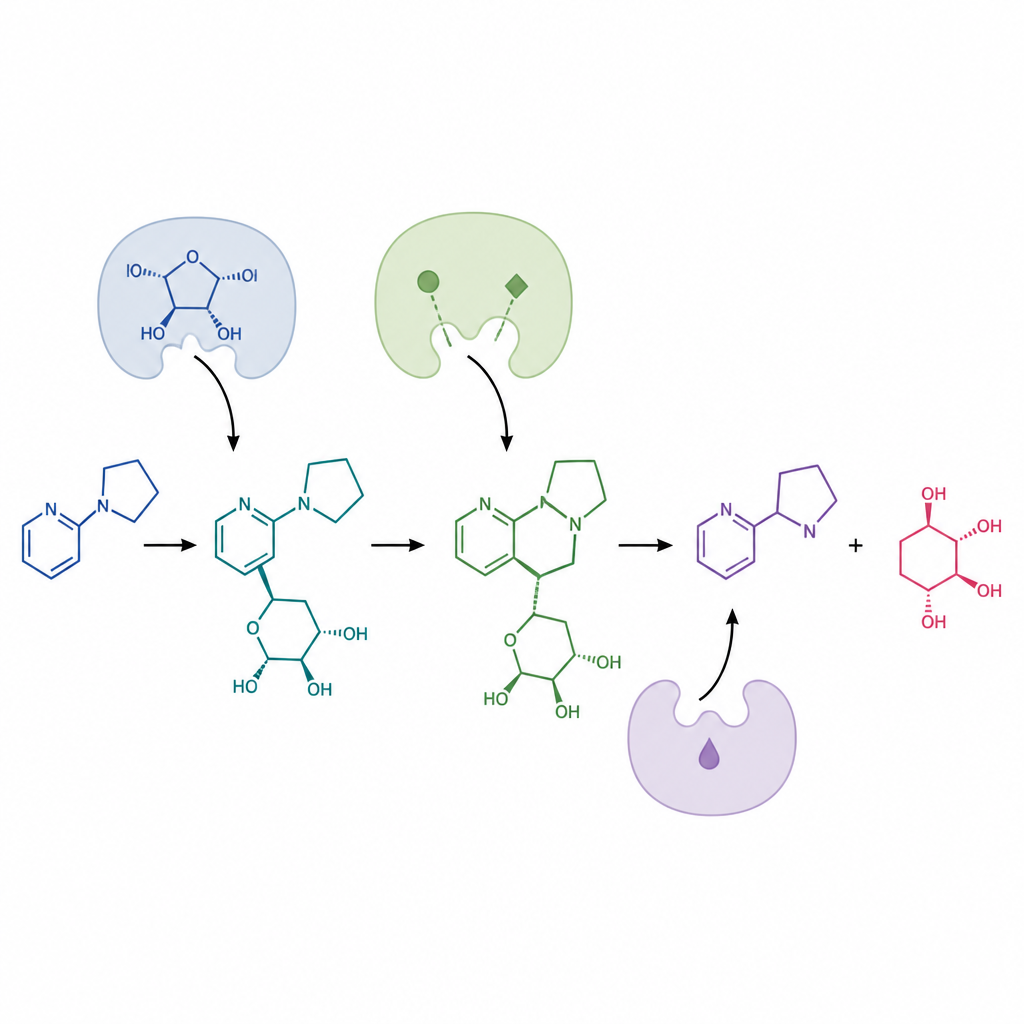
To test this, the team purified four enzymes and combined them with simple starting materials in the lab. One enzyme attached glucose to nicotinic acid, a second used cellular fuel to reduce this sugar-linked molecule into a more reactive form, a third forged the crucial bond to the partner ring while controlling which mirror-image form is made, and a fourth clipped off the sugar to release finished nicotine. Together, these four enzymes produced the natural (S)-nicotine from basic ingredients, recreating the activity of an old, poorly defined “nicotine synthase” preparation. By swapping the partner ring ingredient for related compounds, the same enzyme set could also make other tobacco alkaloids like nornicotine and anabasine, highlighting how modular this chemical assembly line is.
Watching atoms move and enzymes at work
To follow the reaction in finer detail, the scientists fed the system versions of nicotinic acid that carried heavy hydrogen atoms and traced where those atoms ended up in the final products. This showed that one enzyme adds a hydrogen at a specific position on the ring, while another enzyme later removes the opposite hydrogen, neatly explaining puzzling labeling patterns seen in older experiments. They also solved high-resolution 3D structures of two key enzymes using X-ray crystallography, catching them in the act of holding their sugar-tagged substrates and products. These structures reveal how the enzymes position the molecules to steer bond formation, stereochemistry, and the selective loss of particular hydrogens.
Testing the pathway inside living leaves
Proving that a pathway works in glassware is one thing; showing that it operates inside a plant cell is another. The team introduced the same four enzymes, plus upstream nicotine-related enzymes, into the leaves of a tobacco relative that normally makes little nicotine there. When they fed these engineered leaves a labeled precursor, the leaves produced labeled nicotine and related sugar-linked intermediates in the predicted sequence. When individual enzymes were omitted, the pathway stalled and different intermediates piled up, matching the test-tube results. The researchers also detected these sugar-linked molecules in the roots of normal and mutant plants, confirming that such intermediates truly exist in vivo rather than being laboratory artifacts.
Why a temporary sugar tag matters
This work shows that tobacco plants finish building nicotine by briefly attaching and then removing a glucose sugar from a key intermediate, using the sugar both to activate the molecule for further chemistry and to help guide it through cellular compartments. For non-specialists, the take-home message is that a tiny, temporary sugar decoration can control whether, where, and how much of a powerful chemical like nicotine is made. Knowing the full pathway and its “sugar switch” gives plant scientists new gene targets to dial nicotine levels up or down and to repurpose this enzymatic machinery to build other valuable nitrogen-containing molecules.
Citation: Schwabe, B.T.W., Angstman, I.M., Vollheyde, K. et al. Nicotine biosynthesis is completed by cryptic activating glucosylation. Nat Commun 17, 4221 (2026). https://doi.org/10.1038/s41467-026-72705-0
Keywords: nicotine biosynthesis, plant alkaloids, tobacco metabolism, glucosylation, biocatalysis