Clear Sky Science · en
Coupled sulfur-silicon isotopes reveal supracrustal origin of Archean continents
How Earth’s First Continents Took Shape
Earth has been habitable for billions of years partly because light, buoyant continents sit above denser ocean crust. Yet how those first large continents formed on the early Earth has remained hotly debated. This study tackles that mystery by using subtle chemical fingerprints locked in ancient rocks to show that early continents grew from recycled seafloor rather than from untouched deep magmas.
A Planet Built from Two Very Different Crusts
Modern Earth’s surface is divided into thick, long‑lived continents and thin, short‑lived ocean floors. The oldest preserved continental pieces, mostly pale granitic rocks in ancient cratons, record how this contrast first emerged. Many of these rocks belong to a family called TTGs, which are rich in silica and formed more than 2.5 billion years ago. Scientists agree that TTGs were produced when water‑bearing dark rocks partially melted deep in the crust, but they have argued over whether those source rocks were fresh magmas from the mantle or older ocean crust that had been altered by seawater.
Reading the Rock Record with Light Elements
The authors turned to two types of isotopes that act as tracers of where rocks have been. Silicon isotopes can reveal whether a rock’s ingredients once interacted with seawater, which tends to shift silicon toward slightly heavier forms. Sulfur isotopes carry an even more distinctive signal: in the oxygen‑free atmosphere of early Earth, sunlight broke sulfur‑bearing gases in a way that left a quirky, “mass‑independent” pattern that is different from anything produced deep inside the planet. If both silicon and sulfur in ancient granites carry surface‑style signatures, it is strong evidence that their raw materials once sat near the top of the crust and interacted with the ocean and atmosphere.
Ancient Chinese Rocks Tell a Supracrustal Story
The team analyzed granitic rocks up to 2.7 billion years old from the Luxi region of the North China Craton. These rocks show small but consistent departures from deep‑Earth sulfur patterns, along with silicon that is noticeably heavier than that of typical mantle‑derived magmas. The authors carefully tested alternative explanations such as mixing of different magmas, later metamorphism, or contamination from surrounding rocks. These processes could not reproduce the combined sulfur and silicon signals they observed. Instead, the data point to a source made of basaltic crust that had been altered by circulating seawater at or near the seafloor before being buried and melted.
From Stacked Lava Plains to Buoyant Continents
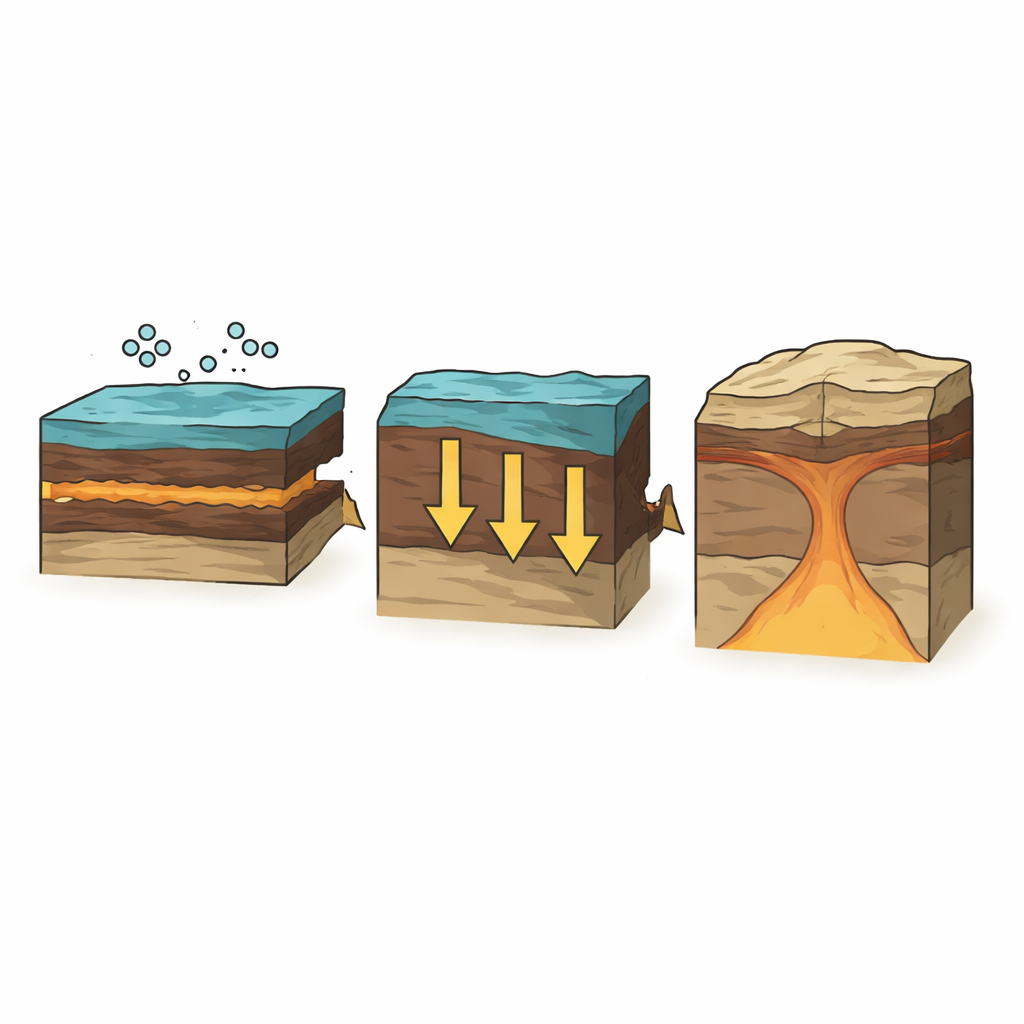
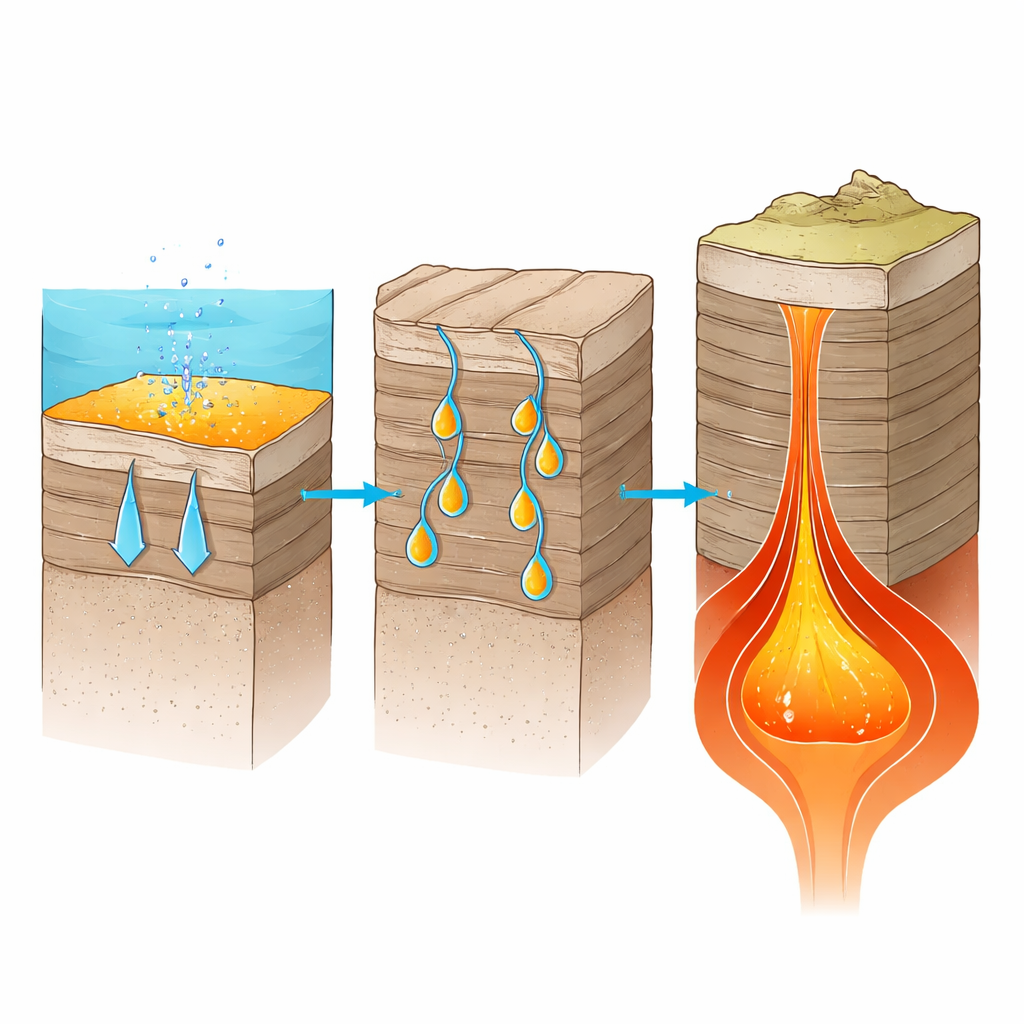
To explain how such altered seafloor reached the depths where melting occurs, the authors favor a “volcanic piling” scenario for early Earth. In this picture, hot mantle plumes repeatedly erupt lava onto the surface, building thick stacks of basalt that slowly sink under their own weight. While near the surface, these lavas react with seawater, gaining the distinctive silicon and sulfur fingerprints. As they are buried deeper, they gradually lose water and sulfur through heating, but their silicon signal remains locked in the rock. Eventually, heating at depth partially melts this buried, altered crust, producing silica‑rich magmas that rise and solidify as the first continental blocks.
A New View of Early Continental Growth
By combining sulfur and silicon isotopes from the North China Craton with data from ancient granites worldwide, the study finds that rocks younger than about 3.8 billion years almost always carry these surface‑derived signatures. This suggests that most early continents formed from recycled, water‑altered seafloor rather than pristine deep cumulates. The work implies that large‑scale recycling between Earth’s surface and interior was already active early in the Archean, linking atmosphere, ocean, and deep rocks. That recycling likely helped stabilize the planet’s environment over immense spans of time, creating the long‑lived continents that underpin life today.
Citation: Shang, K., Zhang, J., Wang, Z. et al. Coupled sulfur-silicon isotopes reveal supracrustal origin of Archean continents. Nat Commun 17, 4203 (2026). https://doi.org/10.1038/s41467-026-72701-4
Keywords: Archean continents, continental crust formation, supracrustal recycling, isotope geochemistry, early Earth tectonics