Clear Sky Science · en
Improving tolerance to fluctuating light through adaptive laboratory evolution in the cyanobacterium Synechocystis
Why changing light matters for tiny green cells
Sunlight does not shine steadily in nature. Passing clouds, moving leaves and waves on water make light jump up and down from one moment to the next. For photosynthetic microbes such as cyanobacteria, these rapid swings are stressful: their light-harvesting machinery can be damaged faster than it can be repaired. This study explores how we might deliberately evolve cyanobacteria that can cope better with such erratic light, with an eye toward more robust biofactories and insights that could someday help crop plants.
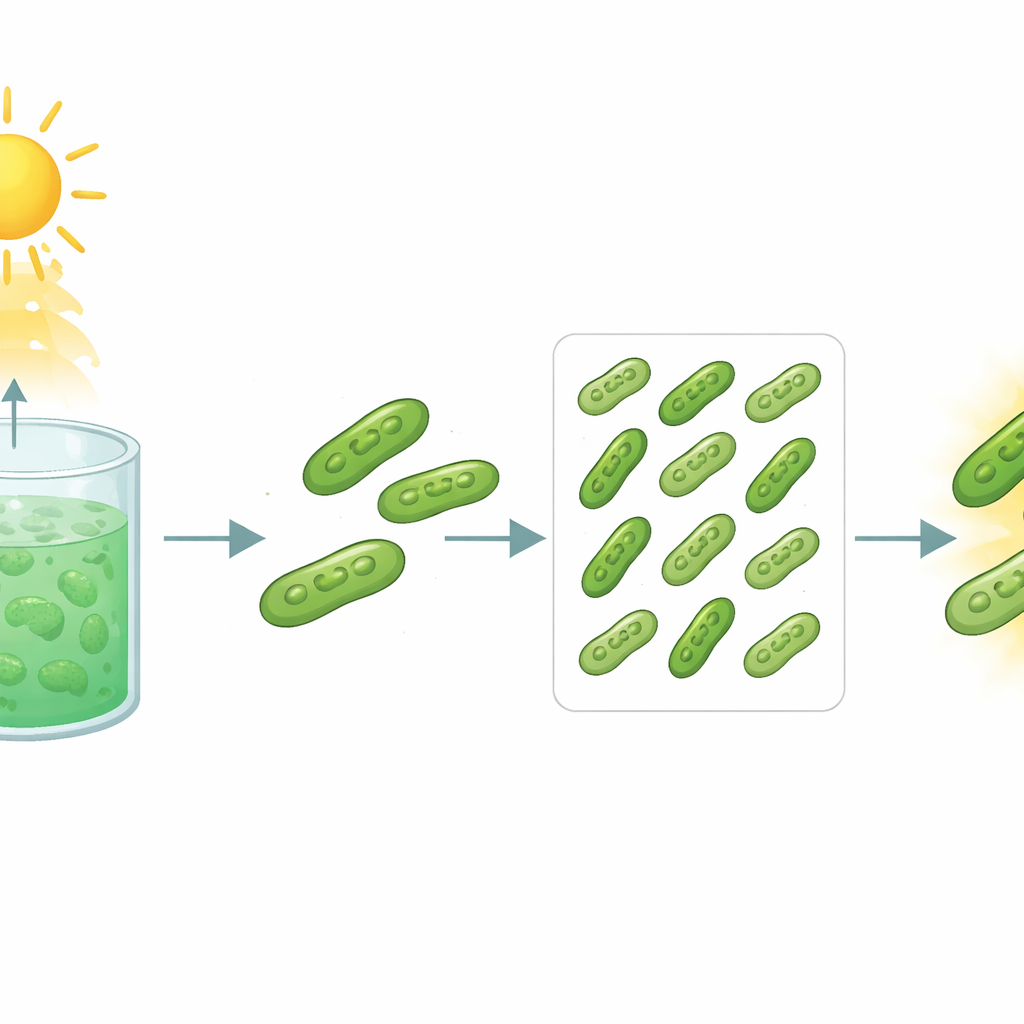
Teaching microbes to ride light roller coasters
The researchers worked with a model cyanobacterium called Synechocystis. Instead of exposing these cells to constant brightness, they grew them for 20 months under two artificial day–night “roller coasters” of light. In the milder regime, light cycled between very bright and dim but always allowed some recovery time; the harsher regime switched rapidly between almost-dark and intensely bright light that was lethal to the original strain. Over many growth cycles, spontaneous mutants that could survive and grow under each fluctuating light schedule gradually took over the cultures.
Finding the genetic tweaks behind tougher cells
From these long-term evolution experiments, the team isolated 24 single mutant strains—12 from the moderate regime and 12 from the lethal one—and sequenced their genomes. They found more than 400 mutations in total, but a much smaller set had spread completely through the evolved populations. Three particular single-letter DNA changes stood out. Two affected proteins called Sll0518 (of unknown function) and Pam68, which helps assemble the photosystem II complex that splits water and powers part of photosynthesis. These two mutations appeared in every evolved strain, suggesting they arose early and were strongly beneficial. A third mutation altered RpaB, a regulator that controls how efficiently cyanobacteria absorb light through their antenna pigments.
Rebuilding evolution’s winners one change at a time
To prove that these mutations caused the new light tolerance, the scientists reintroduced each one individually into the original, non-adapted strain. The modified Pam68 and Sll0518 versions made cells clearly better at handling the moderate fluctuating light, but they still could not cope with the most extreme, lethal regime. The altered RpaB, by contrast, gave cells the ability to thrive under both very harsh fluctuating light and constant high light that normally kills the parental strain, though it slightly reduced growth in very low light. This showed that distinct genetic solutions underlie different types of light stress, and that resistance to constant high light does not automatically grant resistance to rapid fluctuations.
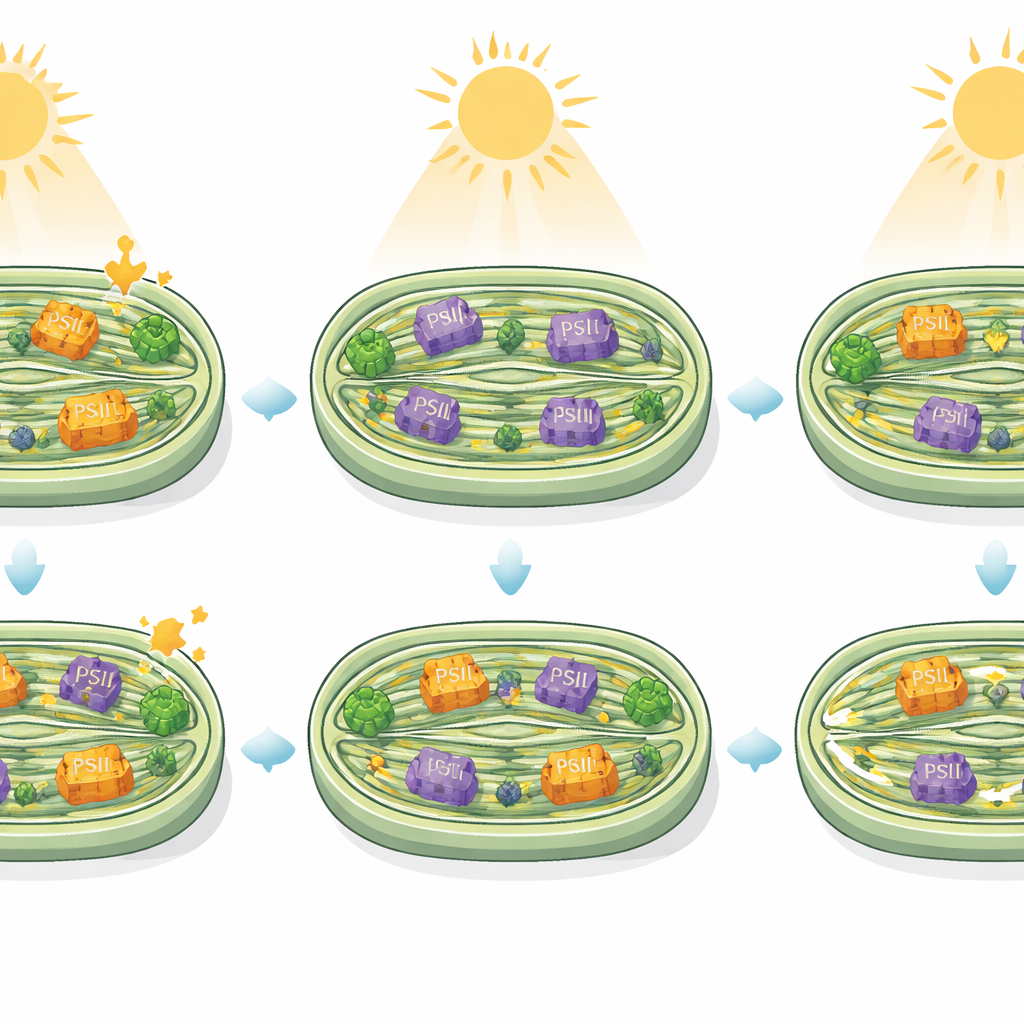
How the mutations reshape the light engine
Detailed biochemical tests revealed how these subtle changes ripple through the photosynthetic machinery. The Pam68 mutation increased the amount and performance of photosystem II dimers under fluctuating light, helping the cells process surges of energy without as much damage. It likely stabilizes assembled complexes, allowing more water-splitting “engines” to stay active even though overall Pam68 protein levels fall. The RpaB mutation, on the other hand, acted more like a volume knob on light input: it reduced the size of the external light-harvesting antennas and shifted the balance between photosystem I and II, especially under high light. This damped the flow of excess energy into the system, altered patterns of protective energy dissipation, and increased certain alternative electron flows that help relieve pressure on vulnerable components.
What this means for future biofactories and crops
In everyday terms, evolution in the lab found two complementary strategies for riding out wild light swings: building tougher “engines” that can handle bursts of power, and shrinking the “solar panels” so they do not overload the circuitry. Single amino-acid changes in key proteins were enough to enact these strategies in cyanobacteria. While the exact Pam68 mutation does not appear to boost fluctuating-light tolerance when copied into a plant version of the protein, the general principles—strengthening core complexes and tuning how much light is harvested and where it flows—could guide future efforts to design microalgae and, eventually, crops that keep photosynthesis running smoothly in a flickering world.
Citation: Figueroa-Gonzalez, T., Chen, W., Abdel-Salam, E.M. et al. Improving tolerance to fluctuating light through adaptive laboratory evolution in the cyanobacterium Synechocystis. Nat Commun 17, 4025 (2026). https://doi.org/10.1038/s41467-026-72689-x
Keywords: fluctuating light tolerance, cyanobacteria evolution, photosynthesis adaptation, Synechocystis, high light stress