Clear Sky Science · en
Diverse mechanisms of translation arrest by a Clostridia ribosome stalling peptide CliM
How cells pause to protect their protein factories
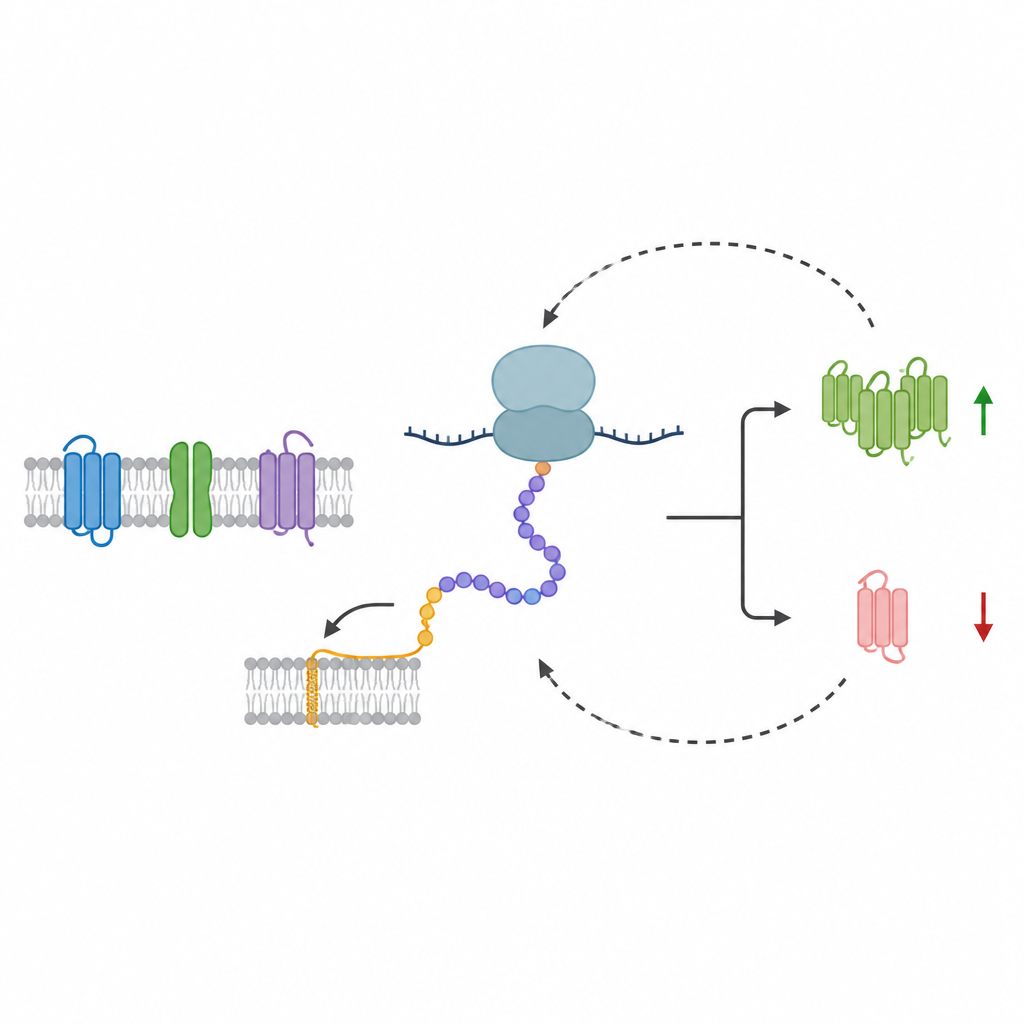
Inside every bacterium, tiny machines called ribosomes build proteins nonstop. But if the machinery that inserts new proteins into the cell membrane falls behind, the cell risks clogging its own production line. This study uncovers how a short protein fragment, named CliM, can temporarily pause the ribosome to measure membrane workload and keep this vital traffic under control.
A molecular sensor for crowded membranes
Bacteria rely on special helper proteins, such as YidC, to guide newly made proteins into the cell membrane. The gene for one version of YidC in Clostridia bacteria carries an extra segment just before it, encoding the CliM peptide. The authors show that CliM acts like a built-in sensor: when its own insertion into the membrane is blocked or slowed, ribosomes stall on CliM, which in turn allows more YidC to be produced. This feedback loop helps the cell adjust YidC levels to match membrane demand.
Different ways to hit the pause button
CliM is not a single peptide but a small family found in related bacteria. The team compared versions from two species and discovered that they stall ribosomes in different ways. In one species, CliM mainly pauses the ribosome while it is still adding amino acids, at several neighboring positions in the genetic code. In the other, the ribosome pauses right at the stop signal, when it would normally release the finished protein. Mutational tests and toeprinting assays showed that both versions actually have the capacity to halt translation during either the building or the finishing step, depending on nearby sequence details.
A compact plug deep inside the ribosome
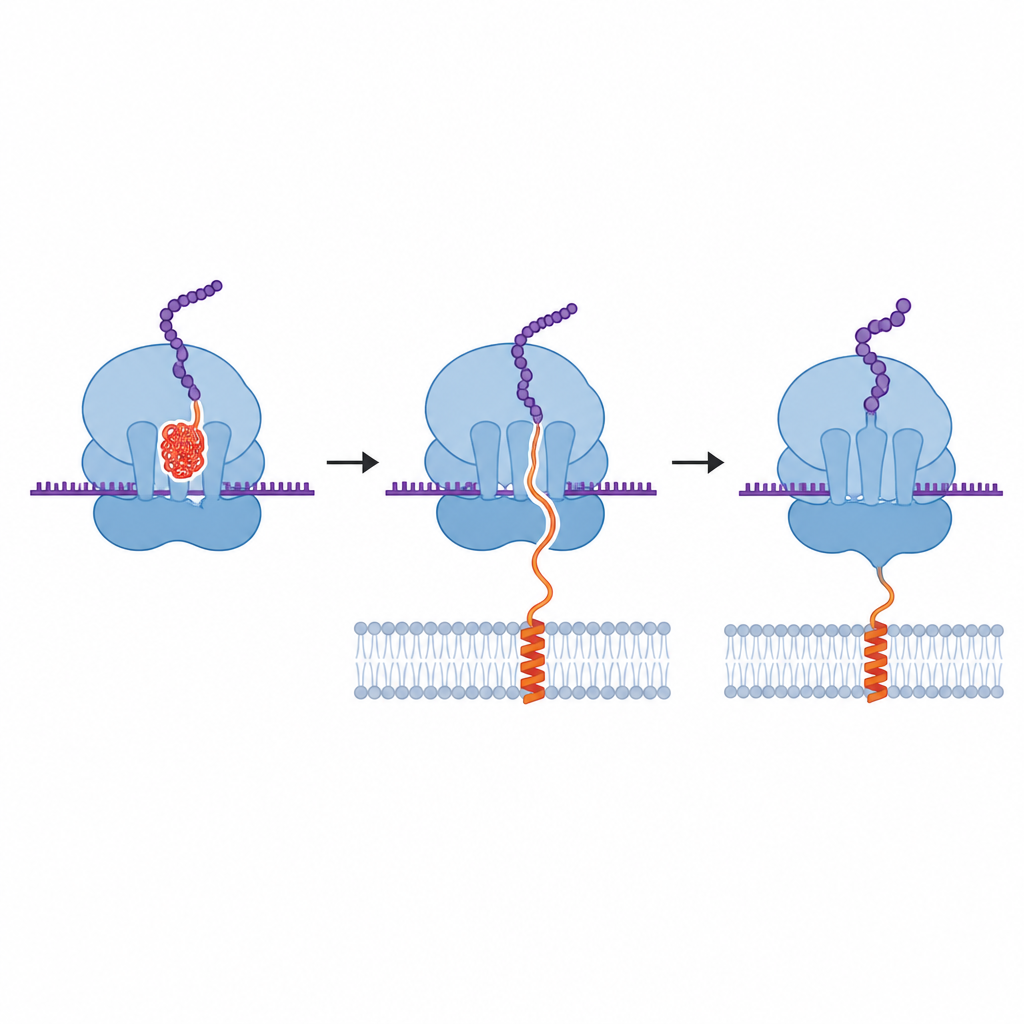
To see how CliM physically blocks the ribosome, the researchers used high-resolution cryo–electron microscopy and computer simulations. They found that the CliM segment inside the ribosome folds into several short helices that pack tightly within the narrow protein exit tunnel. There, CliM makes many precise contacts with the tunnel walls, especially with a flexible loop of a ribosomal protein called uL22. Near the site where new bonds are made, a single amino acid in CliM sits just upstream of the final building step and physically intrudes into the space needed for either a release factor or an incoming transfer RNA to fully settle. This subtle clash is enough to keep the ribosome locked in a stalled state.
How a pulling force restarts protein synthesis
The pause is not permanent. When the front end of CliM successfully enters the membrane with the help of YidC, it experiences a mechanical pulling force. Molecular dynamics simulations suggest that this pull gradually unwinds the helical segments of CliM inside the tunnel, starting from the membrane side and moving back toward the ribosome’s active site. As CliM straightens and slides forward, the key blocking residue near the end of the chain shifts out of the way, freeing space for the release factor or transfer RNA to fully engage. Translation then resumes or finishes, and the ribosome can move on.
A unified picture of flexible ribosome stalling
Taken together, the work reveals CliM as a finely tuned mechanical switch that couples membrane insertion to ribosome pausing. By folding into a compact plug and positioning a single side chain at a critical spot, CliM can halt protein synthesis either during elongation or at termination, and then release the pause when membrane conditions improve. This flexible control mechanism explains why related CliM peptides appear to behave differently in experiments, and shows how even very short protein segments can act as smart regulators that help bacteria balance protein production with membrane capacity.
Citation: Yoshida, M., Gersteuer, F., Berendes, O. et al. Diverse mechanisms of translation arrest by a Clostridia ribosome stalling peptide CliM. Nat Commun 17, 4202 (2026). https://doi.org/10.1038/s41467-026-72673-5
Keywords: ribosome stalling, translation arrest peptide, YidC insertase, membrane protein insertion, cryo EM