Clear Sky Science · en
An organic artificial cardiomyocyte
Building a Heart Cell from Soft Electronics
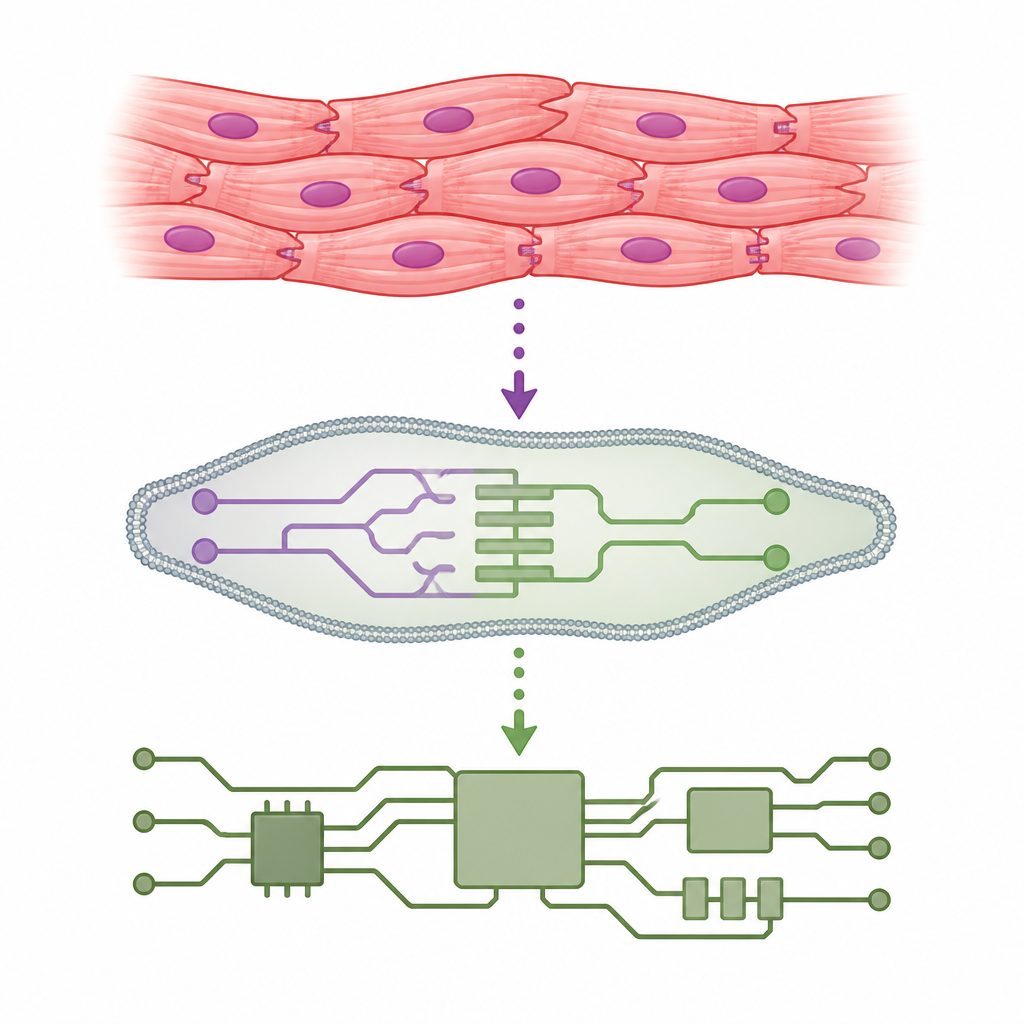
Every heartbeat begins with a tiny electrical pulse inside a heart cell. Doctors and scientists use computer models to study these pulses, but computers do not behave quite like real tissue. In this work, researchers created a soft electronic device that acts like a human heart cell, firing lifelike electrical beats and even listening to signals from living cardiac cells. This organic artificial cardiomyocyte could open new ways to study heart rhythm problems and test treatments using hardware that behaves much more like the real heart.
A New Kind of Artificial Heart Cell
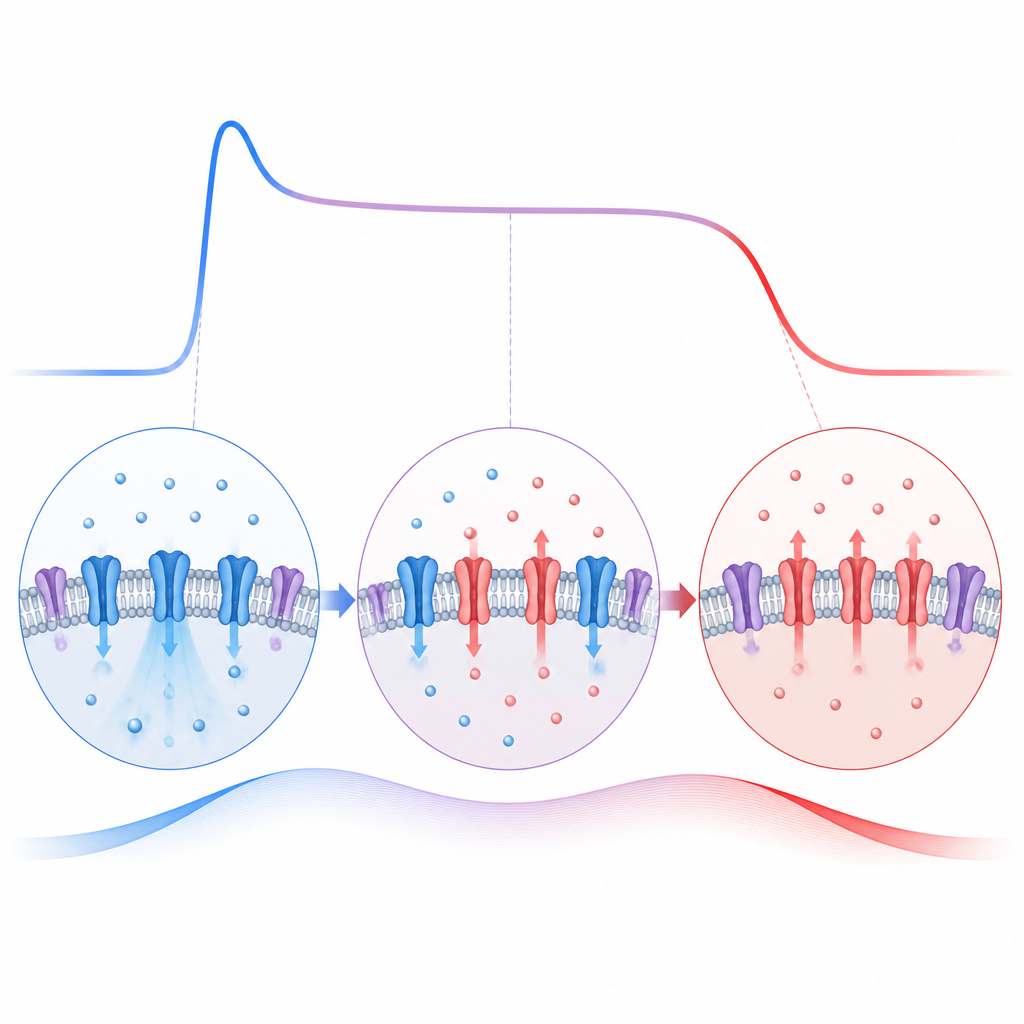
The team set out to build a physical stand in for a ventricular heart muscle cell, the workhorse cell that drives the main pumping chambers. Real ventricular cells generate a characteristic electrical waveform that rises quickly, dips, holds a long plateau, and then slowly returns to rest. This shape is crucial because it links electrical activity to muscle contraction and healthy rhythm. Rather than simulating this on a computer, the researchers used organic electrochemical transistors, soft devices that move both ions and electrons, to construct an "organic electrochemical cardiomyocyte" that reproduces this waveform in real time.
How the Electronic Heart Cell Works Inside
The artificial cell is inspired by a classic mathematical model of heart excitability that describes how different ion flows combine to create each phase of the beat. In the device, a small capacitor plays the role of the cell membrane, while three transistor based blocks mimic fast sodium entry, slower calcium entry, and delayed potassium exit. A sensing inverter watches the membrane voltage and, once a threshold is crossed, swiftly turns on a charging channel that produces a sharp upstroke, like the sodium spike in a real cell. A separate potassium channel, slowed by both material choice and added circuit elements, turns on later and discharges the membrane, shaping the notch, plateau, and gradual return to rest.
Tuning and Stress Testing the Artificial Beat
Like real heart cells, the device only fires a full beat when it receives a stimulus of sufficient strength and duration. Too weak a pulse produces a small blip, while too strong a pulse prevents the cell from resetting. By adjusting bias voltages, the researchers can lengthen or shorten the plateau, echoing how action potential duration varies across different regions of the heart. The artificial cell also shows a realistic refractory period during which a second stimulus cannot trigger a full beat, protecting against continuous contraction. Continuous pacing at heartlike rates produces stable trains of beats, with only modest drift over an hour.
Simulating Disease Chemistry with Salt and Acid
Heart rhythm depends strongly on the chemical environment around cells, including salt levels and acidity. The team explored how changing ion concentrations and pH in the device’s electrolyte alters its behavior. Raising potassium concentration strengthens the discharging current and shortens the electrical pulse, similar to hyperkalemia in patients. Lowering it has the opposite effect and can lead to prolonged or unstable depolarization. Making the environment more acidic reduces current through the potassium channel material, again stretching the pulse, which mirrors how lactic acid buildup during low oxygen episodes can promote dangerous rhythms.
Linking Living Heart Cells to Artificial Ones
To move beyond isolated hardware, the researchers built a bridge between living human stem cell derived cardiomyocytes and their artificial counterpart. They created a "junctional inverter" by culturing a sheet of beating heart cells directly on top of an organic transistor. When the biological cells fire, their voltage changes modulate this transistor, which in turn generates electrical pulses that drive the artificial cardiomyocyte. The resulting artificial beats track the timing and variability of the living cells, suggesting that such devices can mirror not only regular heart rhythms but also the irregular patterns seen in disease.
Why a Hardware Heart Cell Matters
Taken together, this work transforms a long standing theory of cardiac excitation into a tangible piece of soft electronics that behaves like a ventricular heart cell. Because it responds naturally to salts, pH, and biological input, the organic artificial cardiomyocyte offers a new way to study arrhythmias, test drug effects, and prototype future therapeutic devices using hardware that shares the time scales and signal shapes of real tissue. While substantial engineering is still needed to turn this technology into implantable systems, networks of these artificial cells could one day emulate entire patches of heart muscle, helping researchers probe how small changes at the cellular level ripple out into full scale rhythm disorders.
Citation: Gao, D., Ji, J., De Prà, S. et al. An organic artificial cardiomyocyte. Nat Commun 17, 4181 (2026). https://doi.org/10.1038/s41467-026-72584-5
Keywords: artificial cardiomyocyte, organic electronics, cardiac electrophysiology, ion channels, heart rhythm