Clear Sky Science · en
A copper-dependent redox-based hydrogen peroxide perception in plants
How plants sense invisible chemical stress
Plants cannot move away from danger, so they rely on microscopic sensors on their cell surfaces to detect chemical changes around them. This study uncovers how one such sensor in the model plant Arabidopsis tells apart two kinds of reactive chemicals, helping the plant respond appropriately to changing light, pathogens, and other stresses.
A plant alarm that listens to oxidants
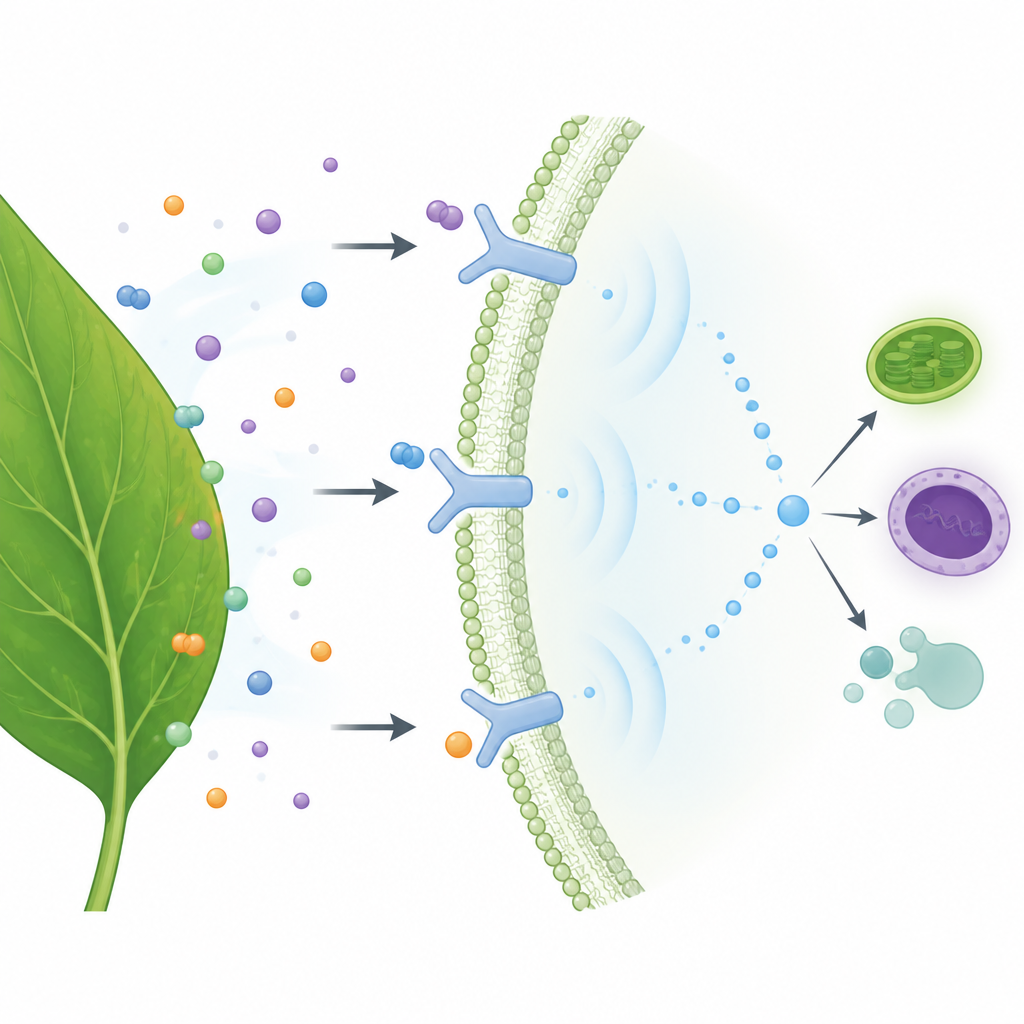
The work centers on a receptor protein called CARD1 that sits in the outer membrane of plant cells. CARD1 can detect both quinones, a class of oxidized organic molecules, and hydrogen peroxide, a simple oxidant better known as a household disinfectant. In plants, hydrogen peroxide is not just a byproduct of stress but also a signal that travels between cells. When CARD1 senses these molecules outside the cell, it triggers a pulse of calcium inside, which acts like an alarm bell and sets off further defense and adjustment responses.
Tracing the family tree of a plant sensor
By comparing DNA and protein sequences from many plant species, the researchers showed that CARD1 and closely related receptors are found across land plants, from simple mosses to flowering species. Several Arabidopsis relatives of CARD1 could substitute for it in mutant plants, restoring their ability to respond to both quinones and hydrogen peroxide. This suggests that the ability to sense these reactive molecules is an ancient and shared feature of this receptor family, likely important for survival on land where oxygen and sunlight constantly generate reactive chemicals.
Revealing the shape of the receptor
To understand how CARD1 works, the team used cryo electron microscopy to determine the three dimensional structure of the part of the receptor that sits outside the cell. They found a curved repeat rich region that forms a horseshoe shape, attached to a second domain resembling a structural module known from animal proteins. Sugar side chains help stabilize the arrangement, and specific disulfide bonds between sulfur containing amino acids act as structural clamps. Earlier work had suggested that several cysteine residues near the end of the outer domain might directly sense hydrogen peroxide by forming or breaking bonds, but the new structural and genetic tests showed that these cysteines mainly support the protein’s stability rather than acting as the chemical sensor itself.
A hidden copper site that feels hydrogen peroxide
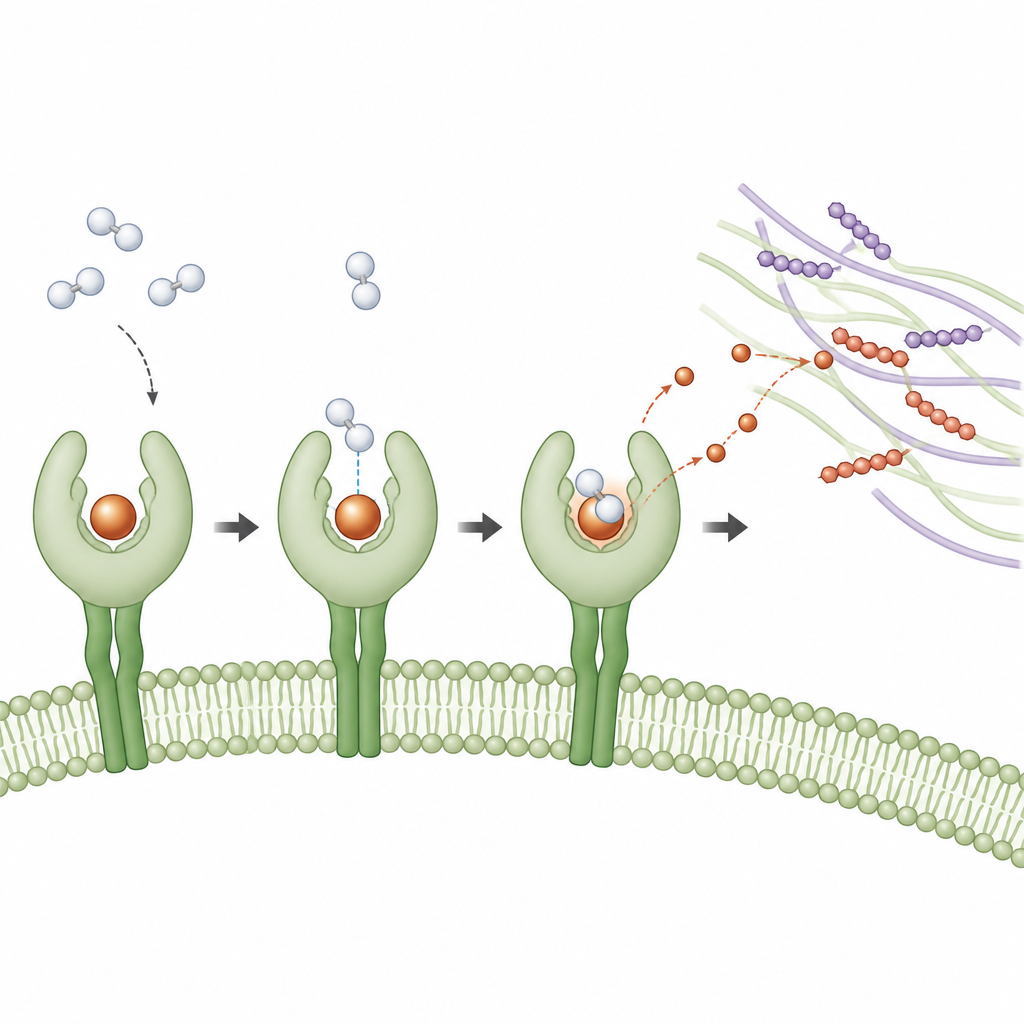
The key discovery was a small pocket on the receptor surface where three histidine amino acids hold a single copper ion. Measurements of purified protein confirmed that copper is the main metal bound, and computer simulations indicated that the site strongly prefers the reduced form of copper. When the scientists mutated these histidines so that copper could no longer bind, plants lost their calcium response to hydrogen peroxide and also showed weakened responses to quinones and to immune signals that generate reactive oxygen outside the cell. Yet the overall shape of the mutated receptor stayed almost unchanged, pointing to the copper itself as crucial for sensing rather than for simple structural support.
From metal spark to chemical message
Based on these results, the authors propose that CARD1 uses its copper ion as a tiny redox engine. When hydrogen peroxide encounters the copper site in the space outside the cell, copper may help split it, producing highly reactive short lived radicals. These radicals can then alter nearby cell wall components, possibly turning them into quinone like molecules that CARD1 or partner proteins can recognize as a more stable signal. In this view, CARD1 does not just sense hydrogen peroxide directly but converts it into secondary messengers that tune the strength and duration of the plant’s response.
Why this matters for plant resilience
The study reveals a new way that plants use metal ions to read their chemical surroundings, distinct from the more familiar sulfur based switches used elsewhere in cells. By tying hydrogen peroxide sensing to a copper site on a surface receptor, plants gain a sensitive and adjustable way to interpret oxidative stress at their boundaries. Understanding this copper dependent system could eventually help scientists design crops that better withstand drought, infection, and other stresses that disturb redox balance without needing to move from their environment.
Citation: Ishihama, N., Fukuda, Y., Shirano, Y. et al. A copper-dependent redox-based hydrogen peroxide perception in plants. Nat Commun 17, 4236 (2026). https://doi.org/10.1038/s41467-026-72573-8
Keywords: plant redox signaling, hydrogen peroxide sensing, copper-dependent receptor, reactive oxygen species, CARD1 protein