Clear Sky Science · en
Synaptic high-frequency jumping synchronises vision to high-speed behaviour
Why fast-flying insects stay in focus
Anyone who has tried and failed to swat a housefly has met an animal whose reactions seem almost impossibly fast. Common wisdom says that rapid head and body turns should blur a fly’s view, briefly making it “blind.” This study overturns that idea. By recording from single neurons, filming tiny motions inside the eye, and building detailed computer models, the authors show that houseflies use motion itself to sharpen vision and speed up the link from sight to action.
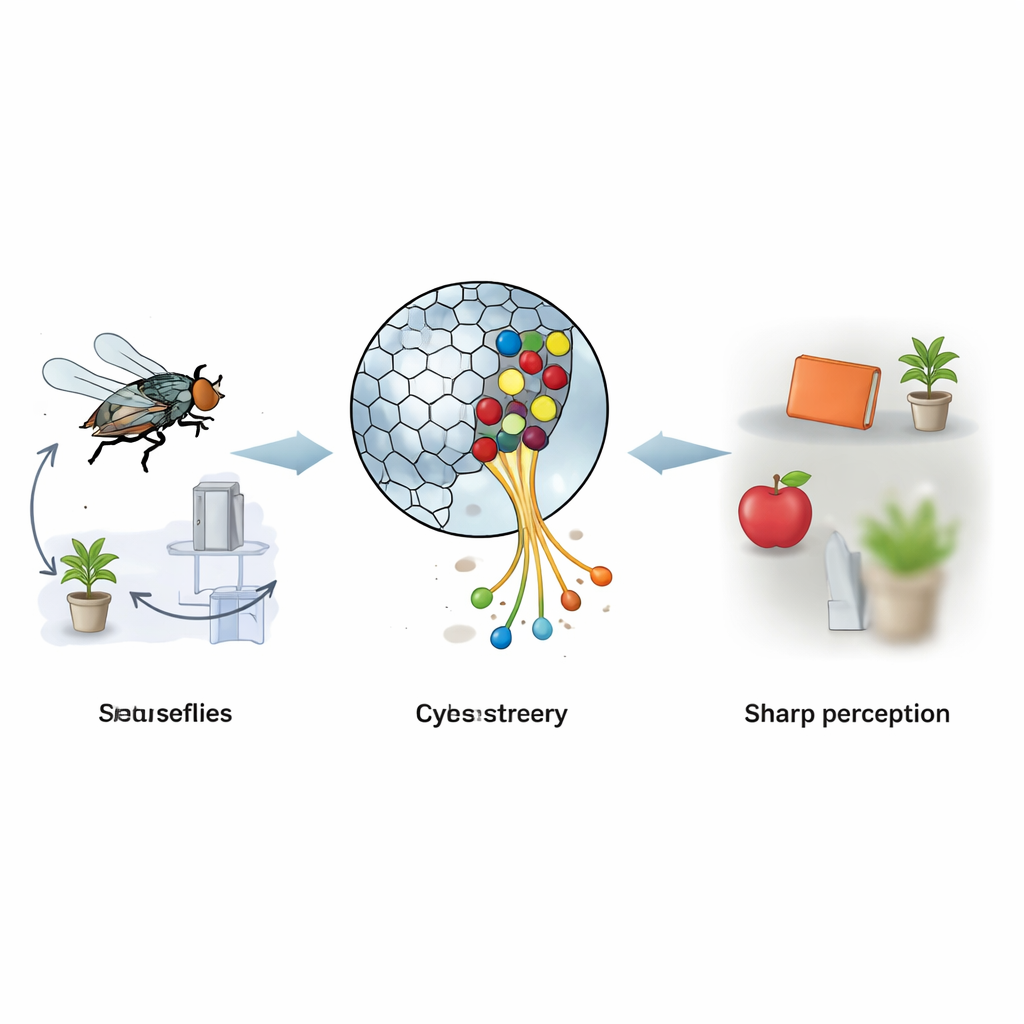
Seeing clearly while the world whips by
When flies make rapid, saccade-like turns, images sweep across their compound eyes at high speed. Classic theories treated the eye’s light-sensing cells as fixed, slow filters that would smear these moving images in space and time. The new work instead reveals a restless visual system. Each unit of the compound eye contains several photoreceptors that do not stay put: they perform microscopic, light-driven jitters and shifts. These tiny motions, combined with overlapping fields of view, allow the eye to sample the scene many times over from slightly different angles, reducing noise and refining detail even as the fly spins.
Tiny jumps inside synapses
The key discovery is a phenomenon the authors call synaptic high-frequency jumping. Light first hits photoreceptors, which convert it into relatively smooth electrical signals. These cells then communicate with downstream neurons called large monopolar cells at synapses in the first visual relay. During natural, bursty light changes like those produced by saccades, the monopolar cells do something unexpected: they turn the slow, smooth input into a string of very fast, precisely timed electrical transients. In frequency terms, information that entered the synapse mostly at a few hundred cycles per second emerges carried on signals approaching a thousand cycles per second.
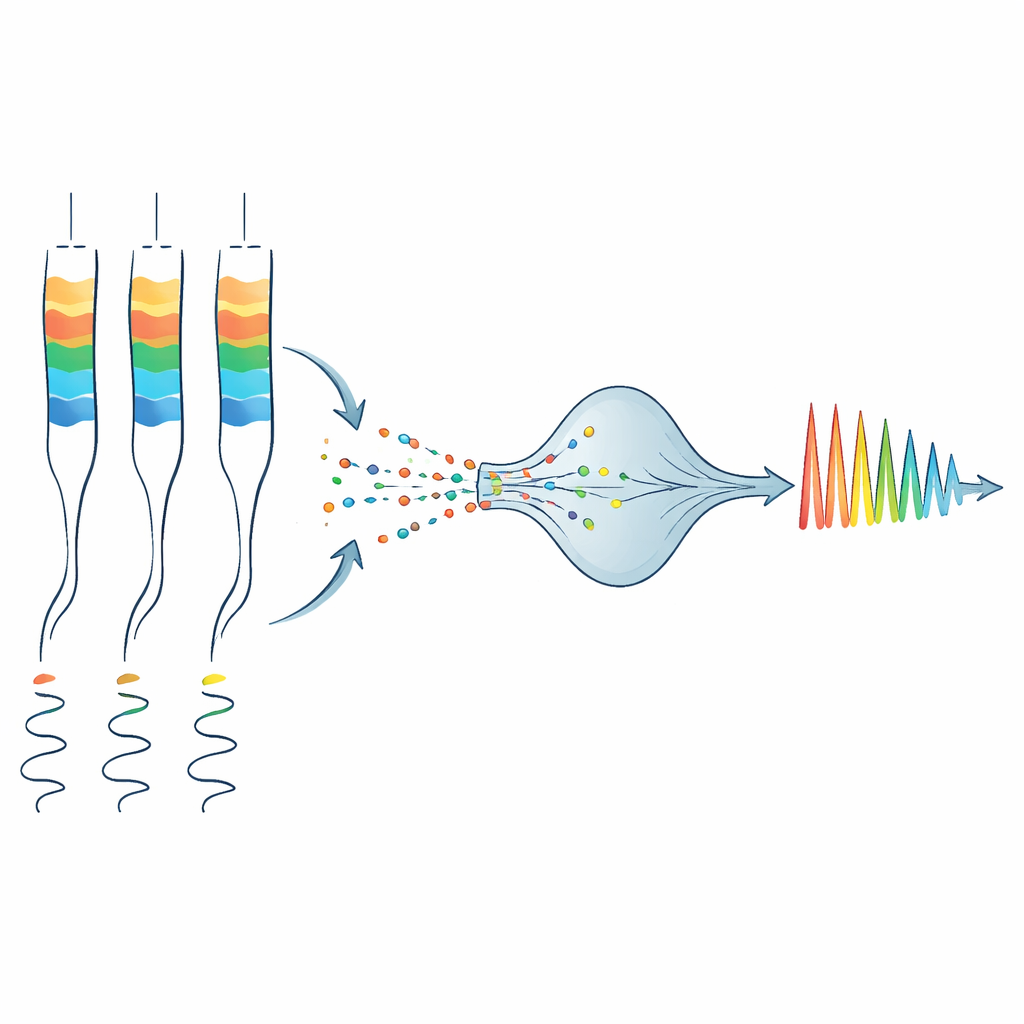
From physical motion to predictive vision
How does this speed-up arise? The study combines ultrastructural imaging, high-speed microscopy, and a biophysically detailed model. Each photoreceptor contains tens of thousands of tiny light-sensing units that respond one at a time and briefly fall silent after each photon. Natural, saccade-like flashes of contrast give these units time to recover between bursts, boosting sensitivity to rapid changes. Multiple photoreceptors with slightly different views all feed into the same monopolar cell. Pooling their nearly noise-free outputs and passing them through a synapse with limited output range effectively clips and sharpens the combined signal, injecting high-frequency components. Feedback signals from the monopolar cells back to the photoreceptors keep the system in its optimal range, so that even strong responses are transmitted with minimal delay.
Sharper than the eye’s optics should allow
Because of these dynamics, the fly’s first visual neurons can encode far more information, and at much higher speeds, than previously thought. The authors show that information transfer rates at this early stage reach several thousand bits per second, well above classical estimates. Importantly, the system also beats the apparent optical limits of the eye. When the researchers presented small moving dots that appeared from behind an obstacle, the recorded responses and model both showed that flies could distinguish objects separated by angles smaller than the spacing between neighboring lenses in the eye. The rapid micro-movements of the photoreceptors, together with the fast synaptic transformation, turn motion into extra sampling opportunities, effectively increasing resolution for moving targets.
From lightning-fast vision to rapid decisions
Do these neural tricks matter for behavior? High-speed video of freely behaving flies reveals that they can react to sudden flashes or looming objects in roughly 13–20 milliseconds. By comparing this to known wiring diagrams in fruit flies, the authors estimate that conventional models of serial neural delays would predict much slower responses. The close timing between early visual signals and these rapid actions suggests that high-frequency jumping and related mechanisms help the fly’s brain keep perception tightly time-locked to movement, reducing lag across multiple processing stages.
What this means for understanding brains and machines
Altogether, the study paints a picture of vision as an active, physically dynamic process rather than a passive camera-like recording. The fly’s visual system exploits self-motion, tiny structural shifts in the eye, and cleverly tuned synapses to minimise blur, increase sharpness, and synchronise signals across the brain in real time. For a layperson, the upshot is that a fly dodges your hand not just because its nerves conduct signals quickly, but because every part of its visual machinery—from moving receptors to smart synapses—has evolved to predict and keep up with its own acrobatics. These principles may inspire new designs for artificial vision systems that need to see and act rapidly in a fast-changing world.
Citation: Mansour, N., Takalo, J., Kemppainen, J. et al. Synaptic high-frequency jumping synchronises vision to high-speed behaviour. Nat Commun 17, 3863 (2026). https://doi.org/10.1038/s41467-026-72509-2
Keywords: fly vision, motion blur, synaptic processing, predictive coding, high-speed behaviour