Clear Sky Science · en
Demonstration of efficient predictive surrogates for large-scale quantum processors
Why this matters for future computing
Quantum computers promise to tackle problems that overwhelm today’s machines, from simulating new materials to exploring exotic states of matter. Yet state of the art quantum processors are expensive, delicate, and scarce, which limits who can use them and how often. This study introduces a way to “bottle” the typical behavior of a large quantum processor into an efficient classical model, so that many tasks can be done on an ordinary computer after only limited access to the real quantum device.
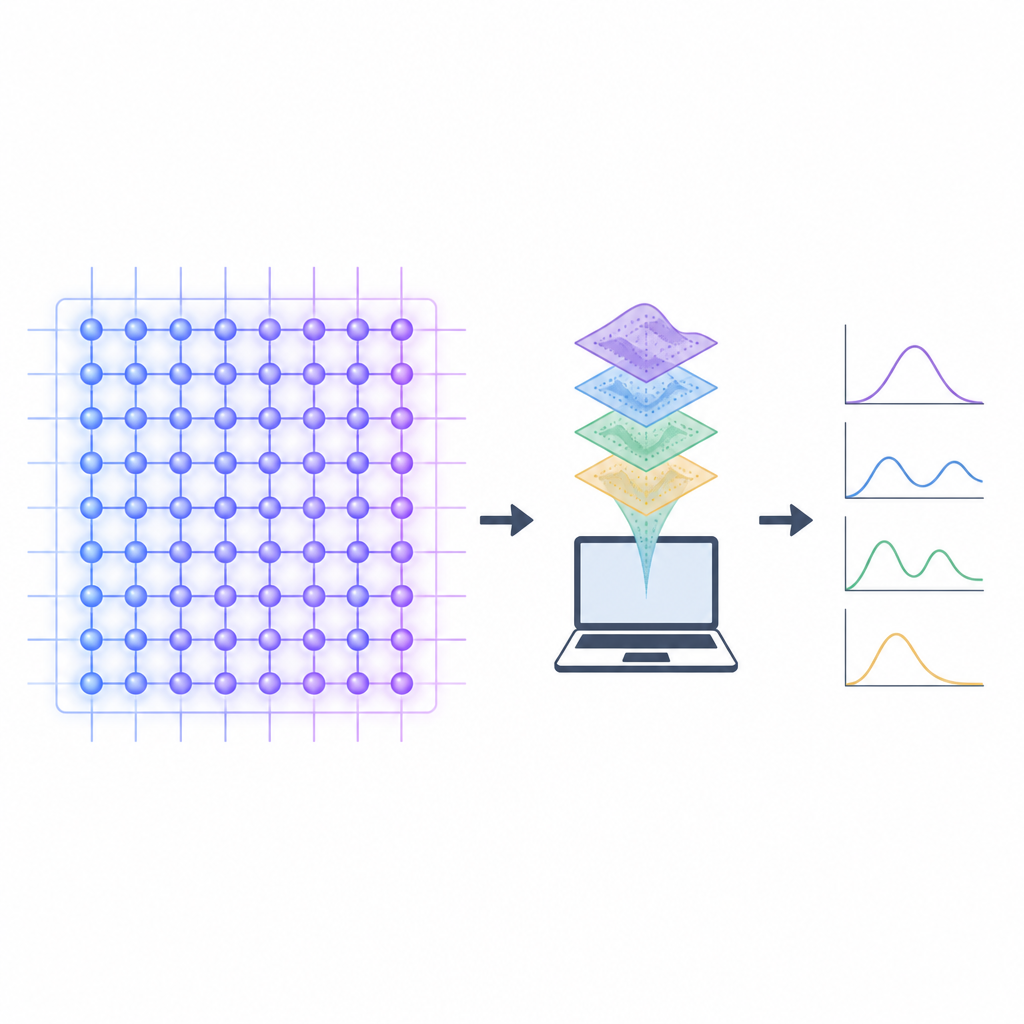
Capturing a quantum computer’s fingerprint
The authors focus on a key quantity that appears in many quantum algorithms: the average value of a measurement made after running a quantum circuit on a noisy processor. Instead of simulating every microscopic detail, they build what they call predictive surrogates. These are classical learning models trained on data gathered from an actual superconducting quantum chip. Once trained, the surrogate can quickly predict measurement averages for new circuit settings, without touching the quantum hardware again, and it automatically reflects that chip’s real noise and imperfections.
Two kinds of digital stand ins
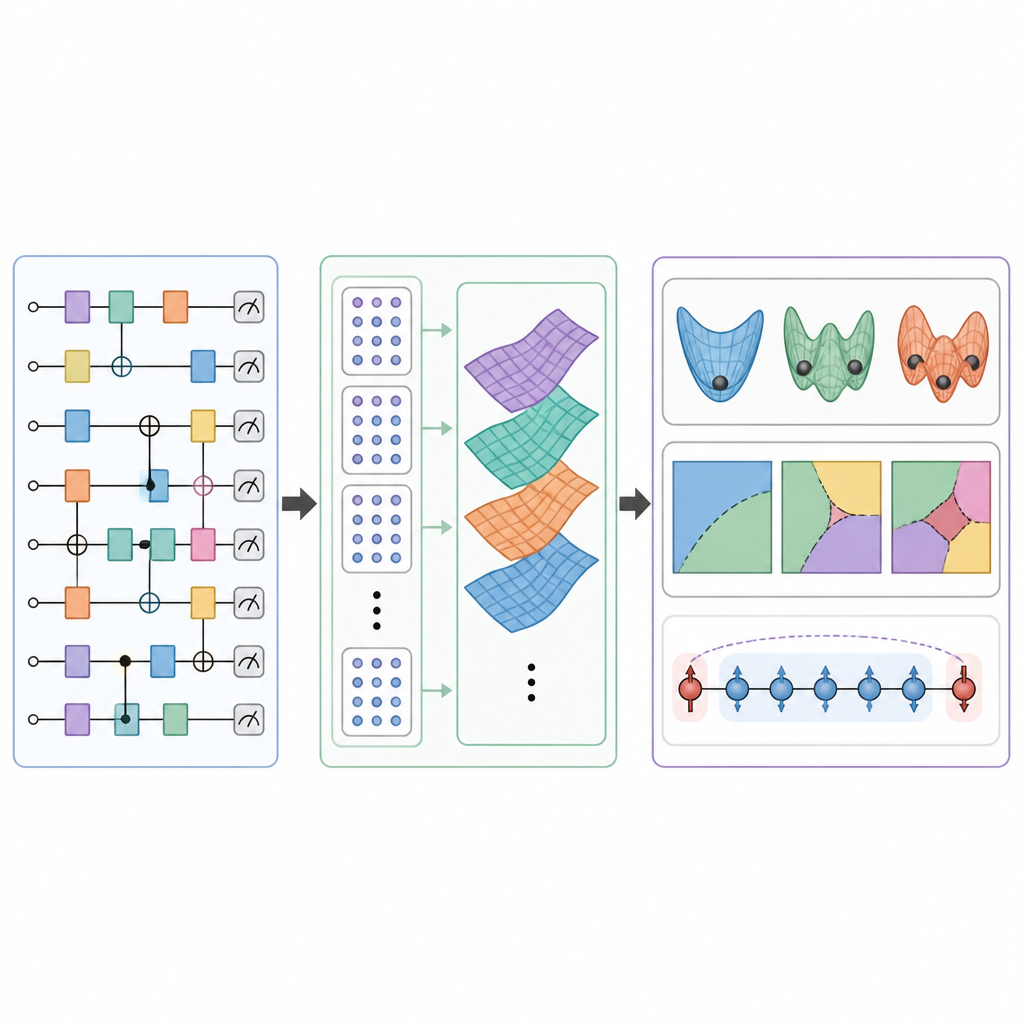
The team designs and analyzes two types of surrogates suited to different use cases. The first, called hcs, handles circuits whose control parameters vary independently and supports many local measurements at once. It builds on the idea of classical shadows, a technique that compresses information from randomized measurements into a compact classical representation. The second, called hqs, targets situations where many parameters in the circuit are linked, as often happens in quantum simulations of materials, chemistry, or machine learning. It is crafted to work with correlated inputs drawn from arbitrary distributions, which more closely matches realistic scientific workloads.
Putting the stand ins to work
To test these ideas, the researchers use a superconducting quantum processor with up to 42 working qubits. They first show that hcs can reliably predict the energy of a model quantum magnet, a one dimensional transverse field Ising model, across many choices of the model’s parameters. They then use this surrogate to pre train a widely used routine called the variational quantum eigensolver. The optimization is done entirely on a classical computer guided by the surrogate, and only later checked and slightly refined on the actual quantum chip. This approach cuts the number of required quantum measurements by orders of magnitude, yet reaches lower energy estimates than running the full quantum optimization from scratch.
Revealing hidden phases of driven matter
The second surrogate, hqs, is applied to a more exotic task: identifying special phases in a chain of spins that is periodically driven in time, known as Floquet symmetry protected topological phases. Traditionally, mapping out these phases requires many repetitive measurements on the quantum device as control settings change. Instead, the authors train a family of surrogates that learn how the local magnetization along the chain responds to the drive. Using only classical calculations with the trained models, they reconstruct signatures of long lived edge oscillations and locate the transition between the protected phase and a thermal, featureless phase, in agreement with direct quantum hardware experiments.
What this means for accessing quantum power
By proving that these surrogates can be trained efficiently and showing that they scale to tens of qubits on a real device, the work suggests a new way to share scarce quantum resources. A limited set of measurements on an advanced processor can be distilled into a reusable classical model that many users can query cheaply. While such surrogates do not replace quantum computers, they can greatly reduce how often we need to run them for tasks based on average measurement values, bringing practical quantum assisted studies of materials, chemistry, and novel phases of matter closer to everyday scientific use.
Citation: Liao, WY., Du, Y., Wang, X. et al. Demonstration of efficient predictive surrogates for large-scale quantum processors. Nat Commun 17, 4731 (2026). https://doi.org/10.1038/s41467-026-72506-5
Keywords: quantum processors, predictive surrogate models, variational quantum eigensolver, digital quantum simulation, Floquet phases
See more on the researcher's website: http://staff.ustc.edu.cn/~quanhhl/