Clear Sky Science · en
Regulating adsorption selectivity by charge-polarized Auδ−-Cuδ+ site for stable glucose electrooxidation
Turning Plant Sugar into Power and Products
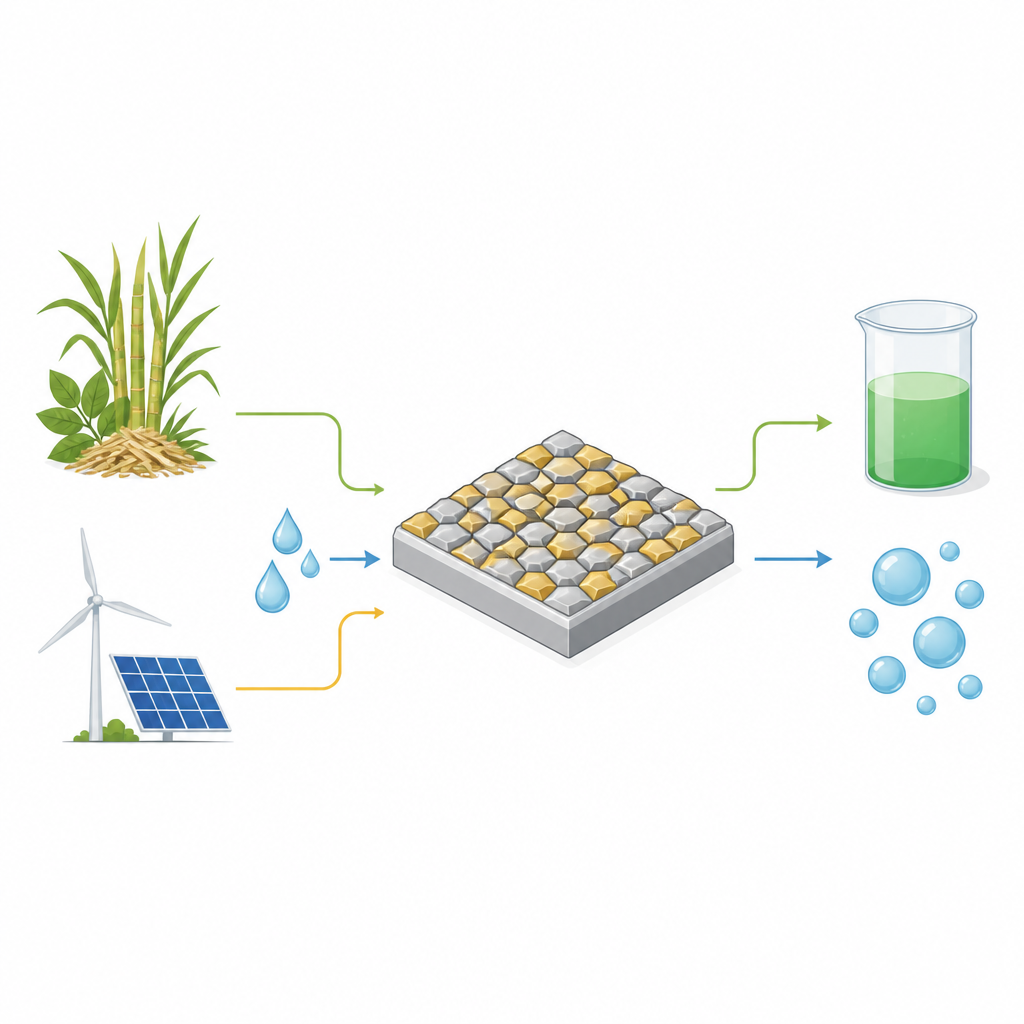
Glucose, a simple sugar found in plants, can be more than just food. This study shows how glucose can be turned into a useful chemical and clean hydrogen fuel using electricity and a carefully engineered metal surface. The work points toward future devices that upgrade renewable biomass while cutting the energy cost of making hydrogen.
Why Sugar Matters for Clean Energy
Our energy system still leans heavily on fossil fuels, but plant-based materials offer a renewable alternative. Glucose is one of the most common building blocks in biomass and can be converted into valuable organic acids. One product, potassium gluconate, is widely used in food, medicine, and agriculture. At the same time, the electrical reaction that turns glucose into this product can replace the usual oxygen-making step in water splitting, which is slow and energy-hungry. Swapping in glucose oxidation can therefore lower the voltage needed to produce hydrogen gas, making the whole process more energy-efficient.
The Problem with Existing Metal Surfaces
Many metal catalysts fall short when asked to oxidize biomass molecules like glucose at high rates. Common transition metals such as iron, cobalt, and nickel often rearrange under strong voltages, forming highly reactive species that break carbon–carbon bonds and waste much of the carbon as low-value fragments. Noble metals like platinum and palladium tend to over-oxidize glucose in a similar way. Gold is better at preserving the carbon backbone and can steer glucose toward valuable products, but its surface gradually gets covered by oxygen-containing layers at higher voltages. These surface oxides block the needed reaction sites and cause the catalyst to lose activity or shut down entirely.
A Smart Gold–Copper Partnership
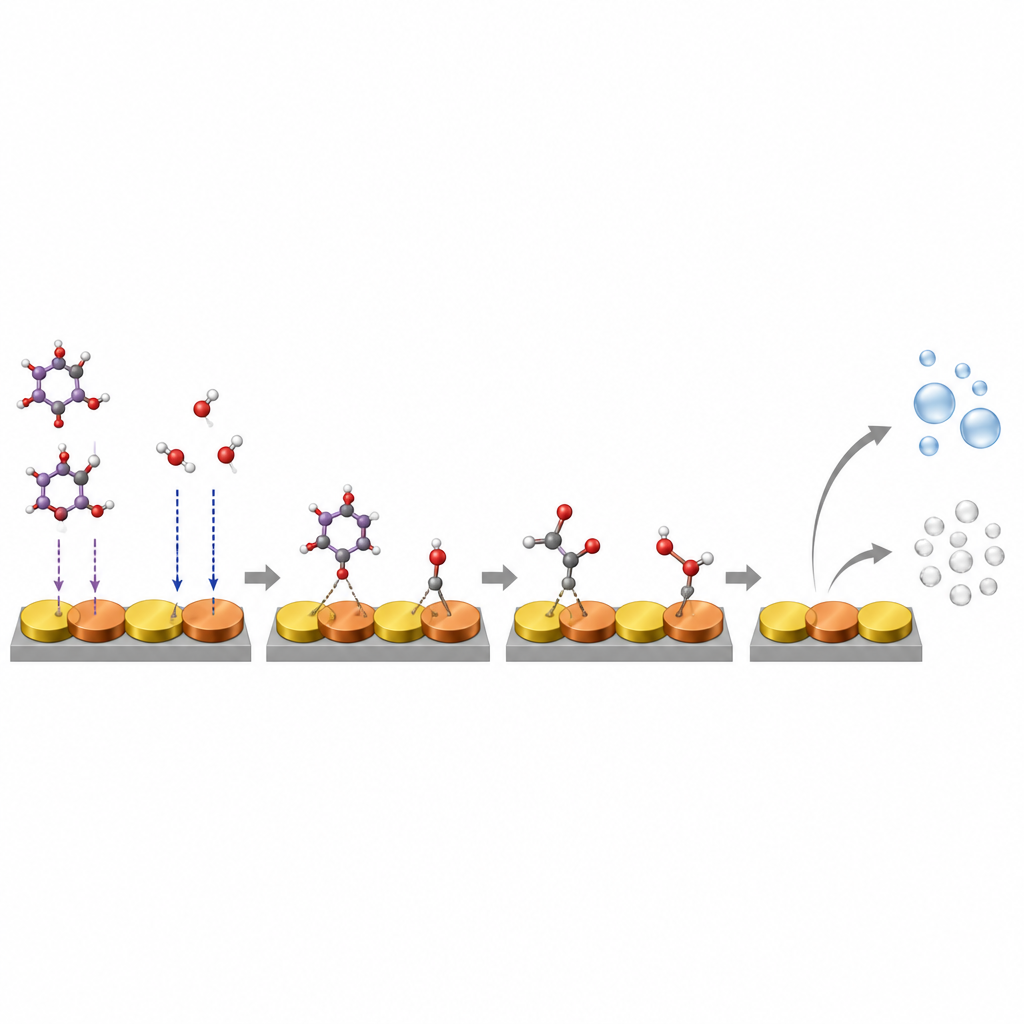
The researchers tackled this issue by building an alloy of gold and copper in a specific ratio, labeled Au4Cu2. On the atomic scale, copper atoms donate some of their electrons to neighboring gold atoms, creating tiny regions where gold becomes slightly more electron-rich and copper slightly more electron-poor. This charge imbalance sets up two complementary types of sites on the same surface. Experiments and computer simulations show that negatively inclined gold sites attract and bind glucose, while positively inclined copper sites favor the attachment of hydroxide from the alkaline solution. Together, these paired sites help form active oxygen species and carbonyl intermediates that smoothly convert glucose into gluconate without tearing the molecule apart.
Fast, Selective, and Long-Lasting Performance
When tested in alkaline solution containing glucose, the Au4Cu2 alloy reached industrially relevant current densities at comparatively low voltages. It achieved a very high selectivity, with about 97 percent of the converted glucose ending up as potassium gluconate and only traces of unwanted byproducts. The alloy also resisted the usual forms of decay. Surface analyses before and after long electrolysis runs showed that the alloy’s structure and composition stayed largely intact, and that copper-rich sites preferentially hosted hydroxide, shielding gold from forming thick oxide layers. As a result, the catalyst maintained both its activity and its Faraday efficiency—how effectively electrical charge is turned into chemical product—over many hours of operation.
A Membrane-Free Device for Dual Production
To demonstrate practical potential, the team built a membrane-free flow electrolyzer using the Au4Cu2 alloy as both the positive and negative electrodes. Glucose dissolved in alkaline water was pumped through the cell, where it was oxidized to potassium gluconate at one side while hydrogen gas formed at the other. This setup reached high current densities at much lower voltages than those needed for conventional water electrolysis and produced gluconate at industrially meaningful rates. A simple economic analysis suggested that, at typical renewable electricity prices and moderate current densities, the process could generate potassium gluconate at a competitive cost while significantly reducing the electricity needed per volume of hydrogen.
What This Means for Everyday Life
In simple terms, this work shows how a carefully tuned gold–copper surface can guide plant sugar and water into a useful chemical and clean fuel with high efficiency and durability. By giving different parts of the surface different electrical personalities, the alloy manages where key reaction steps happen and avoids self-damage that plagues pure gold. If scaled up, such systems could help future biorefineries turn agricultural streams into valuable products while lowering the energy bill for green hydrogen, linking food, chemicals, and clean energy in a single integrated process.
Citation: Liu, Y., Tao, X., Huang, C. et al. Regulating adsorption selectivity by charge-polarized Auδ−-Cuδ+ site for stable glucose electrooxidation. Nat Commun 17, 4372 (2026). https://doi.org/10.1038/s41467-026-72465-x
Keywords: glucose electrooxidation, gold copper alloy, potassium gluconate, biomass upgrading, hydrogen production