Clear Sky Science · en
Real-time monitoring of multimode squeezing
Why watching quantum light matters
Light is usually thought of as smooth and continuous, but at the quantum level it becomes grainy and noisy. Physicists have learned to “squeeze” this noise, pushing it down in a useful way that can make sensors more precise, communications more secure, and quantum computers more powerful. The work in this paper shows how to watch and control many squeezed patterns of light at once, in real time, inside a single laser beam—an ability that could unlock far more capable quantum technologies.
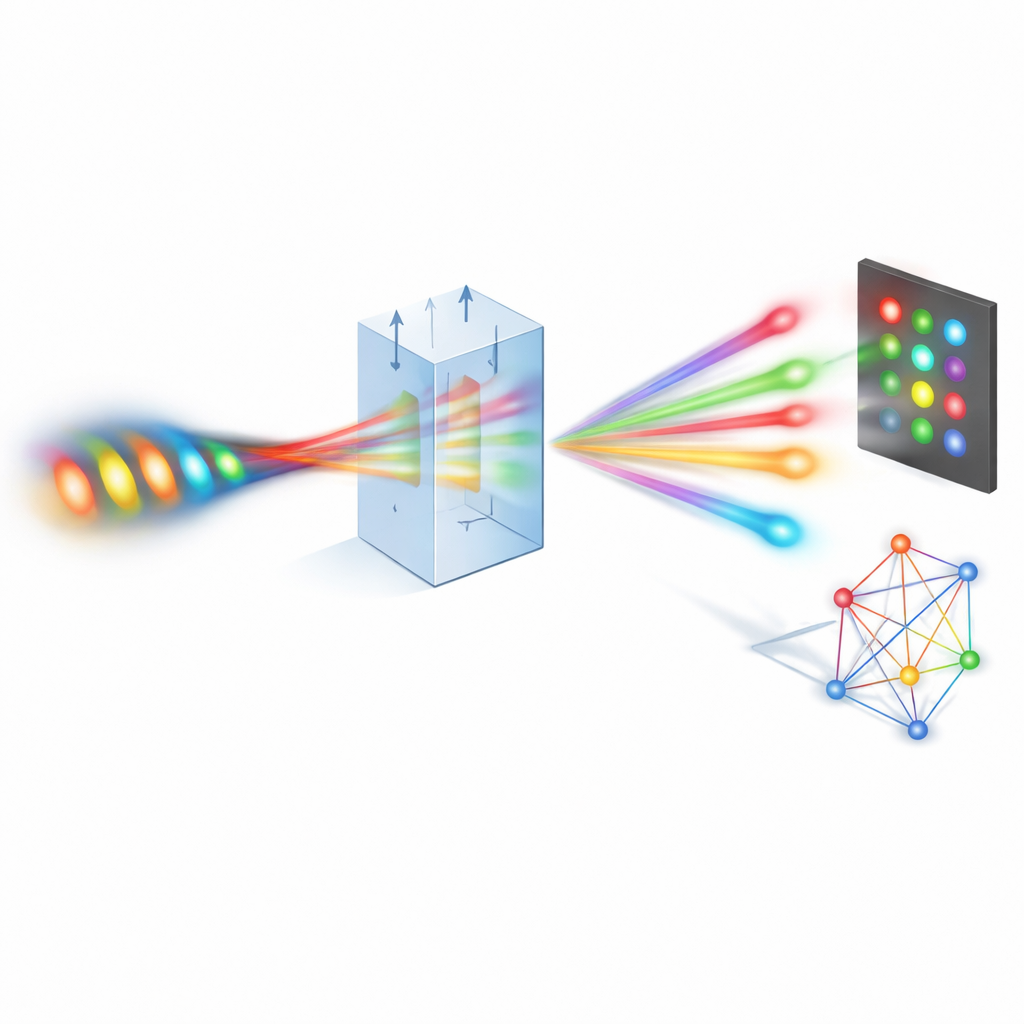
Many patterns hiding in one beam
A laser beam can secretly carry dozens of distinct spatial patterns of light, called modes, all stacked together. Each mode can host its own squeezed quantum state, so a single beam can act like a high‑capacity quantum data bus. Until now, however, scientists could only examine these modes one by one, using a method that compares the beam to a reference beam. This approach is slow, easily spoiled by losses and noise, and fundamentally limited to looking at a single mode at a time—far from ideal for large‑scale quantum networks or computations that rely on many modes acting together.
Using light to read light
The authors replace the traditional detector with another specially designed light amplifier. This amplifier, based on a nonlinear crystal, boosts or suppresses specific fluctuations of the incoming quantum light while largely ignoring ordinary loss after the amplification. Because the amplifier itself supports many spatial modes, it can act on all of them at once. By carefully shaping the strong pump beam that drives the amplifier, the team makes its internal modes closely match those of the incoming squeezed light, so that each pattern in the input beam is mapped cleanly onto a corresponding pattern at the output.
Sorting and measuring many modes at once
After amplification, the different spatial patterns are still traveling together in one beam, so the next challenge is to separate them without destroying their quantum features. The researchers use a programmable device that steers each pattern to a different bright spot on a camera, effectively turning a stack of overlapping modes into an array of separate pixels. Even though this sorting process is extremely lossy—less than one photon in 300 actually reaches the detector—the earlier amplification step makes the measurement robust. In this way, they simultaneously monitor nine distinct spatial modes and track how their quantum noise swings between squeezed and anti‑squeezed values as they slowly change the phase of the pump beam.
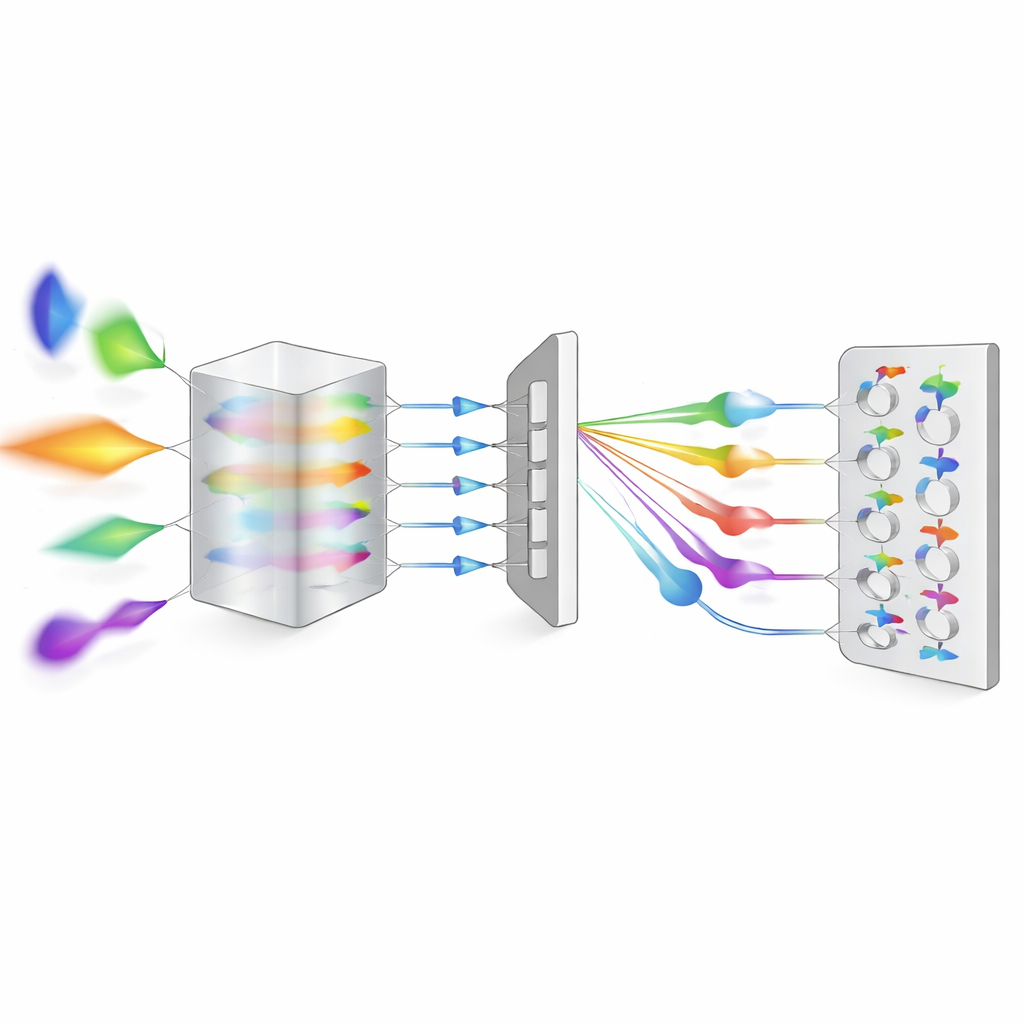
Building quantum networks inside a beam
Having real‑time access to many individual modes allows the team to do more than just measure them separately. By taking suitable superpositions of these patterns, they form small building blocks of quantum networks known as cluster states, in which multiple “nodes” share strong quantum correlations. The authors demonstrate and characterize many two‑node clusters and estimate the quality of larger three‑, four‑, and five‑node networks, all encoded in different combinations of the same underlying spatial modes. Remarkably, despite the huge overall detection loss, they observe very strong squeezing—nearly eight decibels—for the fundamental mode with high purity, setting a record for pulsed squeezed light.
What this means for future quantum devices
To a non‑specialist, the key message is that the authors have turned a fragile, hard‑to‑measure quantum resource into something that can be watched and steered in real time across many channels at once. By using an optical amplifier that is naturally matched to the squeezed light source, they overcome the usual penalties of loss, limited bandwidth, and single‑mode operation. The same strategy can be extended to color (frequency) modes as well as spatial ones, and scaled up to tens or hundreds of modes. This makes the technique a strong candidate for powering future quantum sensors, ultra‑secure communication links, and large continuous‑variable quantum computers that rely on complex webs of entangled light.
Citation: Kalash, M., Sudharsanam, A., M. Passos, M.H. et al. Real-time monitoring of multimode squeezing. Nat Commun 17, 3904 (2026). https://doi.org/10.1038/s41467-026-72357-0
Keywords: multimode squeezed light, optical parametric amplification, quantum imaging, continuous-variable entanglement, cluster states