Clear Sky Science · en
Multipolar electric and magnetic contributions to sum-frequency generation spectra reveal biaxial interfacial water structure
Why the surface of water is more complex than it looks
The surface of a glass of water may seem simple and smooth, but at the scale of molecules it is an ultrathin, highly organized zone that controls many processes in the atmosphere, in living cells, and in chemistry. This study shows that widely used laser techniques have been missing key pieces of that hidden structure, and introduces a new way to read the light coming from water’s surface to reveal how its molecules really line up there. 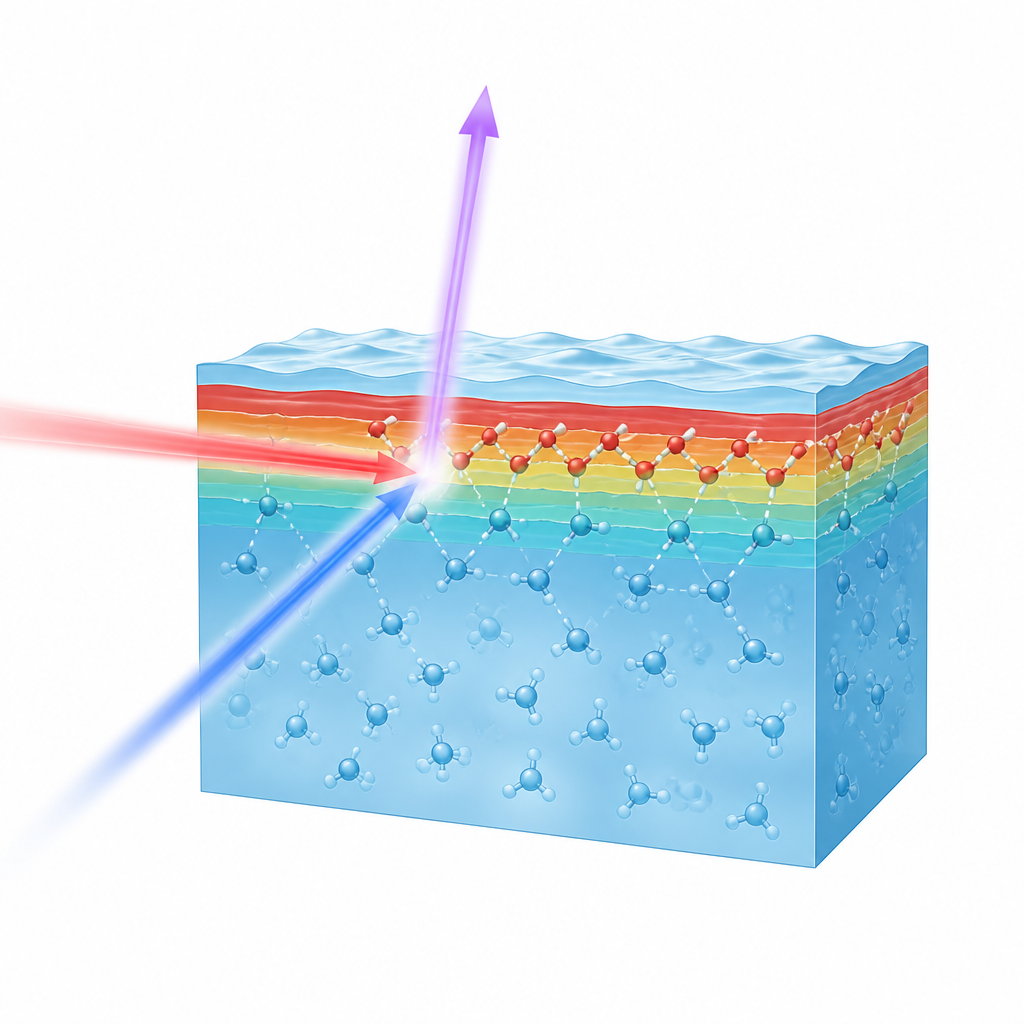
Light that only sees the surface
Researchers often probe liquid surfaces with a method called sum-frequency generation spectroscopy, in which two laser beams hit the interface and generate light at a new color. Because this process is strongest where the symmetry of bulk liquid is broken, it is naturally sensitive to surfaces and has become a workhorse for studying interfacial water. Traditionally, scientists assumed that this new light is created only by a simple response of electric dipoles, a kind of basic molecular vibration that acts like tiny charge-separated springs. That approximation made it possible to extract properties such as bond orientations and surface thickness, but it also quietly discarded more subtle ways that electrons and currents in the liquid can respond to light.
Hidden players in the light signal
The authors show that higher-order effects, known as electric quadrupoles and magnetic dipoles, contribute substantially to the signal and cannot be ignored if one wants a faithful picture of the interface. Using a detailed theoretical framework rooted in time-dependent response theory and large-scale molecular simulations of the air–water interface, they calculate all of these contributions on equal footing. When they compare the predicted spectra to several high-quality experiments across the key vibrational ranges of water, they find quantitative agreement once these multipolar terms are included. In the frequency region associated with bending motions of the water molecule, the usual dipole picture almost completely breaks down, and the observed signal is dominated by quadrupole and magnetic terms that arise mainly from the bulk liquid rather than from the surface layer itself.
A three-layer surface only eight angstroms thick
By carefully separating out the different light contributions, the researchers can isolate the part of the signal that truly comes from the interfacial electric dipoles, which acts as a fingerprint of molecular ordering. This analysis reveals that the top of liquid water is not a single blurred layer but an ultrathin structure only about 0.8 nanometers thick, composed of three distinct sublayers. Slightly below the surface, most water molecules tilt inward, pointing one hydrogen bond toward the bulk. Around the conventional surface dividing line, many molecules lie roughly flat, with their bonds spread in the surface plane. Just above this, near the vapor side, molecules tend to point one hydrogen bond outward into the air. This arrangement is not simply aligned along one axis; instead, the molecules show biaxial ordering, meaning their orientation around their own dipole axis also matters. 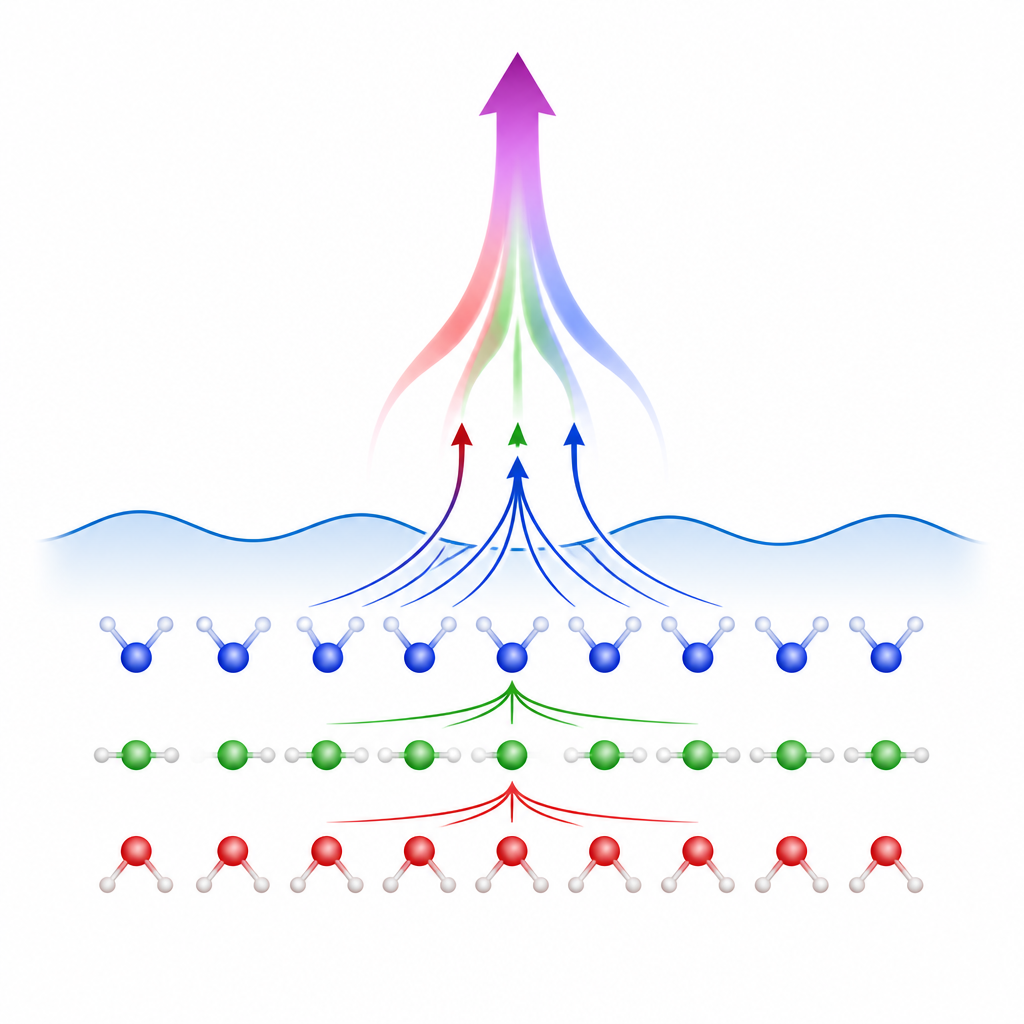
Different vibrations tell different structural stories
The study also compares how bending and stretching vibrations of water sense the interface. The bending band, once corrected for the bulk multipole background, turns out to be a sensitive reporter of this biaxial orientation pattern. In contrast, the stretching band, which involves more dramatic changes in hydrogen bonds, responds mainly to how abruptly the hydrogen-bond network changes across the interface and is strongly shaped by quadrupole contributions. The authors further compute how the local dielectric response and infrared absorption vary with depth, showing how the overall optical behavior of water changes from bulk-like just a few molecular diameters below the surface to vapor-like just above it.
Sharper tools for reading water’s surface
Overall, the work demonstrates that to interpret surface-specific laser spectra of water and other liquids, one must first subtract the strong but structure-blind multipole background that arises from the bulk. When this is done using accurate simulations, the remaining signal directly reveals how interfacial molecules are oriented in space, exposing a surprisingly intricate triple-layer ordering at the air–water boundary. The new framework turns sum-frequency spectroscopy into a more quantitative microscope for molecular structure at liquid interfaces, with implications for fields ranging from atmospheric chemistry to electrochemical energy technologies.
Citation: Lehmann, L., Becker, M.R., Tepper, L. et al. Multipolar electric and magnetic contributions to sum-frequency generation spectra reveal biaxial interfacial water structure. Nat Commun 17, 4333 (2026). https://doi.org/10.1038/s41467-026-72345-4
Keywords: interfacial water, sum frequency generation, multipole contributions, water structure, nonlinear spectroscopy