Clear Sky Science · en
Plasticity of source-sink dynamics contributes to wheat yield stability
Why Wheat’s Hidden Balancing Act Matters
Wheat feeds billions of people, but its harvests are increasingly threatened by heat waves, shifting rainfall, and stricter limits on fertilizers and pesticides. This study digs into how modern wheat varieties quietly juggle energy capture in their leaves and grain filling in their heads to keep yields more stable, even as the weather swings. By piecing together a vast trove of field and greenhouse data, the authors show that breeders have unintentionally selected wheat plants that are better at flexibly reallocating resources throughout their life cycle, creating a kind of built‑in safety system for grain production.
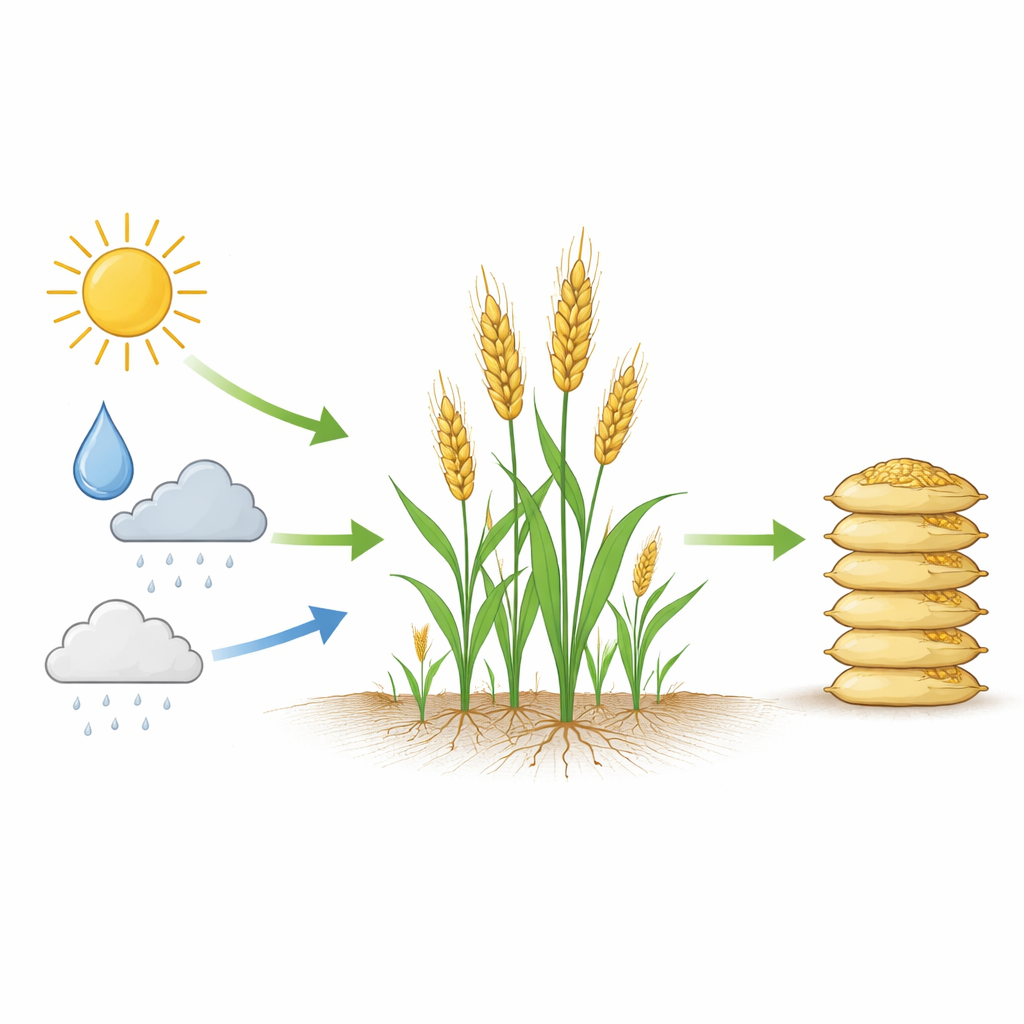
How Wheat Turns Sunlight into Grain
At the heart of the work is the relationship between the plant’s “source” organs, which capture and store energy (mainly leaves and stems), and its “sink” organs, which use that energy to grow grains (the spikes full of kernels). The researchers assembled six large datasets covering 202 German winter wheat varieties released between 1963 and 2018, tested across more than 100 field, greenhouse, and growth‑chamber experiments. They tracked 61 traits in total, ranging from leaf size and canopy greenness to spike weight and disease resistance, across all stages from seedlings to mature plants. This allowed them to see how breeding over the past six decades has jointly reshaped the plant’s ability to capture light, store reserves, and fill grains.
Breeding Has Quietly Rewired the Plant
The data show that modern wheat has not just become higher yielding; it has been systematically re‑engineered in subtle ways. Plants released around 2010 have leaves that stay green longer, maintain higher chlorophyll levels, and have more and slightly larger pores on their surfaces, improving gas exchange and overall efficiency of using light. At the same time, their stems and spikes at flowering store more water‑soluble carbohydrates, creating a backup reserve that can be tapped when clouds, heat, or disease briefly cut down photosynthesis. While average leaf size has shrunk, slightly more tillers and altered angles of stems help maintain total canopy area and light capture. Grain “sink” capacity has also grown: modern varieties carry more grains per spike and somewhat heavier kernels, backed by a modest increase in spike number.
Plasticity: Flexibility Where It Counts
A key finding is that breeding has not simply maximized all traits, but has changed how flexible they are from one environment to another. Traits that support yield in almost all conditions—such as overall efficiency of using light, canopy greenness, spike dry weight, and plant height—have become less plastic, meaning they vary less with weather and management. In contrast, several adaptive traits, like leaf area, leaf width, and how many tillers actually become grain‑bearing spikes, have become more plastic. This pattern suggests a “meta‑mechanism”: a coordinated network in which some plant functions are kept stable, while others remain adjustable so the plant can shift effort between growth stages when stress hits. The team also detected genetic signatures of selection on many of these traits, implying that they have been indirectly shaped by decades of choosing high‑yielding lines.
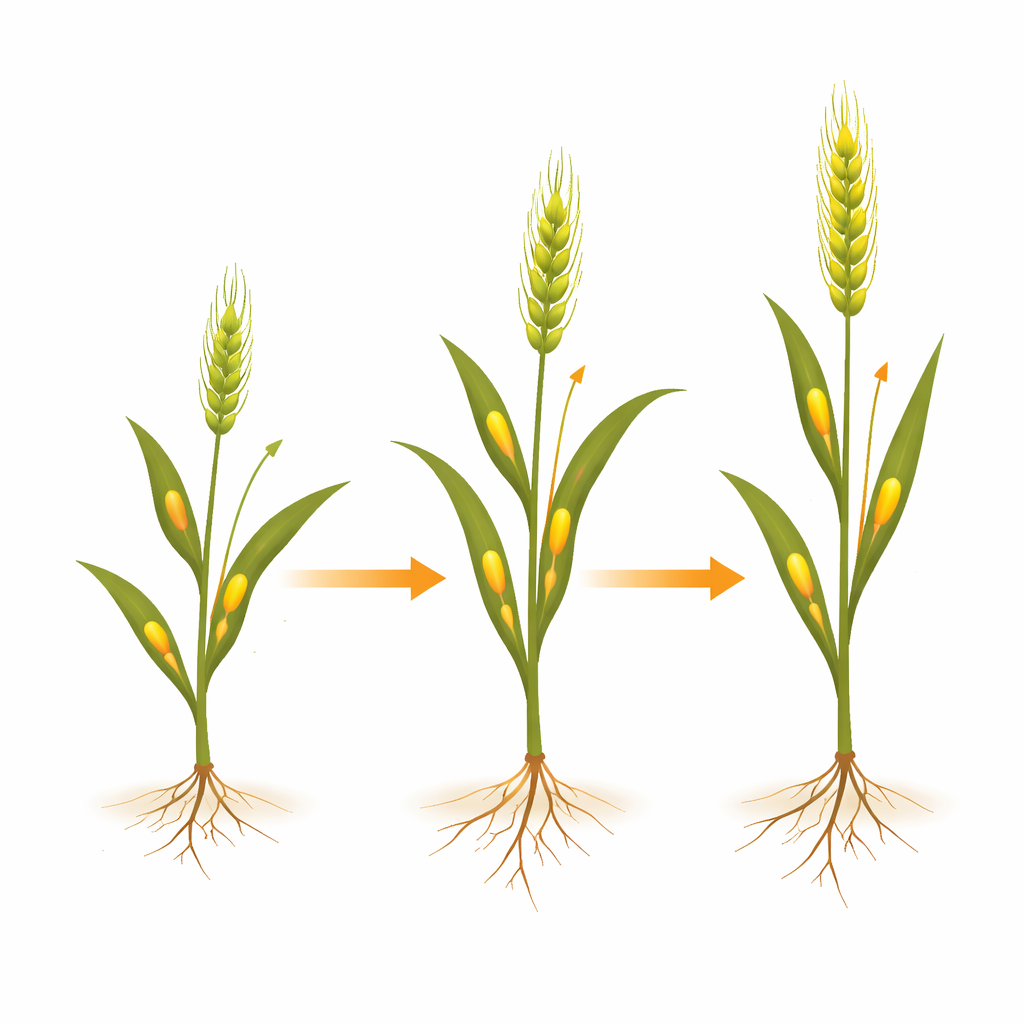
Coping with Hotter, Harsher Weather
To see how this plays out under climate stress, the researchers re‑analyzed detailed field trials comparing older cultivars (released before 1980) with modern ones (after 2010). They linked short episodes of temperature, radiation, and rainfall at specific growth stages to yield components such as grain number per spike, spike number, and kernel weight. Modern varieties, despite having more stable final yields, actually showed stronger positive responses to higher night‑time temperatures in key windows before and after flowering—periods when the developing spike is especially sensitive. Warmer nights during early spike development tended to boost kernel weight, and modest warmth around flowering and early grain filling tended to increase grain number, particularly in the newer cultivars. This suggests that breeding under a warming climate has favored plants that can take advantage of mild heat at the right time, while buffering yield against short‑term weather shocks.
What This Means for Future Harvests
Overall, the study concludes that long‑term wheat breeding has created plants whose internal “budgeting” between energy capture and grain building is both better coordinated and more flexible. Rather than relying on single traits, modern varieties combine sturdier baseline functions—like sustained canopy greenness and robust spikes—with adjustable features that can compensate when stress strikes at sensitive stages. This built‑in flexibility of source‑sink dynamics helps stabilize yields under variable conditions and offers a roadmap for future breeding: instead of chasing one “magic” characteristic, breeders can target networks of traits, including overlooked ones like stem carbohydrate reserves and developmental timing, to keep wheat harvests reliable in an increasingly unpredictable climate.
Citation: Wang, TC., Moritz, A., Mabrouk, M. et al. Plasticity of source-sink dynamics contributes to wheat yield stability. Nat Commun 17, 3781 (2026). https://doi.org/10.1038/s41467-026-72330-x
Keywords: wheat yield stability, source-sink dynamics, crop breeding, climate resilience, phenotypic plasticity