Clear Sky Science · en
Trophic status strongly regulates nitrous oxide but not methane production in global freshwater lake sediments
Why Lake Mud Matters for the Climate
Hidden beneath the calm surfaces of lakes, thin layers of mud quietly help decide how much greenhouse gas escapes into the air. This study looks at how changing nutrient levels in lakes—whether they are clear and low-nutrient or murky and algae-filled—alter the production of two powerful gases: nitrous oxide, a long‑lived heat‑trapping gas, and methane, the main component of natural gas. Understanding these invisible processes helps us see how farming, fertilizer use, and water‑quality policies ripple all the way up to the global climate.
From Drinking Water to Greenhouse Gases
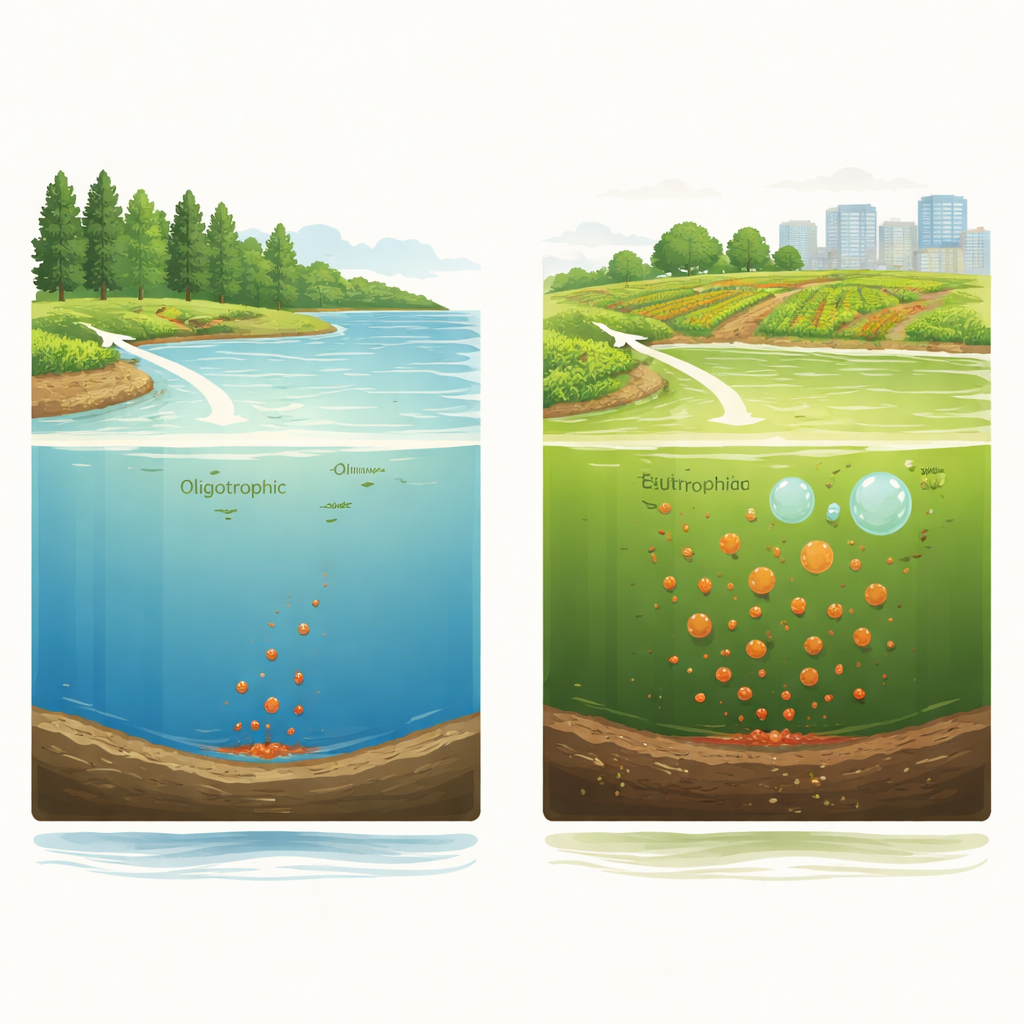
Freshwater lakes supply drinking water and support fisheries and recreation, but they are also major sources of greenhouse gases. As fertilizers and other nitrogen‑rich pollutants wash off farmland and cities into lakes, they fuel algal blooms and a process called eutrophication—where waters become greener, oxygen in deeper layers is depleted, and biodiversity declines. At the same time, those nutrients feed the microbes that control whether nitrogen leaves the lake safely as harmless nitrogen gas or leaks out as nitrous oxide, and whether buried organic matter is converted into methane. Yet, until now, scientists have not clearly understood how a lake’s nutrient status—its trophic state—determines which gases are produced, and by which microbial pathways.
Following Microbes Around the World
The authors combined detailed laboratory experiments with a global DNA survey of lake sediments to tackle this question. They sampled sediments and overlying waters from lakes that span a wide range of nutrient conditions, from very clear, nutrient‑poor systems (oligotrophic) to heavily enriched, algae‑choked ones (eutrophic). Using metagenomics, they read the genetic blueprints of the microbes present and tracked key genes linked to nitrogen and methane cycling. They then incubated sediments in the lab under carefully controlled conditions, adding specific forms of nitrogen and using inhibitors to turn particular microbial processes on or off. This allowed them to measure how fast nitrous oxide and methane were produced, and to pin those rates to the underlying microbial machinery.
Two Different Nitrous Oxide Worlds
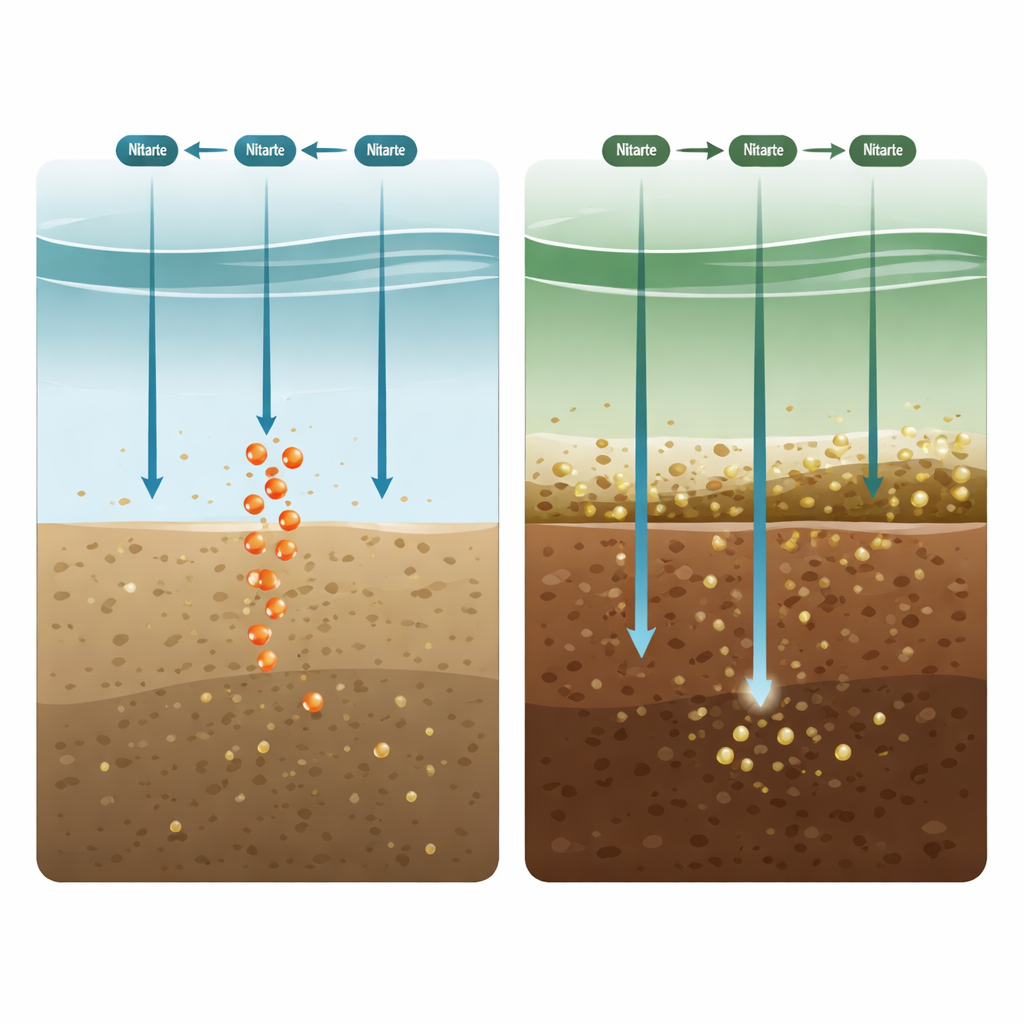
A striking pattern emerged for nitrous oxide. In nutrient‑rich, eutrophic sediments, organic carbon is plentiful, and microbes are well supplied with the energy they need to carry out complete denitrification—finishing the job by converting reactive nitrogen all the way to harmless nitrogen gas. In these lakes, nitrous oxide mainly arises as a by‑product of nitrification, a pathway in which microbes oxidize ammonia; when researchers blocked this step with a specific inhibitor, nitrous oxide emissions almost vanished. In contrast, in nutrient‑poor, oligotrophic sediments with little organic carbon, denitrification often stalls halfway. Microbes convert nitrate to nitrous oxide but lack the resources to finish the final step, so nitrous oxide builds up and escapes to the atmosphere. Genetic markers mirrored this split: eutrophic sediments were dominated by gene types linked to strong nitrous oxide consumption, while oligotrophic sediments carried more genes associated with incomplete denitrification and higher nitrous oxide release.
Methane Follows a Different Set of Rules
Methane told a more complicated story. Across the global dataset, the abundance of genes responsible for methane production in sediments closely tracked genes for nitrogen fixation in specialized microbes, suggesting that methane‑producing archaea often make their own nitrogen fertilizer from nitrogen gas. Laboratory incubations confirmed that supplying nitrogen gas boosted both methane production and ammonium levels in sediments. However, unlike nitrous oxide, methane‑related genes and production rates did not show a clear, consistent shift between nutrient‑poor and nutrient‑rich lakes. Instead, methane output appears to depend on a broader mix of influences, including temperature, sediment chemistry, lake depth, and how quickly material accumulates on the bottom, making it harder to predict from trophic state alone.
Turning the Nutrient Dial Up and Down
To move beyond snapshots of existing lakes, the researchers ran an inventive “cross‑inoculation” experiment. They mixed live microbes from a nutrient‑poor lake into sterilized sediments from a nutrient‑rich lake, and vice versa, creating a gradient from oligotrophic to eutrophic conditions in the lab. As they gradually enriched poor sediments, nitrous oxide production shifted from being controlled by incomplete denitrification to being dominated by nitrification, matching the pattern seen in real eutrophic lakes. When they made rich sediments more like low‑nutrient ones, the system flipped back again. This reversible switch shows that as lakes are pushed along the eutrophication–oligotrophication spectrum by human actions or restoration efforts, the main microbial source of nitrous oxide predictably changes with them.
What This Means for Climate and Lake Management
For a non‑specialist, the key outcome is that lake nutrient levels strongly steer how nitrous oxide is made, but have no simple, direct control over methane. In eutrophic lakes, cutting back on ammonium inputs or limiting the conditions that favor nitrification could sharply reduce nitrous oxide emissions. In oligotrophic or recovering lakes, strategies that keep denitrification running to completion—such as boosting carbon relative to nitrate or removing stored nitrate from sediments—can help prevent nitrous oxide leaks. Because global fertilizer use and land development are expected to increase eutrophication in many regions, these findings offer a practical roadmap: by managing the nutrient status of lakes, we can deliberately shift the balance of microbial pathways in bottom muds and, in turn, curb a significant source of a powerful greenhouse gas.
Citation: Yang, Y., Zhang, H., Herbold, C.W. et al. Trophic status strongly regulates nitrous oxide but not methane production in global freshwater lake sediments. Nat Commun 17, 3791 (2026). https://doi.org/10.1038/s41467-026-72269-z
Keywords: lake eutrophication, nitrous oxide emissions, methane from sediments, microbial nitrogen cycling, freshwater greenhouse gases