Clear Sky Science · en
Purcell enhancement of directional edge photocurrent in a van der Waals self-cavity
Turning Tiny Crystals into Terahertz Signal Sources
Wireless technologies and ultrafast electronics increasingly rely on terahertz waves—radiation that sits between microwaves and infrared light, but is notoriously hard to generate and control. This study shows how ultra-thin crystals of a quantum material called WTe2 can act as both the source and the resonant chamber for terahertz signals, turning a microscopic flake into a compact, tunable emitter that needs no external wires or applied voltage.
Why Small Structures Matter
When light interacts with matter, its behavior is strongly shaped by the surrounding environment. Optical cavities—tiny resonant structures that trap light—can dramatically boost how strongly light and electrons talk to each other. This enhancement, known from quantum optics as the Purcell effect, has transformed research at visible and infrared wavelengths. But at much lower terahertz frequencies, which are especially relevant for collective motions of electrons and atoms, it has been unclear how to build equally powerful cavities or how they might influence electrical currents driven by light.
A Flake That is Its Own Resonant Chamber
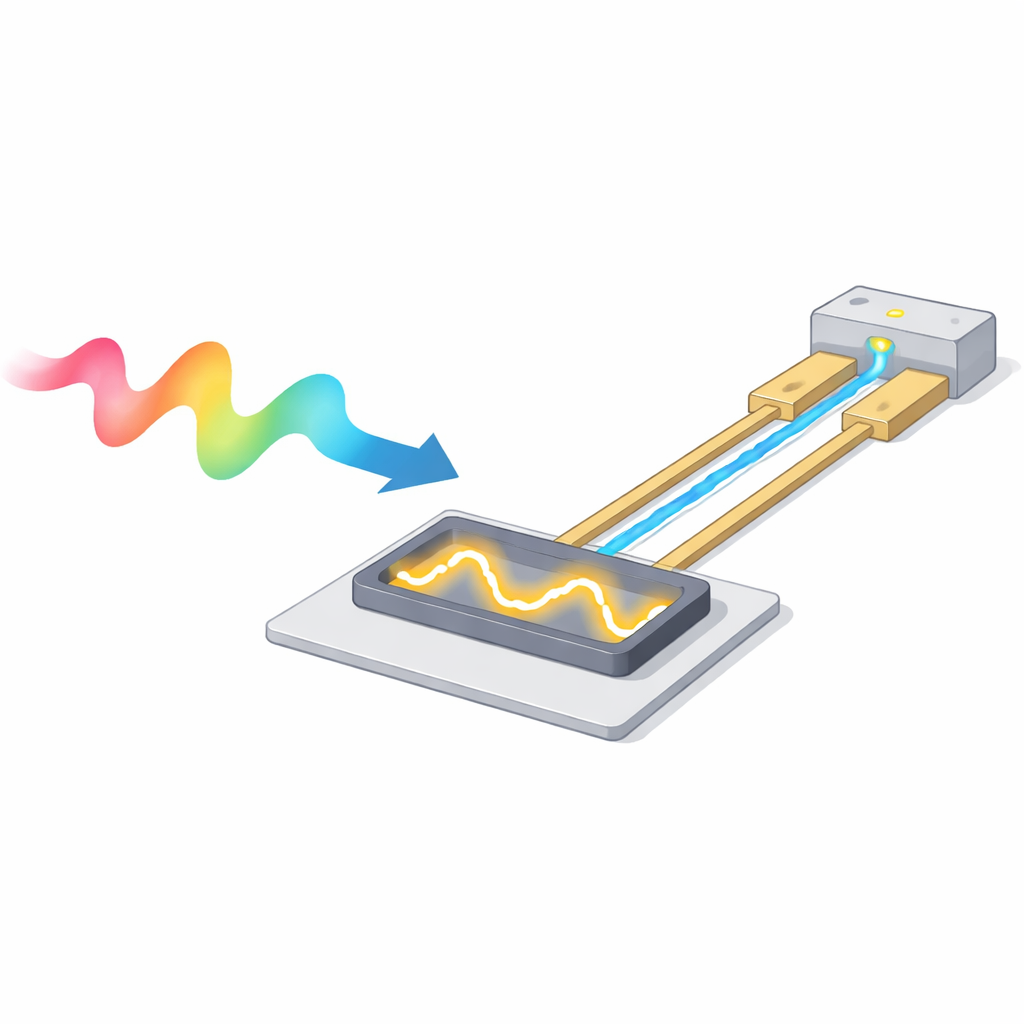
The authors exploit a special class of materials known as van der Waals crystals, which can be peeled into ultrathin flakes only a few atoms thick. In their devices, a thin WTe2 flake is sandwiched between insulating layers and placed on a chip with two parallel metallic strips that act as a terahertz circuit. When a very short laser pulse hits the edge of the WTe2 flake, it creates a brief electrical current that flows along the edge without any applied voltage. Because the flake is only a few micrometers wide, the resulting charge motion cannot spread freely; instead, it reflects from the flake boundaries and forms standing wave patterns, effectively turning the flake into a “self-cavity” for collective electron oscillations, or plasmons.
Watching Edge Currents Radiate
To detect what happens inside this self-cavity, the team uses on-chip terahertz circuitry rather than conventional wires, which often make poor contact to such delicate materials. The edge current launches a terahertz field that couples into the gap between the two metallic strips and travels down the chip to a tiny photoconductive switch that reads out the signal as a function of time. When the laser hits opposite edges of the flake, the measured terahertz pulses have opposite signs, revealing that the underlying photocurrents flow in opposite directions. This confirms the presence of a directional, bias-free photocurrent that is set by the crystal orientation and by the fact that the edge breaks the material’s mirror symmetry.
Resonance Boost from the Self-Cavity
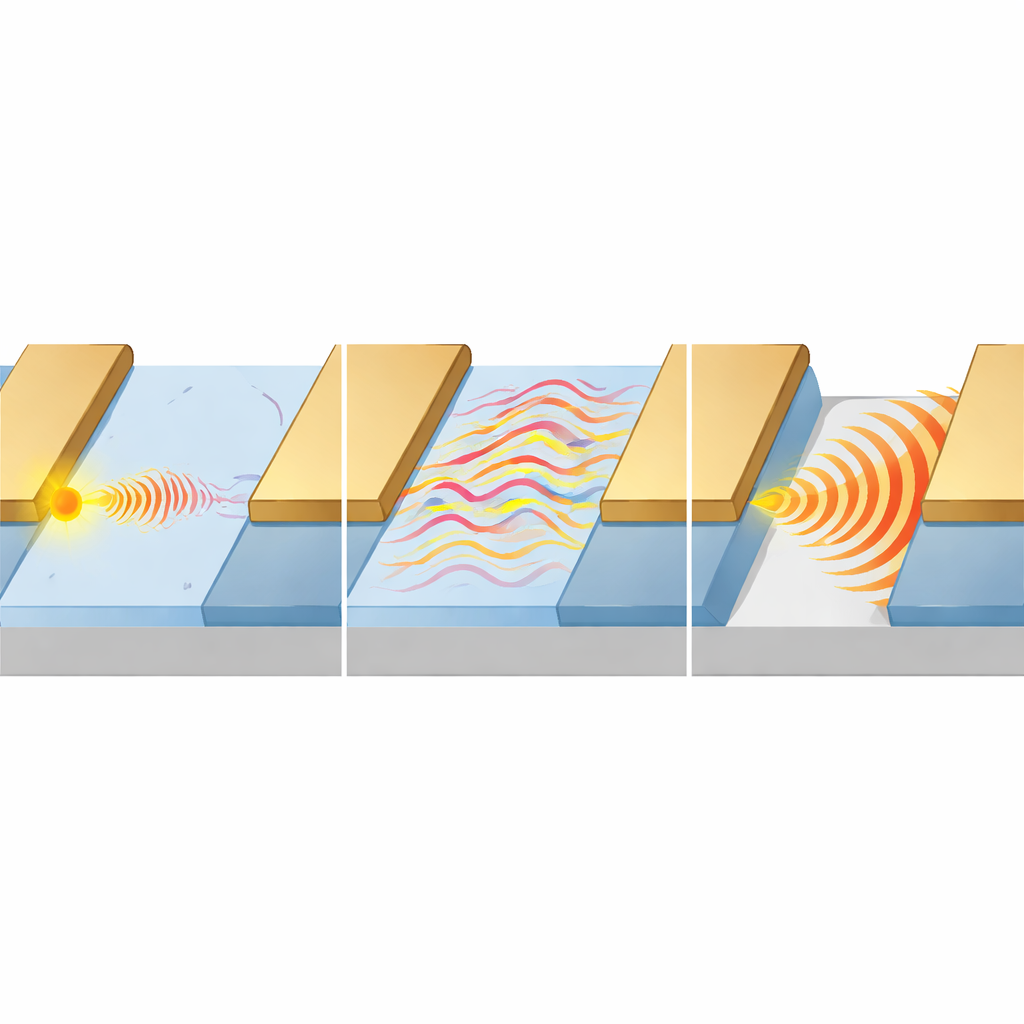
Strikingly, when the laser is moved to the side of the flake outside the metal strips, the emitted signal changes from a simple pulse into a ringing waveform with a well-defined terahertz frequency. As the laser intensity increases, this resonant peak grows stronger and shifts in frequency, a hallmark of interference between different current paths inside the self-cavity. The researchers develop an analytical model that treats the WTe2 flake and its metallic surroundings as a plasmonic resonator. By solving Maxwell’s equations with realistic boundary conditions, they compute a “Purcell factor” that tells how strongly the cavity boosts the current at each frequency. The predicted resonance frequencies closely match those extracted from experiments across several devices with different thicknesses and geometries.
Tuning Terahertz Waves by Design
Because the resonance depends on the device shape, layer thicknesses, and position of the metal strips, the emission frequency can be engineered in advance, and then further tuned in operation simply by choosing where to shine the laser and how intense it is. In some devices, the cavity resonance becomes so dominant that it even reverses the sign of the detected terahertz field compared with the low-intensity response. The authors also show that the resonant emitter is efficient compared with widely used terahertz sources, suggesting that these self-cavity structures could be practical for spectroscopy, next-generation wireless links, or on-chip signal generation in hard-to-reach frequency bands.
What This Means for Future Technologies
In everyday terms, this work turns a tiny crystal flake into a self-contained “terahertz whistle” that not only generates a tone when struck by light, but also sets its own pitch through its size and surroundings. By carefully shaping the flake and the nearby metal, scientists can shift energy from a broad, short-lived electrical pulse into a sharp, tunable terahertz note, all without applying a voltage. This approach opens a pathway to compact, bias-free terahertz sources and offers a new way to steer the ultrafast behavior of quantum materials simply by engineering the small spaces they occupy.
Citation: Li, X., Hagelstein, J., Kipp, G. et al. Purcell enhancement of directional edge photocurrent in a van der Waals self-cavity. Nat Commun 17, 3865 (2026). https://doi.org/10.1038/s41467-026-72260-8
Keywords: terahertz emission, van der Waals materials, plasmonic cavity, photocurrent, quantum optoelectronics