Clear Sky Science · en
HCN1 is a primary HCN Pacemaker Channel in Neurons
Why your brain’s inner clocks matter
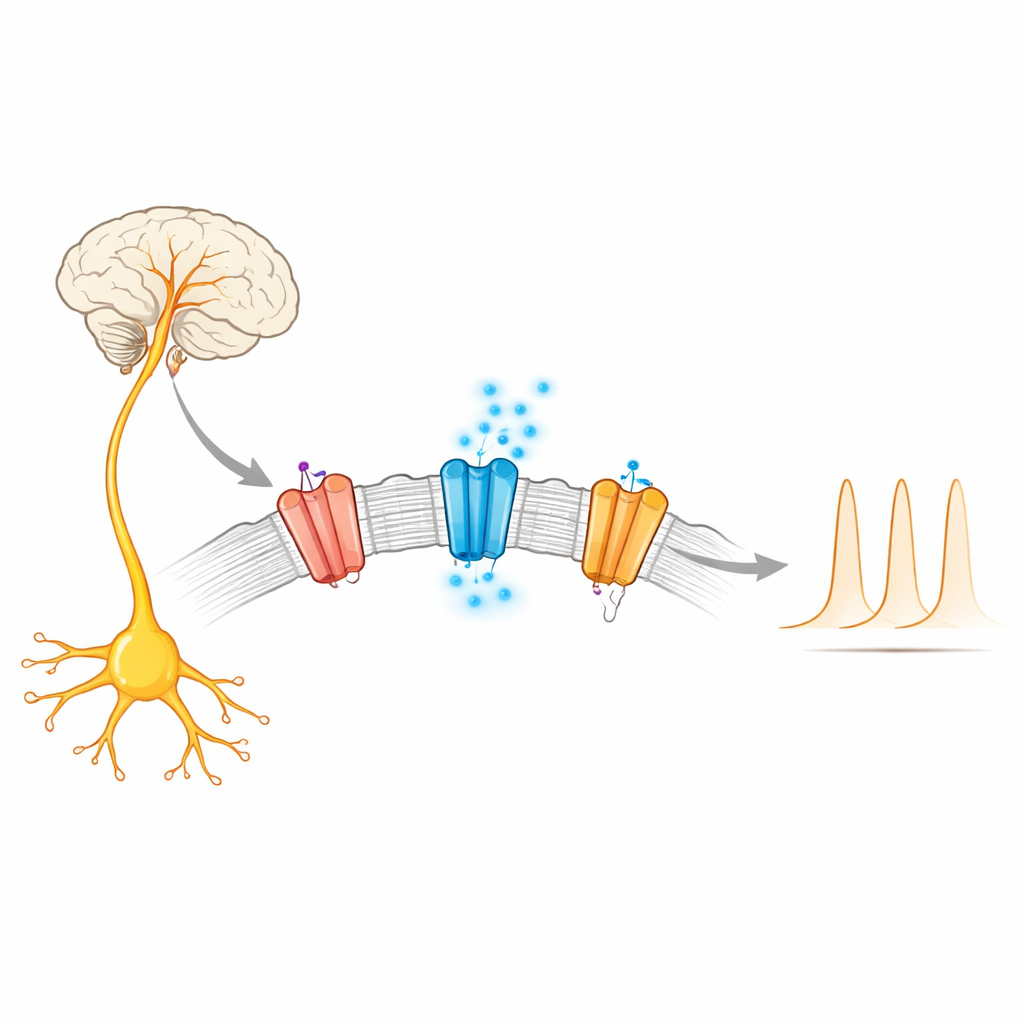
Deep inside the brain, tiny groups of neurons act as timekeepers. They help set our sleep–wake cycles, keep us alert, and coordinate daily rhythms in body and mind. These cells fire electrical impulses in a steady, repeating pattern, much like the ticking of a clock. For years, scientists have known that a family of “pacemaker” ion channels called HCN channels plays a role in this rhythm. But which specific HCN channel actually drives the beat in neurons, and how it does so in real time, has remained surprisingly unclear.
The tiny gates that set the pace
HCN channels are microscopic pores in the cell membrane that open and close to let charged atoms flow, subtly nudging a neuron toward firing. Mammals have four versions of these channels—HCN1 through HCN4—that differ in how quickly they respond and how sensitive they are to chemical messengers like cAMP, which rises when we are aroused or under stress. All four can, in principle, carry a pacemaker current, yet older measurements painted a puzzling picture: the channels seemed to activate at voltages more negative than those typically seen during a neuron’s “ramp up” to a spike, and they opened far more slowly than the firing rates actually observed in brain pacemaker cells.
Watching single channels during real nerve spikes
To resolve this puzzle, the authors used an advanced technique called an action-potential clamp on single channels in frog egg cells engineered to express mouse HCN1, HCN2, or HCN4. Instead of stepping the voltage in artificial square pulses, they played back realistic voltage waveforms reconstructed from a naturally firing brain clock neuron. This allowed them to track, with exquisite precision, the probability that individual channels were open at each instant during the gentle voltage rise that precedes each spike. They tested both a fast firing pattern (10 spikes per second) and a slower one (about 3 spikes per second), mimicking different rhythmic regimes in the brain.
Fast versus slow channel “gears”
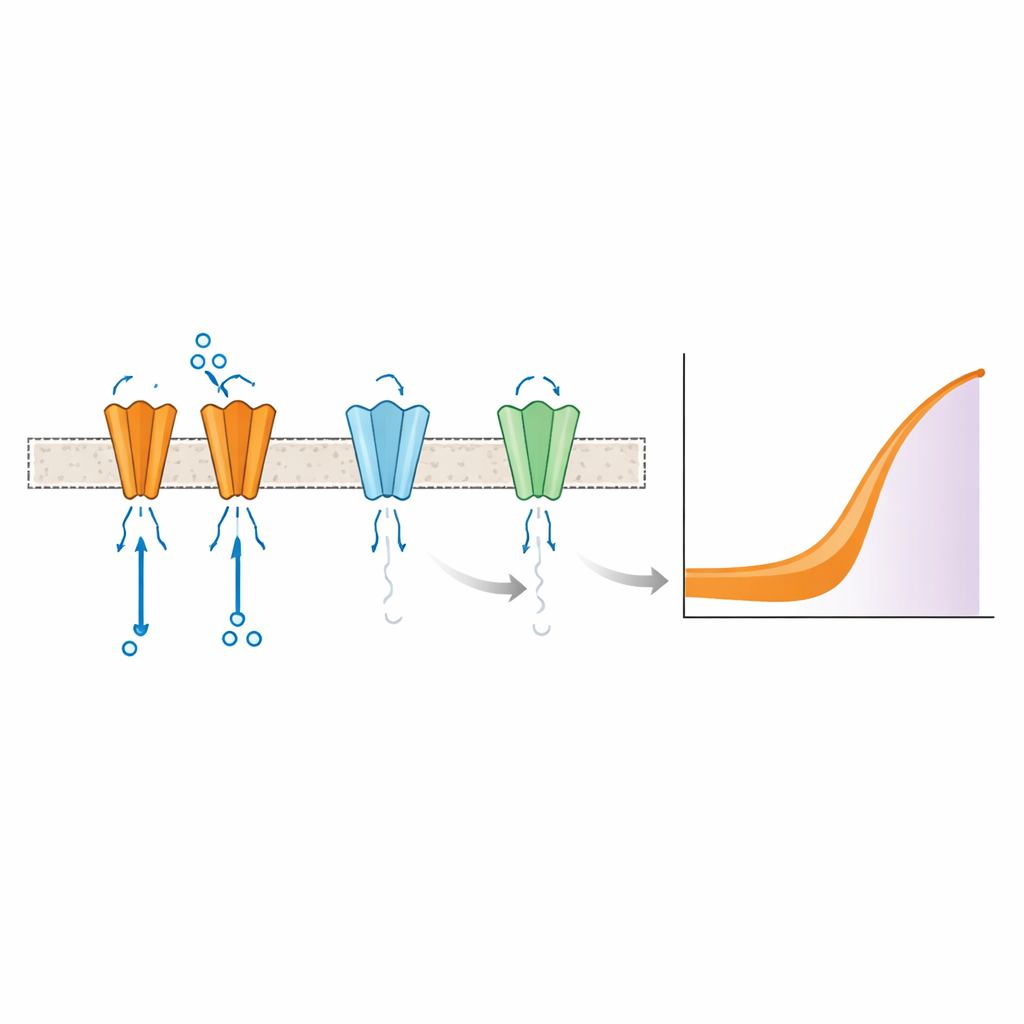
The results revealed a sharp split in behavior. HCN2 and HCN4 channels, long suspected contributors to pacemaking, turned out to be sluggish in this context. During the pacemaker depolarization, their open probability stayed essentially flat: they provided a steady background conductance that changed only very slowly, over many seconds, as the channels recovered from being shut off. In other words, they acted more like a static leak setting the baseline voltage than like dynamic gears turning with each beat. By contrast, HCN1 channels showed clear cycles of activation and deactivation within individual firing intervals, especially at the slower firing rate. Their open probability nearly doubled during the pacemaker phase, on a timescale of tens of milliseconds—fast enough to keep up with neuronal rhythms.
Triggering the start, but not doing all the work
To understand what this means for a real neuron, the researchers fed their measured HCN1 behavior into a simple computer model of a brain clock cell. They asked how far HCN1 alone could push the cell toward firing. The simulations showed that realistic HCN1 activity can depolarize the membrane only partway—from a very negative starting point to around −73 millivolts—roughly the first quarter of the total climb needed to trigger a spike. Beyond that, additional depolarizing currents, likely carried by other channels such as T-type calcium channels, must take over to drive the membrane to the firing threshold. This division of labor explains how HCN1 can be essential for timing the start of each ramp, while other conductances complete the job.
A new view of the brain’s pacemaker parts list
Taken together, the work recasts the roles of HCN channels in neuronal timing. HCN1 emerges as the primary pacemaker channel in the strict sense: it is the only isoform that reliably opens and closes fast enough, in the right voltage range, to act as a beat-by-beat trigger for the pacemaker depolarization. HCN2, HCN3, and HCN4 instead behave more like adjustable background settings, shaping the voltage landscape and fine-tuning how strongly messengers like cAMP can influence rhythm, but not providing the rapid switching needed for each step of the clock. For a lay reader, the conclusion is that the brain’s timing neurons do not rely on a single “on/off” switch; rather, HCN1 supplies the spark that starts each beat, while slower relatives and additional channels shape and sustain the rhythm that keeps our internal clocks on time.
Citation: Enke, U., Schweinitz, A., Tewari, D. et al. HCN1 is a primary HCN Pacemaker Channel in Neurons. Nat Commun 17, 3745 (2026). https://doi.org/10.1038/s41467-026-72257-3
Keywords: neuronal pacemaker, HCN1 channels, brain rhythms, ion channel gating, circadian timing