Clear Sky Science · en
Detection of Zwan-Wolf effect in the ionosphere of Mars
A Hidden Wind Tunnel Around Mars
Mars looks like a quiet, cold desert world, but high above its surface an invisible battle is underway between the planet’s thin upper atmosphere and the constant stream of particles blowing from the Sun. This study reveals that a subtle squeezing effect, long known near Earth, is also shaping the charged gas above Mars. During a strong burst of space weather, a NASA spacecraft finally caught this elusive process in action, offering a new window into how the Sun sculpts the environments of worlds without strong magnetic fields.
Solar Wind Meets a Bare Planet
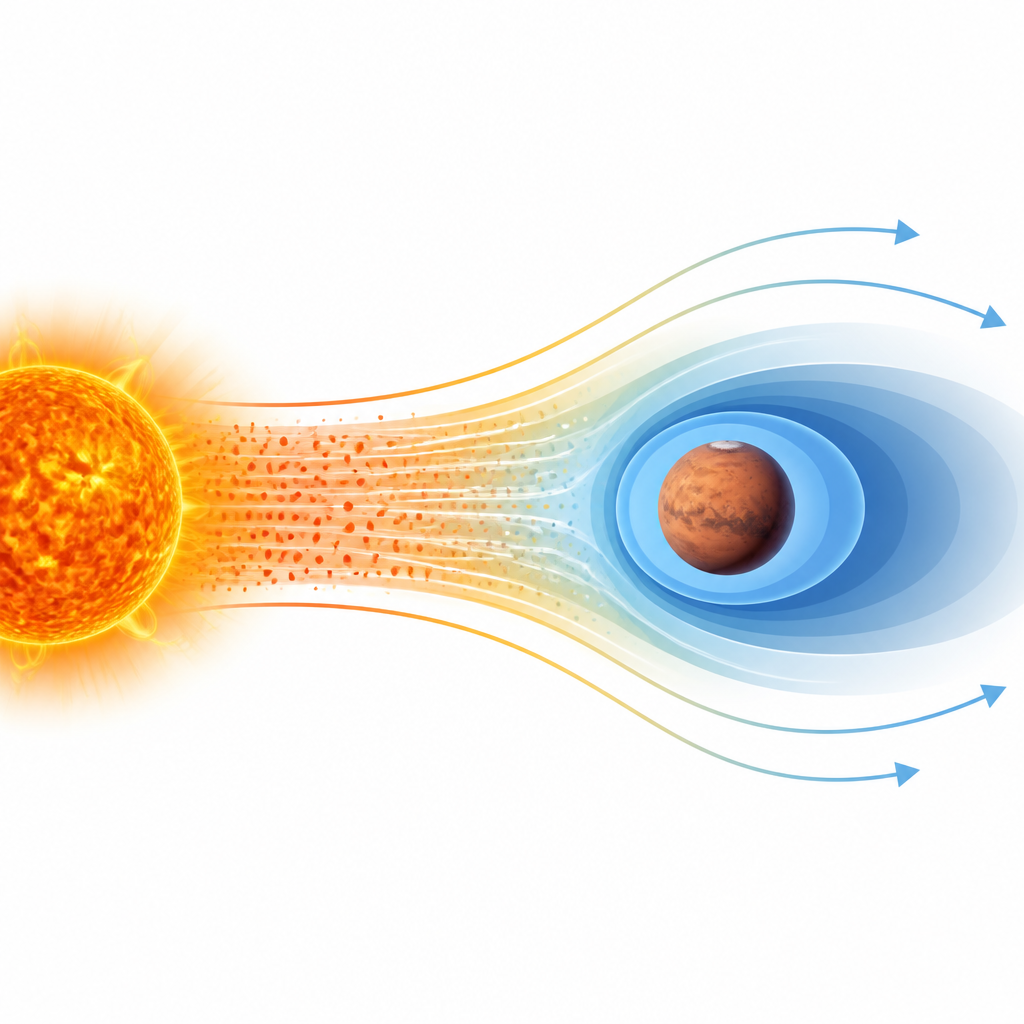
The Sun throws off a continuous flow of charged particles called the solar wind, racing outward at supersonic speeds. When this wind meets a planet, it must slow and divert around the obstacle. At Earth, a strong global magnetic field pushes the solar wind back far from the surface, creating a large magnetic bubble. There, a process called the Zwan-Wolf effect helps this diversion by squeezing solar wind along magnetic field lines, thinning the plasma in front of the planet. Mars, by contrast, lacks a global magnetic shield. Instead, its upper atmosphere and ionized gas act as a smaller, induced barrier. Scientists were not sure whether the same squeezing effect could operate in such a different setting, or how important it might be for steering the solar wind around Mars.
A Space Weather Event as a Natural Experiment
In December 2023, a large burst of solar material known as a coronal mass ejection slammed into Mars. The impact compressed and disturbed the region where the solar wind meets the Martian atmosphere. NASA’s MAVEN spacecraft happened to be in just the right place and time, skimming through Mars’s dayside upper atmosphere near the boundary between day and night. Instruments on board measured magnetic fields and charged particles as the planet’s upper atmosphere was jolted and its protective bubble was pushed inward. This rare, highly energized state turned out to be ideal for making subtle effects big enough to detect clearly.
Magnetic Ridges that Squeeze the Upper Air
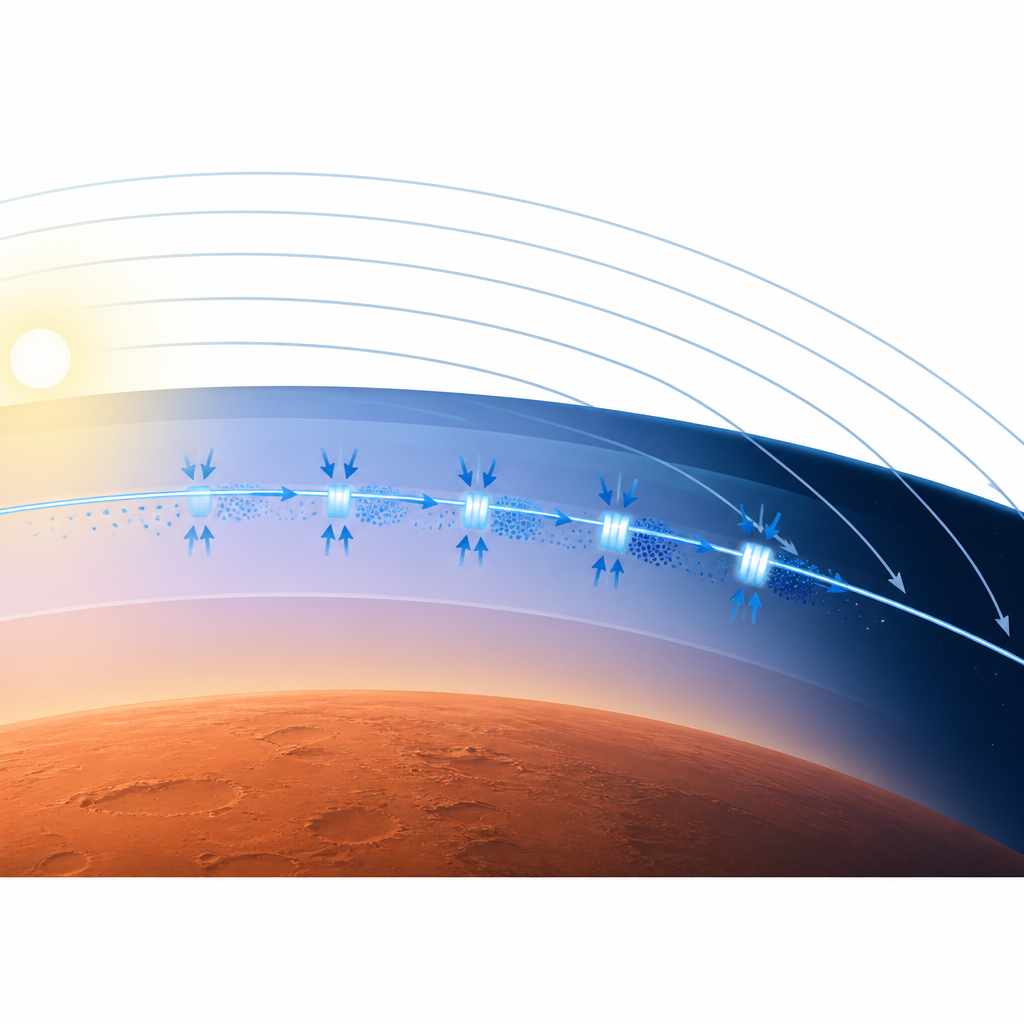
As MAVEN flew through the ionized gas around 185 kilometers above the surface, it encountered a series of sharp magnetic “ridges.” Each ridge showed a sudden jump in magnetic strength over about two seconds, followed by a slower return to normal over roughly half a minute. At the front of each ridge, the density of charged particles dropped by about one-third to nearly one-half, while the particles were pushed toward the planet’s nightside. This pattern was not what would be expected if the particles simply adjusted gently to a stronger magnetic field. Instead, the observations match a picture in which the magnetic ridges create pressure gradients that physically squeeze the plasma along curved field lines draped around Mars, just as the Zwan-Wolf effect does near Earth.
Continuous but Usually Invisible Squeezing
The study shows that these magnetic structures likely formed when sudden jumps in solar wind pressure struck the boundary where Mars’s induced magnetic field piles up. There, part of the solar wind’s push was converted into extra magnetic pressure that then traveled downward into the ionosphere as compressive waves. Under normal, calmer conditions, the resulting changes in particle density and flow at Mars are predicted to be too small for current instruments to see. During the December 2023 event, however, the magnetic changes were roughly forty times stronger than during quiet times, finally lifting the Zwan-Wolf effect above MAVEN’s detection threshold. The analysis also suggests that while each structure carries enough energy to noticeably heat and stir the charged particles, it is unlikely to drive large amounts of atmospheric escape by itself.
What This Means for Mars and Other Worlds
For a non-expert, the essence of this work is that Mars’s upper atmosphere behaves more like Earth’s magnetic boundary than previously confirmed, even though Mars lacks a powerful internal magnet. Magnetic field lines draped around the planet can channel solar-wind-driven pressure pulses, which in turn squeeze and redirect ionized gas high above the surface. This squeezing effect is probably always active but usually too gentle to spot, becoming visible only during strong space weather. The findings imply that other worlds without strong magnetic fields, such as Venus, some moons, and even comets, may experience similar hidden reshaping of their upper atmospheres whenever the Sun’s output surges.
Citation: Fowler, C.M., Hanley, K.G., McFadden, J. et al. Detection of Zwan-Wolf effect in the ionosphere of Mars. Nat Commun 17, 4224 (2026). https://doi.org/10.1038/s41467-026-72251-9
Keywords: Mars ionosphere, solar wind, space weather, magnetic structures, plasma dynamics