Clear Sky Science · en
Ultra-low friction graphene oxide in the Atotsugawa Fault System
Why ultra-slippery rocks matter
Earthquakes happen when rocks deep underground grind past each other and suddenly slip, releasing energy. But some faults move quietly, creeping along with little shaking. This study explores why a major fault system in central Japan behaves this way and reveals a surprising culprit: an ultra-slippery form of carbon called graphene oxide that may let parts of the fault glide almost as easily as ice on ice.
A fault that slips quietly
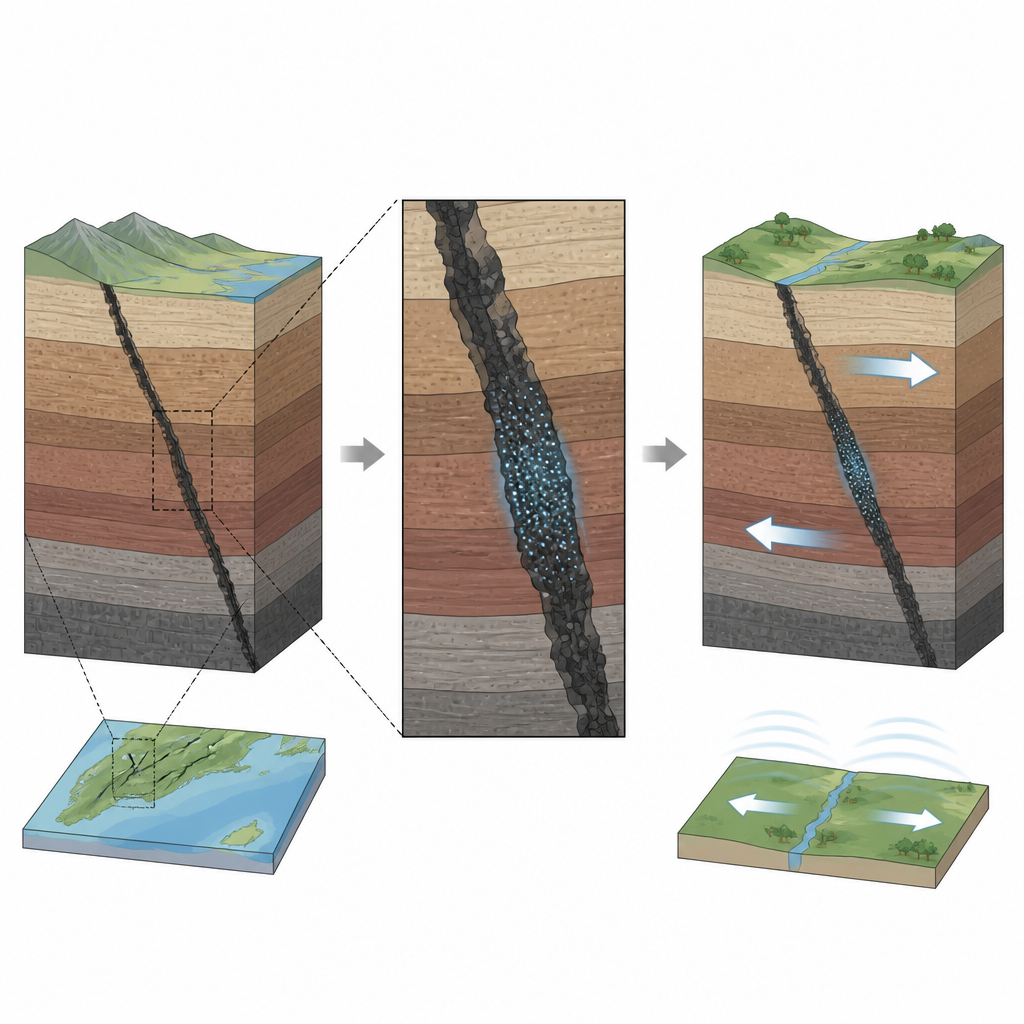
The Atotsugawa Fault System is one of Japan’s most active fault networks, stretching about 60 kilometers through the mountains of central Honshu. It has produced damaging earthquakes in the past, yet modern measurements show something puzzling. Instruments that track ground movement and small earthquakes indicate that a long central section of the fault is unusually quiet and appears to creep slowly at depths of 7 to 8 kilometers. Instead of building up strain for large quakes, this zone seems to slip gradually over time, suggesting that something deep in the fault makes it much weaker than ordinary rock.
A close look at the fault’s carbon
To uncover what makes this fault so weak, the researchers collected soft, crushed rock known as fault gouge, along with surrounding sandstone, from several locations along the fault system, including an underground tunnel that cuts directly through the active fault. Under the microscope, these gouges are dark and rich in carbon-bearing grains mixed with common minerals like quartz and clay. Using advanced Raman spectroscopy, the team could distinguish different forms of carbon and found that certain samples, especially those within the fault zones, contained a special kind of carbon material with a signature similar to graphene oxide.
Finding ultra-low friction graphene oxide
Graphene oxide is a chemically modified cousin of graphene, famous for its strength and electrical properties. Laboratory tests from materials science show that graphene oxide can have a friction coefficient around 0.01, far lower than typical rocks and even lower than ordinary graphite lubricant. Using X-ray photoelectron spectroscopy, the researchers showed that the carbon in selected fault gouge has the same types of chemical bonds and oxygen-containing groups as graphene oxide, with many hydroxyl groups on its surfaces. Transmission electron microscopy then revealed that this material occurs as single, sheet-like particles only a few billionths of a meter across, concentrated inside tiny cracks and along thin cleavage surfaces in the gouge. These sheets form nearly two-dimensional films rather than stacked layers, a structure ideal for slipping.
How slippery carbon changes fault behavior
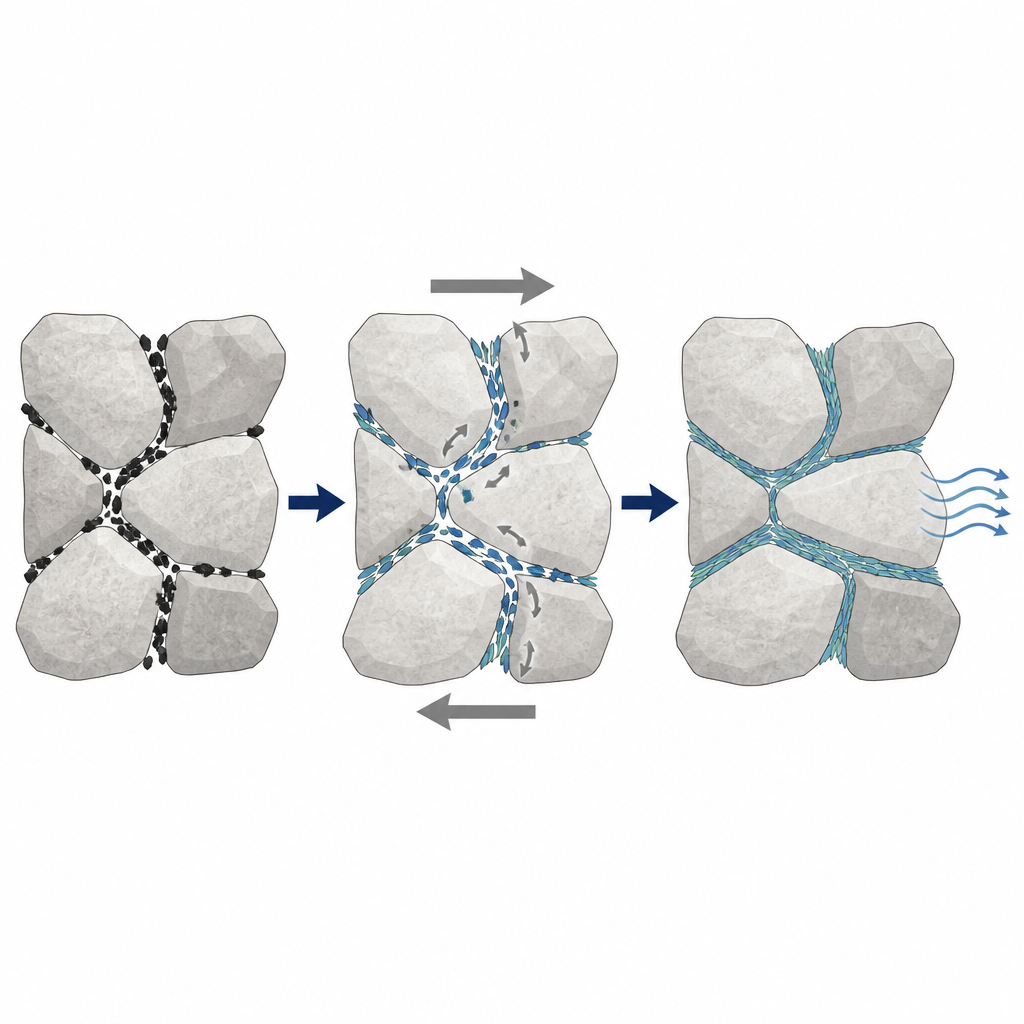
The team proposes that during fault movement, shearing and frictional reactions transform organic-rich carbon in the host rocks into graphene oxide and sweep it into microcracks between gouge grains. Once there, the nanosheets act like a lubricant film that prevents direct rock-to-rock contact, drastically lowering friction along key slip surfaces. Because the graphene oxide is rich in hydroxyl groups and can hold thin layers of water, it becomes even more effective at letting surfaces slide past one another. Calculations suggest that this material remains stable at temperatures below about 200 degrees Celsius, which matches the depth range of the low-seismicity, creeping segment of the fault system. In hotter or more strongly shaken portions of the crust, the graphene oxide would likely break down, so the ultra-slippery behavior may be confined to cooler, more gently deforming parts of the fault.
A quiet path for fault motion
By showing that natural fault rocks can host graphene oxide with extremely low friction, this study offers a concrete explanation for why some segments of the Atotsugawa Fault System creep rather than producing frequent large earthquakes. The presence of these nanoscale carbon sheets within microcracks can greatly weaken the fault, allowing slow, steady movement instead of sudden rupture. Over time, changes in how much graphene oxide is formed, preserved, or destroyed could help drive the shifting patterns of creep and locking seen in geodetic and seismological records, giving scientists a new way to connect deep mineral processes with the surface expression of earthquakes.
Citation: Shimada, T., Nagahama, H., Muto, J. et al. Ultra-low friction graphene oxide in the Atotsugawa Fault System. Nat Commun 17, 3861 (2026). https://doi.org/10.1038/s41467-026-72239-5
Keywords: graphene oxide, fault creep, earthquakes, fault friction, Atotsugawa Fault