Clear Sky Science · en
Immune-metabolic trajectories delineate subgroups in paediatric long COVID
Why this matters for kids and families
Most children bounce back quickly after a COVID-19 infection, but a small group continue to struggle for months or even years with tiredness, brain fog and other lingering problems. This study followed children and teenagers with long-lasting symptoms to uncover what is happening inside their bodies. By tracking their immune system and metabolism over time, the researchers show that paediatric long COVID is not one single condition but a set of overlapping pathways. That insight could help doctors move beyond treating just symptoms and work toward more targeted care and better clinical trials. 
Who was studied and what was measured
The team followed 74 children and adolescents with clear, ongoing symptoms after COVID-19 and compared them with 27 peers without long COVID. Participants were followed for up to 3.2 years after their initial infection. At two clinic visits, the children completed detailed questionnaires about fatigue, memory, mood and daily functioning, and performed tests such as a sit-to-stand exercise. Doctors also checked heart and lung function and collected blood to measure immune signals, autoantibodies, vitamin levels and other routine lab markers. This allowed the researchers to link how children felt in daily life with changes in their blood and organs over time.
What long COVID looked like in these children
Symptom burden was high and often persistent. Many children reported deep fatigue, difficulty concentrating, headaches, shortness of breath and sleep problems months after their infection. On average, there was little overall improvement in physical or mental health scores across the cohort, though some individuals got better and some worse. Heart scans and electrocardiograms were mostly normal, and lung function tests generally fell within age-appropriate ranges. A blood marker of nerve stress, called neurofilament light chain, usually stayed in the normal range but tended to be higher in children who were more severely impaired, hinting at subtle nervous system involvement in some cases. 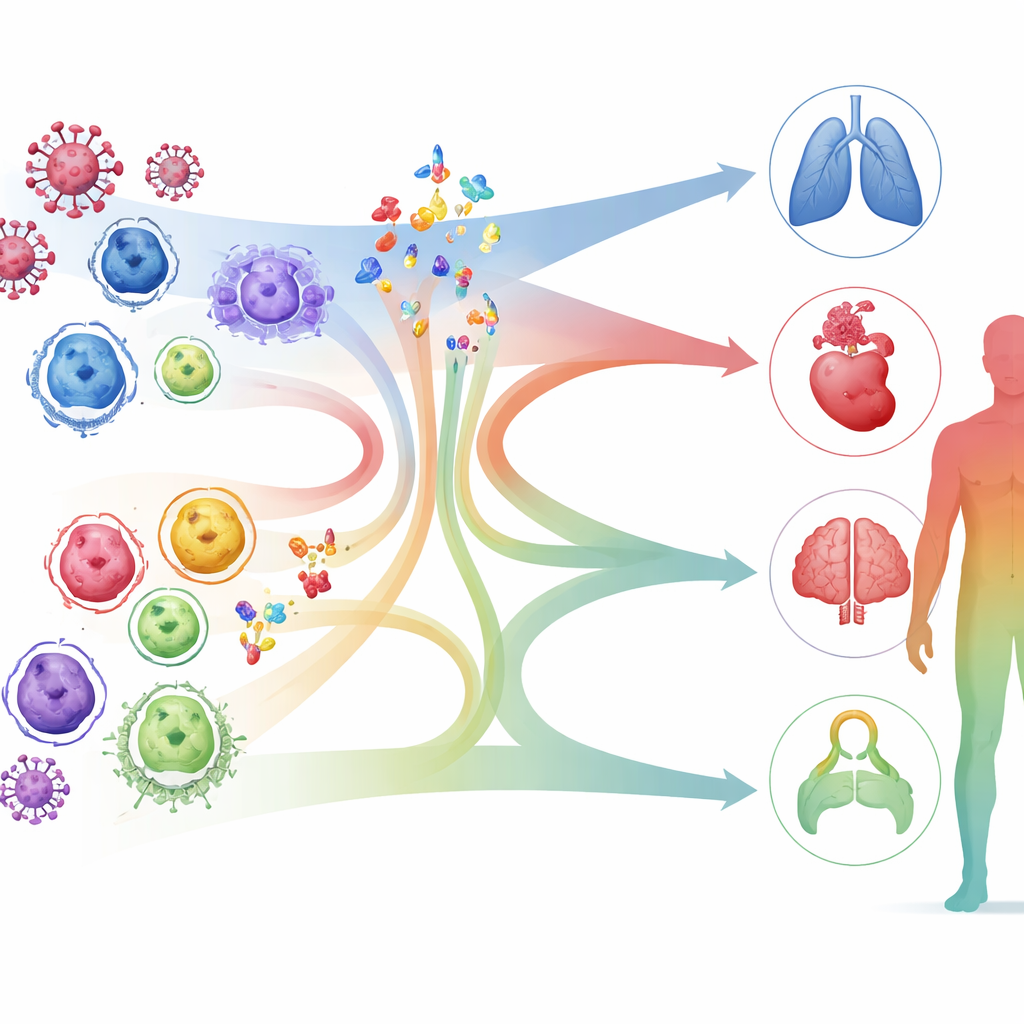
Hidden patterns in the immune response
When the researchers looked closely at immune messengers called cytokines, clear time patterns emerged. Within the first year after infection, children with long COVID showed strong antiviral and allergy-like signals, including elevated interferon and type 2 helper T-cell markers. Over time, the direct antiviral signature faded, but a different pattern persisted: a mix of innate inflammation and type 2/type 17 immune activity that suggests a smouldering, low-grade response rather than an active virus attack. Classic autoantibodies linked to autoimmune diseases were not enriched compared with controls, arguing against widespread full-blown autoimmunity as the main driver in this paediatric group.
Subgroups shaped by past infections and blood chemistry
The study identified several overlapping biological subgroups. Children who had previously been infected with Epstein–Barr virus (EBV), a common herpesvirus, showed a more inflammatory immune profile with higher levels of certain cytokines and neutrophils, but not more autoantibodies or worse mental health scores. Another subgroup was defined by an unusual autoantibody called anti-DFS70, which is often seen in benign conditions; these children had fewer blood clotting abnormalities, suggesting a possibly less harmful immune state. A third axis involved basic blood measures and vitamins: in children without prior EBV exposure, worse day-to-day function was linked to higher concentration of haemoglobin in red blood cells, while better function tracked with higher levels of an immune messenger (IL-12p40), more basophils (a type of white blood cell) and more vitamin B1, pointing toward an “immune–metabolic” route to recovery.
What this means for understanding and treating long COVID
To a lay reader, the main message is that long COVID in children is real, measurable and biologically diverse. Instead of finding one glaring problem, the researchers saw a set of shifting immune and blood patterns that change over the months after infection and differ from child to child. Heart damage, classic autoimmune disease and runaway clotting did not explain most cases. Instead, the picture is of an early antiviral surge that gradually gives way to long-lasting, low-level immune activation, with some children showing signs of more protective, repair-focused responses. Because many of the key markers can be measured in routine blood tests, this framework could eventually help doctors sort children into more precise groups, monitor who is on a path to recovery and design targeted treatments rather than relying only on trial and error.
Citation: Vilser, D., Han, I., Vogel, K. et al. Immune-metabolic trajectories delineate subgroups in paediatric long COVID. Nat Commun 17, 4023 (2026). https://doi.org/10.1038/s41467-026-72224-y
Keywords: paediatric long COVID, immune profiling, Epstein–Barr virus, cytokine patterns, biomarker stratification