Clear Sky Science · en
Large-magnitude events unlikely in induced earthquake sequences
Why small man-made quakes matter
As we increasingly inject fluids deep underground for energy production and to store carbon dioxide, we sometimes trigger earthquakes. People naturally worry that these human-induced quakes could grow into large, damaging events. This study looks at hundreds of such earthquakes from around the world to ask a simple question: when we trigger earthquakes, how big are they likely to get?
Counting small and large shakes
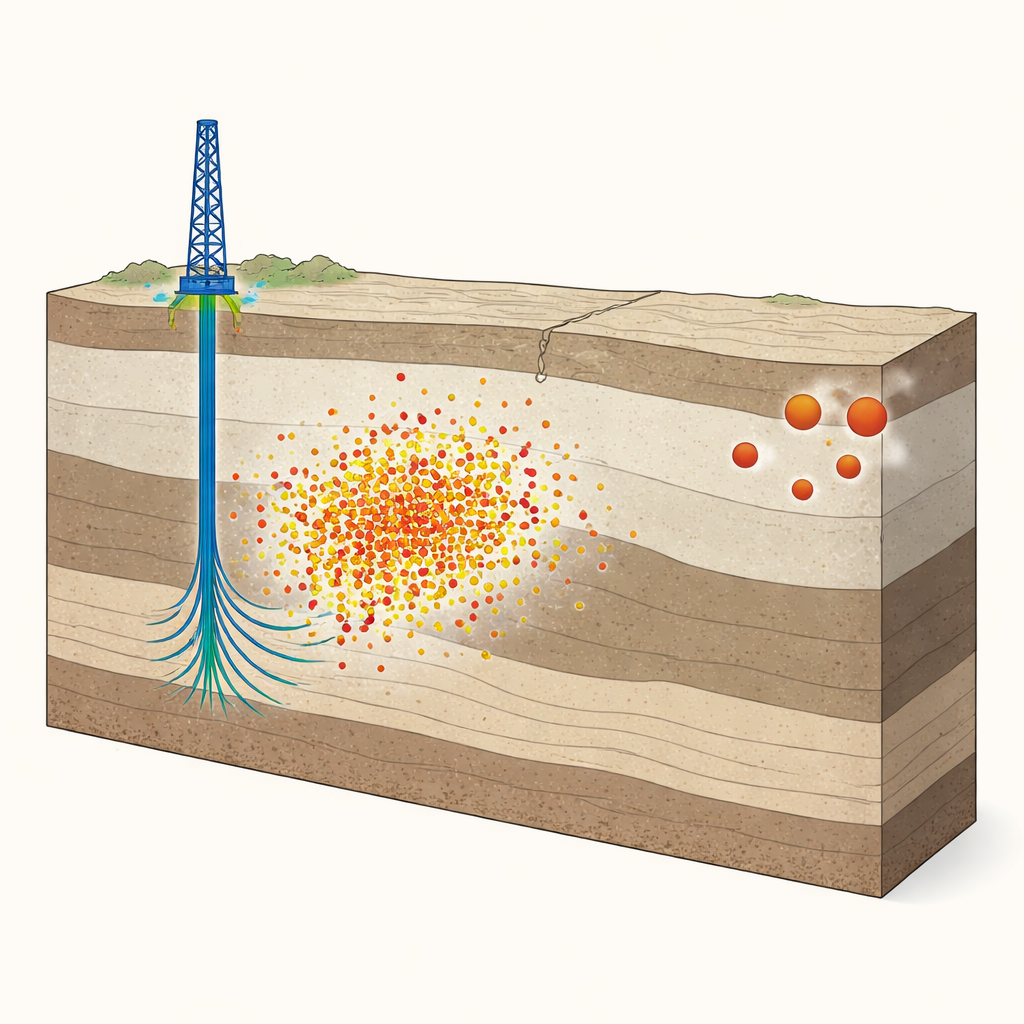
Earthquakes follow a well-known pattern: small ones are common, big ones are rare. For natural quakes, this pattern can usually be described by a smooth mathematical curve that falls off steadily as magnitude increases. The authors assembled detailed records from 38 cases where industrial activities—such as hydraulic fracturing, geothermal projects, wastewater injection, and underground gas storage—had clearly triggered earthquakes. They then tested whether these sequences followed the usual pattern or something different, carefully accounting for how well the events were recorded and how complete each catalog was.
When the usual rule breaks down
About half of the induced sequences did not follow the standard pattern. Instead, they showed a sharp drop in the number of larger earthquakes, meaning that big events were rarer than expected. A slightly modified statistical curve, called a “tapered” distribution, fit these cases much better. In these sequences, the chance of earthquakes bigger than about magnitude 2–3 fell off much faster than for ordinary tectonic activity. When the researchers used the standard curve, it systematically over-predicted how large the biggest quake should have been. The tapered curve, by contrast, matched the observed maximum sizes and reflected the fact that in many projects, magnitudes rarely exceed 2 or 3.
Clues from the shape of earthquake clouds
The team then asked what distinguished the sites that followed the tapered pattern from those that did not. They found that tapered cases tended to have shallower earthquakes and smaller volumes of rock affected by seismic activity. The spatial distribution of events was also more three-dimensional and irregular, resembling a cluster of short, crisscrossing cracks rather than a single neat fault plane. In contrast, sites that followed the standard pattern more often outlined simpler, flatter fault structures and produced larger maximum magnitudes. This suggests that in messy, disorganized fault networks, ruptures have trouble growing very large, which naturally caps the size of induced earthquakes.
Simulating how fluid changes the rules
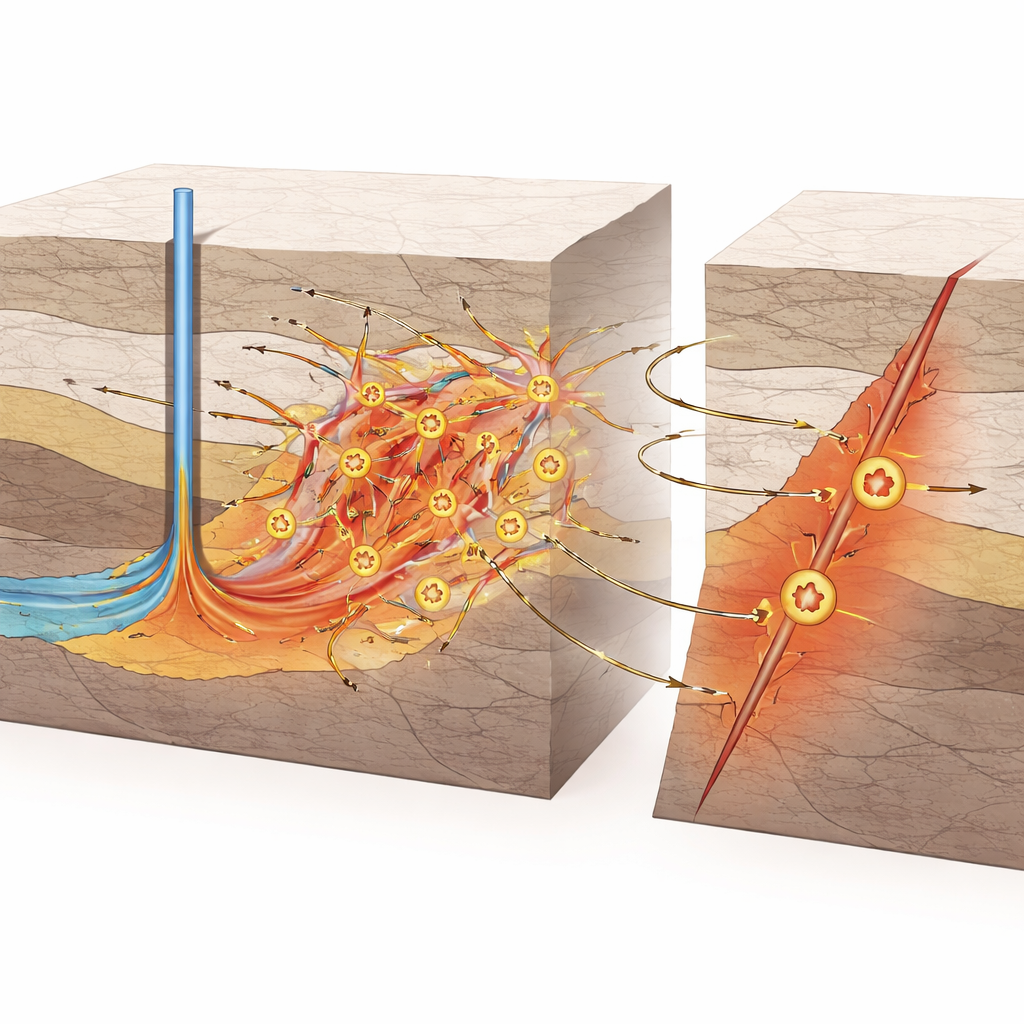
To probe the physics behind these patterns, the authors ran computer simulations of faults loaded both by steady tectonic forces and by localized fluid injection. On an idealized, uniform fault, adding fluid created a patch of uneven stress around the well. This uneven loading encouraged the nucleation of many small ruptures while making it harder for any one rupture to grow into a very large event. When they introduced realistic, rough variations in fault strength and stress, the simulations reproduced the observed spectrum of behaviors: nearby injection often favored swarms of smaller quakes, whereas broader, more distant stress changes could still allow larger ruptures on well-organized faults.
Watching risk evolve in real time
Building on these insights, the study proposes a practical way to monitor seismic risk during ongoing injection operations. Operators can start by assuming the usual pattern and estimating a safe injected volume for an acceptable maximum magnitude. As earthquakes are recorded, statistical tests track whether the data begin to favor a tapered pattern, which implies that large quakes are unlikely, or whether the standard pattern persists, which signals that damaging events remain possible. Case studies from a successful carbon storage project and a halted geothermal project show how this approach could have provided early guidance on risk as operations unfolded.
What this means for safety underground
For many injection projects, the findings are cautiously reassuring: induced earthquakes often stay smaller than once feared because complex fault networks and uneven stress around wells tend to limit rupture growth. However, the study also emphasizes that this is not guaranteed everywhere. Some sites still behave like natural faults capable of larger events, so dense local monitoring and real-time statistical checks are essential. Together, the results offer a more nuanced, evidence-based way to judge how risky a given project is likely to be, supporting safer development of geothermal energy, wastewater disposal, and carbon storage.
Citation: Li, L., Im, K. & Avouac, JP. Large-magnitude events unlikely in induced earthquake sequences. Nat Commun 17, 4192 (2026). https://doi.org/10.1038/s41467-026-72219-9
Keywords: induced earthquakes, fluid injection, seismic hazard, geothermal energy, carbon storage