Clear Sky Science · en
Dynamics of non-self-similar earthquakes illuminated by a controlled fault asperity
Why tiny lab quakes matter
Earthquakes come in many sizes, from small tremors to devastating megathrust events. For decades, seismologists have believed that most of them follow a simple rule: the bigger the quake, the longer it shakes, in a predictable way. Yet certain clusters of earthquakes stubbornly disobey this rule, releasing very different amounts of energy in almost the same amount of time. This study recreates such unusual quakes in the laboratory, allowing researchers to watch, in unprecedented detail, how miniature faults slip and why some earthquakes break the usual patterns. 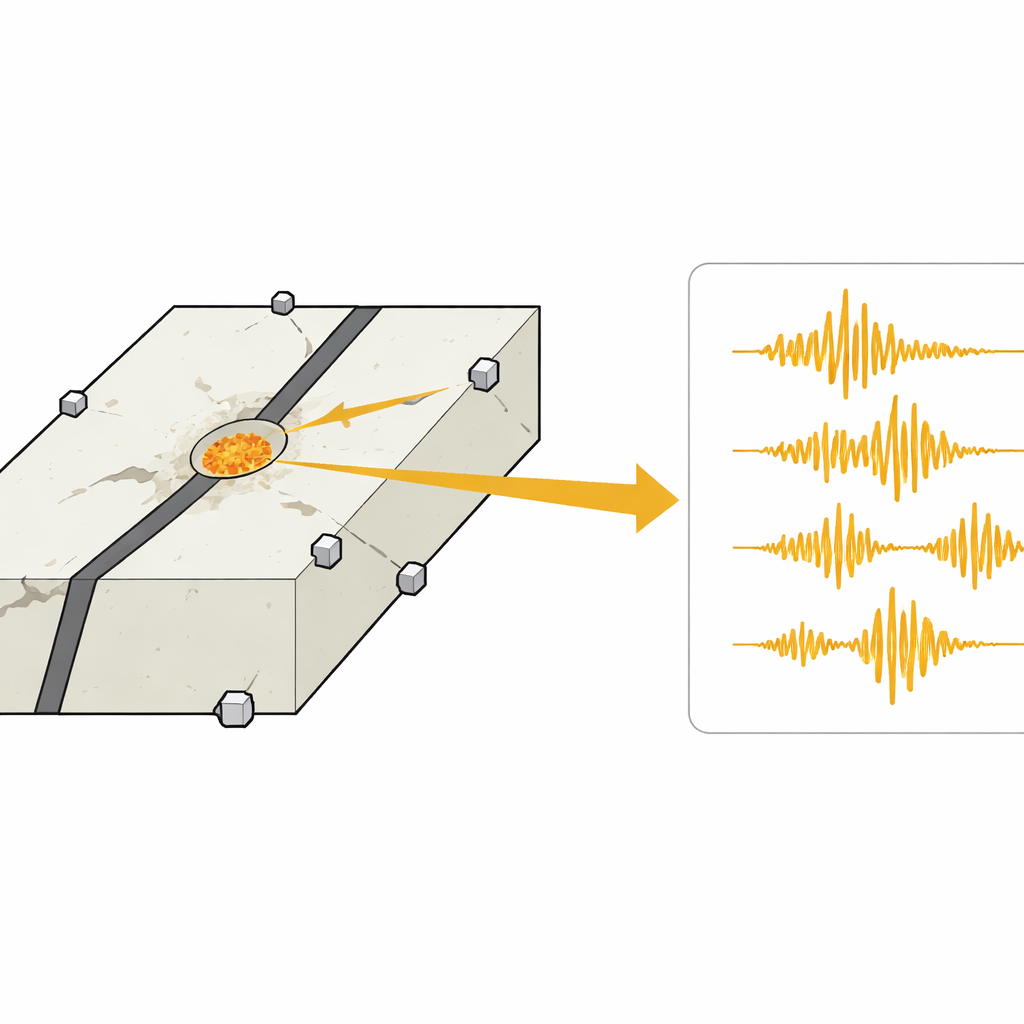
When the usual size rule breaks
In ordinary earthquakes, a quantity called seismic moment (a measure of total slip and fault area) and the duration of shaking scale together: roughly, if you increase the moment by a factor of a thousand, the source duration grows by about a factor of ten. This self-similar behavior suggests that earthquakes are like scaled-up versions of the same basic process. But several natural earthquake clusters—beneath California, Taiwan, Japan, and in fluid-injection fields—show nearly constant durations even as their moments vary widely. These so-called non-self-similar earthquakes hint at a different kind of fault behavior, but it has been difficult to prove that the effect is real rather than an artifact of imperfect instruments and complex geology along the wave path.
Building an artificial fault in the lab
To tackle this problem, the authors constructed a four-meter-long artificial fault by pressing two large rocks together in a powerful biaxial machine. Along this fault, they embedded seven tiny circular patches filled with pulverized rock, known as gouge, to mimic small, strong spots—or asperities—on a larger slipping surface. They then slowly loaded the system until it produced stick–slip events, the lab analogs of main shocks, along with numerous smaller foreshocks and aftershocks on the gouge patches. A dense array of acoustic and strain sensors recorded motions at very high frequencies, and the team carefully corrected the data for sensor response, coupling, and attenuation inside the rock, eliminating many of the uncertainties that plague field observations. 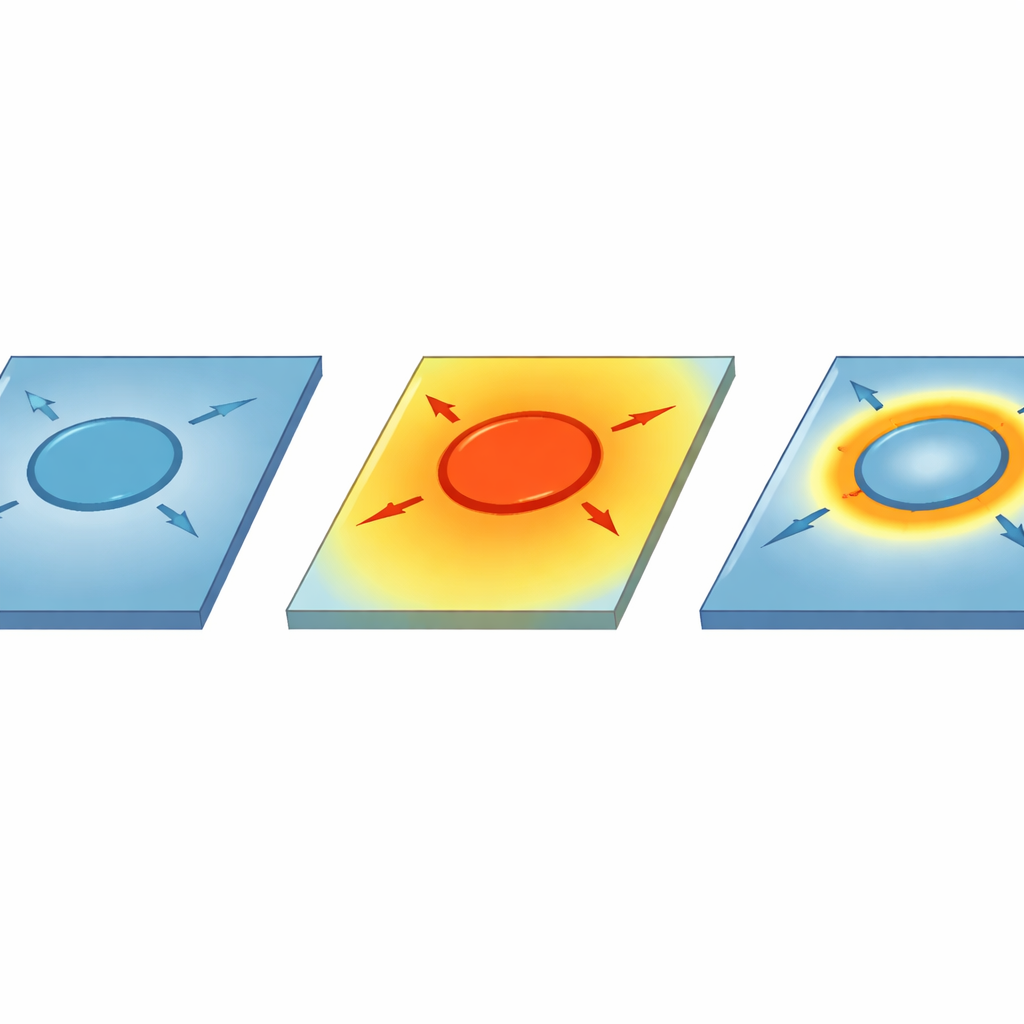
Tiny quakes with nearly fixed duration
On one particularly active gouge patch, the researchers identified a cluster of more than thirty small events spanning almost two orders of magnitude in seismic moment. Despite this wide range in size, most events had nearly the same source duration of about 2.5 microseconds. The team confirmed that this was not a limitation of their setup by finding a few even shorter-duration events, proving that their sensors and the rock itself could transmit higher-frequency signals. Detailed analysis of moment–duration trends, together with comparisons of spectral shapes, showed that these patch events truly deviated from the classic scaling law, closely resembling non-self-similar behavior reported for certain natural earthquake families.
Revealing the hidden fault mechanics
With the geometry and size of the gouge patch known, the researchers then built dynamic rupture simulations to reproduce the observed waveforms. They assumed that all events ruptured the same-sized patch but differed in how much shear stress was released during slip. Around the patch, the surrounding fault surface acted only as a weak barrier, so larger stress drops alone would normally lead to larger ruptures and longer durations—contrary to what was observed. The key ingredient that resolved this mismatch was a self-healing style of friction: as slip on the patch grows beyond a certain amount, the friction strength recovers, limiting further slip, especially at the center. This self-healing behavior, rooted in prior high-speed friction experiments and theoretical work, produces pulse-like ruptures that grow stronger (higher moment) without dramatically lengthening in time.
What this means for real earthquakes
The study shows that a fixed-size fault patch with variable stress drop and self-healing friction can naturally generate a family of earthquakes that share almost the same duration while differing greatly in size. This framework complements earlier ideas that relied on very strong barriers or special nucleation conditions and broadens the range of environments where non-self-similar quakes might appear—from major plate boundaries to volcanic and glacial settings. More broadly, it suggests that while an entire fault network may display self-similar behavior when viewed across many asperity sizes, individual patches can host their own non-self-similar families. Understanding these small, repeatable sources may help seismologists better interpret unusual scaling in earthquake catalogs and refine how they infer fault strength and slip behavior deep underground.
Citation: Okubo, K., Yamashita, F. & Fukuyama, E. Dynamics of non-self-similar earthquakes illuminated by a controlled fault asperity. Nat Commun 17, 3860 (2026). https://doi.org/10.1038/s41467-026-72217-x
Keywords: earthquake scaling, laboratory earthquakes, fault friction, dynamic rupture, asperity