Clear Sky Science · en
Conserved and divergent features of human mRNA decapping revealed by biochemical reconstitution
How Cells Decide When Messages Have Reached Their Expiration Date
Every cell in your body relies on tiny molecular messages called mRNAs to tell it which proteins to make, when, and how much. But just as important as creating these messages is knowing when to get rid of them. This study uncovers how human cells strip a protective “cap” from mRNA molecules—a decisive step that marks them for destruction—and reveals that humans use this system in ways that differ surprisingly from simple organisms like yeast.
Taking the Cap Off: A Critical Control Switch
mRNA molecules carry a special chemical cap on one end that protects them and helps launch protein production. When the cell wants to silence a message, it removes this cap in a process called decapping, after which the mRNA is quickly chewed up. The main cap-removing enzyme is a protein named DCP2. Until now, most of what we knew about DCP2 came from yeast, not humans, and often from incomplete or mixed protein samples. In this work, the researchers painstakingly rebuilt the human decapping system from scratch using purified, full-length proteins, then compared it head‑to‑head with the yeast machinery to see what is shared and what has changed over evolution. 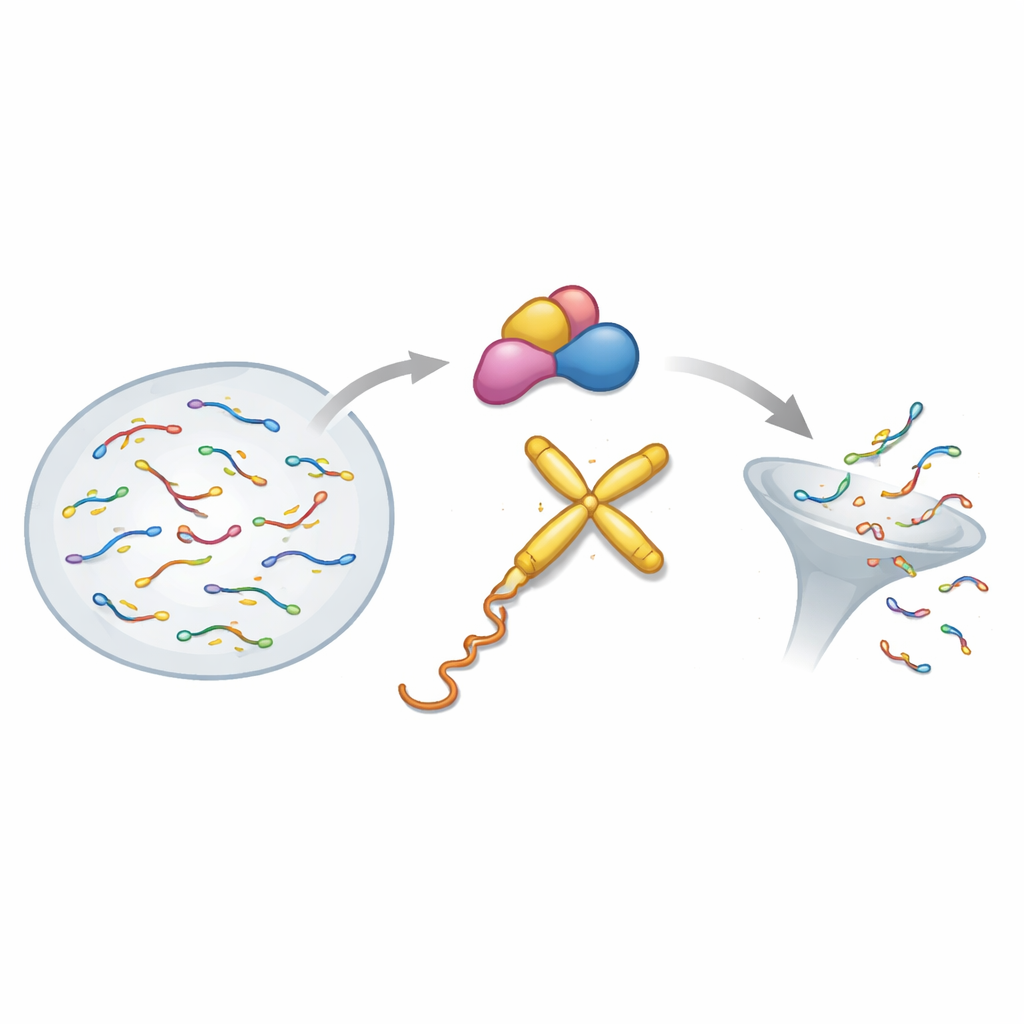
Human and Yeast Use the Same Tool in Different Ways
Yeast and humans both rely on DCP2, but its “tail” behaves very differently in the two species. In yeast, the long tail region at the end of Dcp2 actually dampens the enzyme’s activity, acting like an internal brake. When that tail is removed, the yeast enzyme becomes more active. In humans, the opposite is true: cutting off the tail of DCP2 makes it much worse at its job. The team showed that the human tail is packed with positive charges and is crucial for gripping the RNA body of the message. Without it, the enzyme can still touch the cap briefly, but it can’t hold the full mRNA firmly enough to work efficiently. Structural predictions support this picture, showing the human tail wrapping around RNA and pressing it against the main body of DCP2.
Helpers That Turn the Enzyme On, Not Just Hold It
Decapping in cells is not left to DCP2 alone—other proteins act as helpers and switches. One of these is DCP1, long thought to bind tightly to DCP2 and directly boost its activity, as seen in yeast. Using sensitive binding tests and single‑molecule mass measurements, the authors found that human DCP1 does not form a stable pair with human DCP2 and does not, by itself, speed up decapping. Instead, DCP1 mostly forms three‑part clusters (trimers) and can even build larger assemblies. Its key role is as a matchmaker: it brings in a separate enhancer protein called PNRC2. When PNRC2 and DCP1 are both present, they strongly stimulate human DCP2; when PNRC2 is added alone, it actually soaks up RNA and slows the reaction. A short motif in PNRC2 closely resembles a known activation motif in yeast, suggesting that while the cast of characters has changed, the basic script for turning DCP2 “on” is conserved.
Building Scaffolds for Decay Factories Inside the Cell
Another major player, EDC4, acts more like a structural hub than a direct catalyst. Inside cells, EDC4 is a core component of “P‑bodies,” droplets in the cytoplasm where many mRNAs are stored or destroyed. The researchers showed that the tail end of EDC4 naturally assembles into four‑part bundles (tetramers) through long coiled‑coil segments, and these tetramers can further stack into very large complexes. Microscopy reveals elongated shapes that match this model. A short, phenylalanine‑rich segment near the end of DCP2 fits snugly into a groove formed by the EDC4 tetramer, providing a docking site that recruits DCP2 to these hubs. Interestingly, adding EDC4 to the purified system did not speed up decapping and sometimes slowed it, pointing to its main role as an organizer and scaffold rather than a simple accelerator. 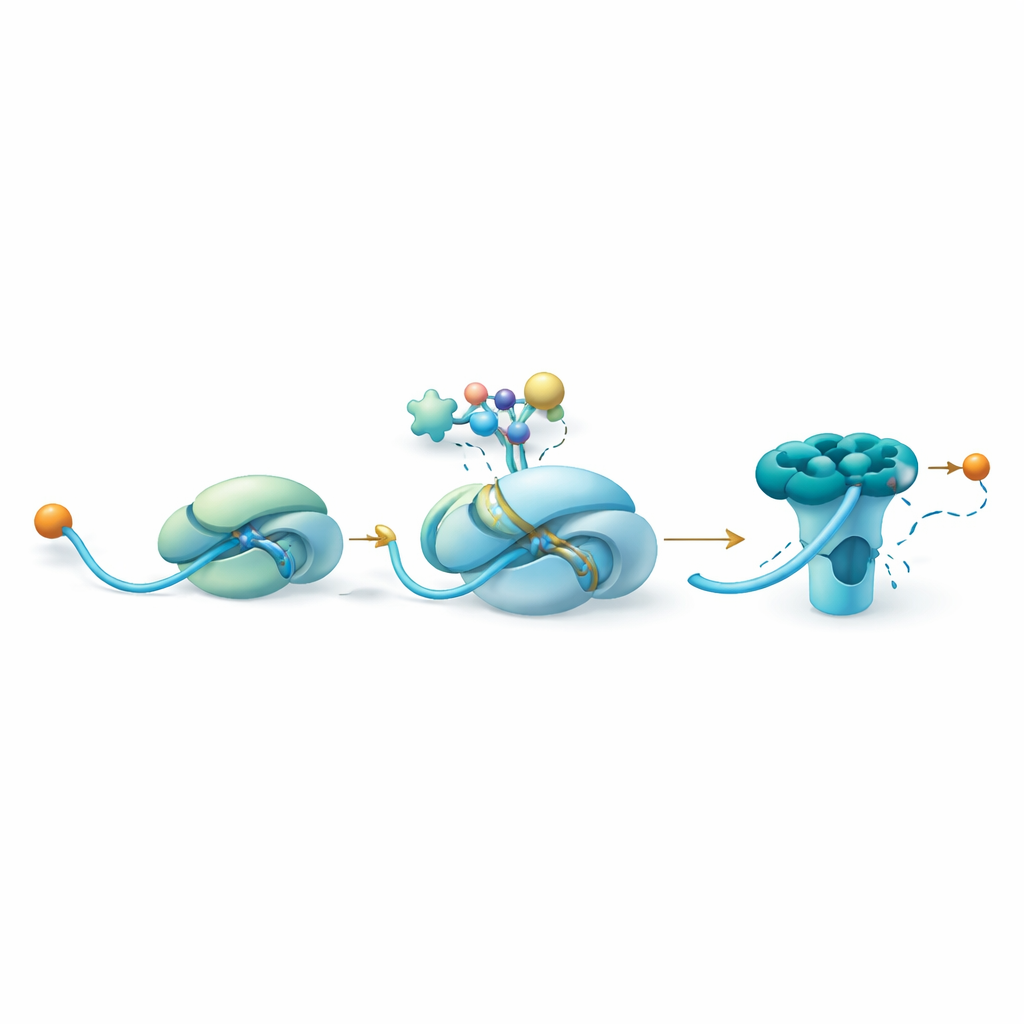
What This Means for Understanding Cellular Health
Together, these results show that human cells have re‑wired the same basic components found in yeast to create a more modular and flexible decapping network. The human DCP2 tail has shifted from a brake to a gripping handle for RNA, DCP1 has evolved into a trimeric adaptor that relays signals from enhancers like PNRC2, and EDC4 builds multivalent platforms that concentrate decay factors in specialized droplets. For non‑specialists, the key message is that turning off genetic messages is just as carefully engineered as turning them on, and small structural differences in these molecular machines can have big consequences for how cells respond to stress, infection, or errors in gene expression.
Citation: Simko, E.A.J., Muthukumar, S., Myers, T.M. et al. Conserved and divergent features of human mRNA decapping revealed by biochemical reconstitution. Nat Commun 17, 3697 (2026). https://doi.org/10.1038/s41467-026-72177-2
Keywords: mRNA decay, RNA decapping, DCP2 enzyme, P-bodies, gene regulation