Clear Sky Science · en
Breakdown of microbial networks links nutrient stress and reef coral disease
Why Sick Corals Matter to All of Us
Coral reefs are often called the rainforests of the sea. They shelter a quarter of all marine species and protect coastlines that millions of people call home. Yet strange dark bands that slowly kill corals are appearing more often around the world. This study asks a simple but urgent question: why are these band-like diseases spreading, and what does fertilizer pollution have to do with it?
When Food Becomes a Problem
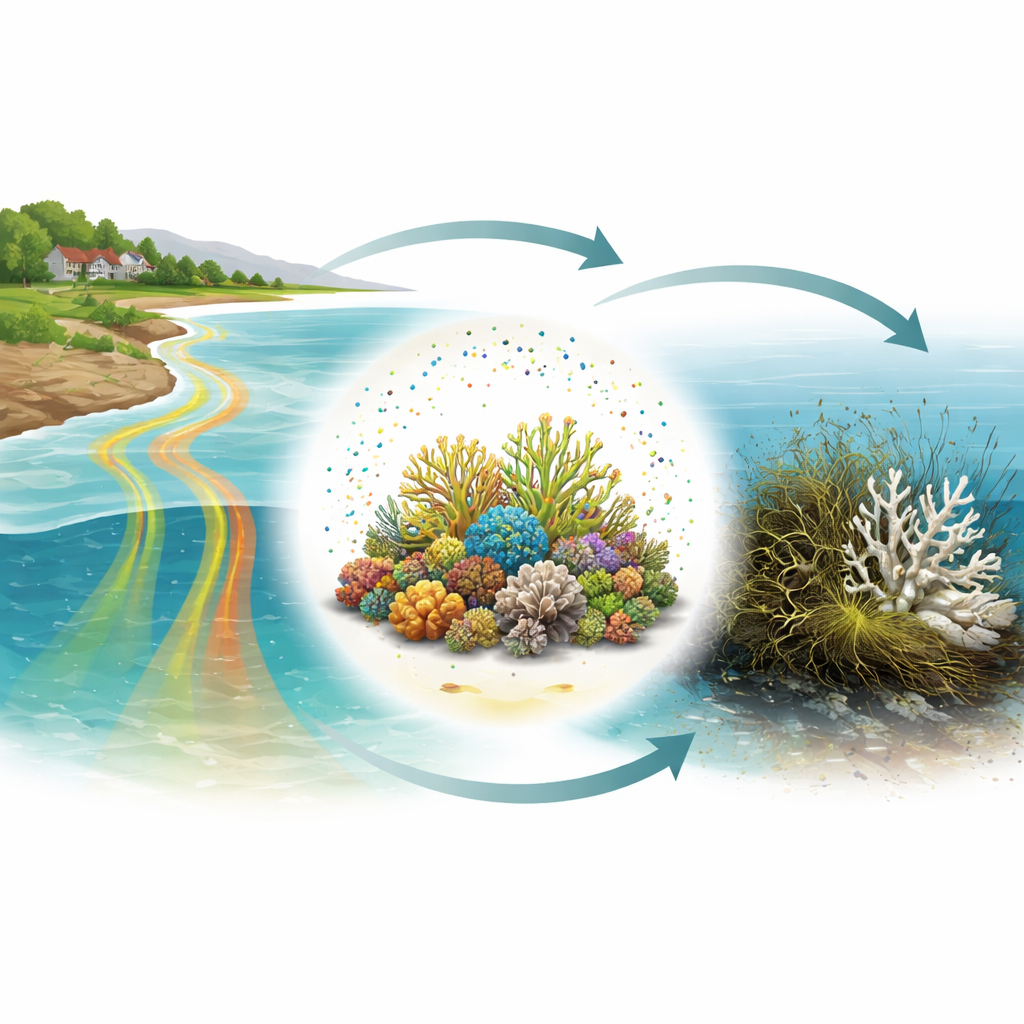
Corals thrive in naturally low-nutrient tropical waters, living in tight partnership with microscopic algae and bacteria. Modern life, however, is changing the recipe of the sea. Runoff from farms, cities, and rivers can overload coastal waters with forms of nitrogen and phosphorus, the basic ingredients of plant fertilizer. The researchers focused on a common coral illness called Black Band Disease, which leaves behind a moving strip of dark microbes and bare white skeleton. By looking at both controlled aquarium experiments and global records of outbreaks, they explored how an imbalanced mix of nitrogen and phosphorus might tip coral ecosystems from health to disease.
A Lab Reef Under Nutrient Stress
In the laboratory, the team grew colonies of the plate-like coral Turbinaria reniformis under three types of water chemistry. One had a balanced ratio of nitrogen to phosphorus, similar to naturally nutrient-rich but healthy reefs. The other two were skewed in opposite ways: one was strongly nitrogen-limited and the other strongly phosphorus-limited. Corals in balanced water stayed healthy for the full 73-day experiment. In contrast, corals in the skewed treatments developed tissue wounds surrounded by a dark, slimy band that crawled across the colony, closely matching the appearance of Black Band Disease in the wild. These diseased corals lost tissue much faster when phosphorus was scarce, and their symbiotic algae showed clear signs of stress.
The Hidden World of Coral Microbes
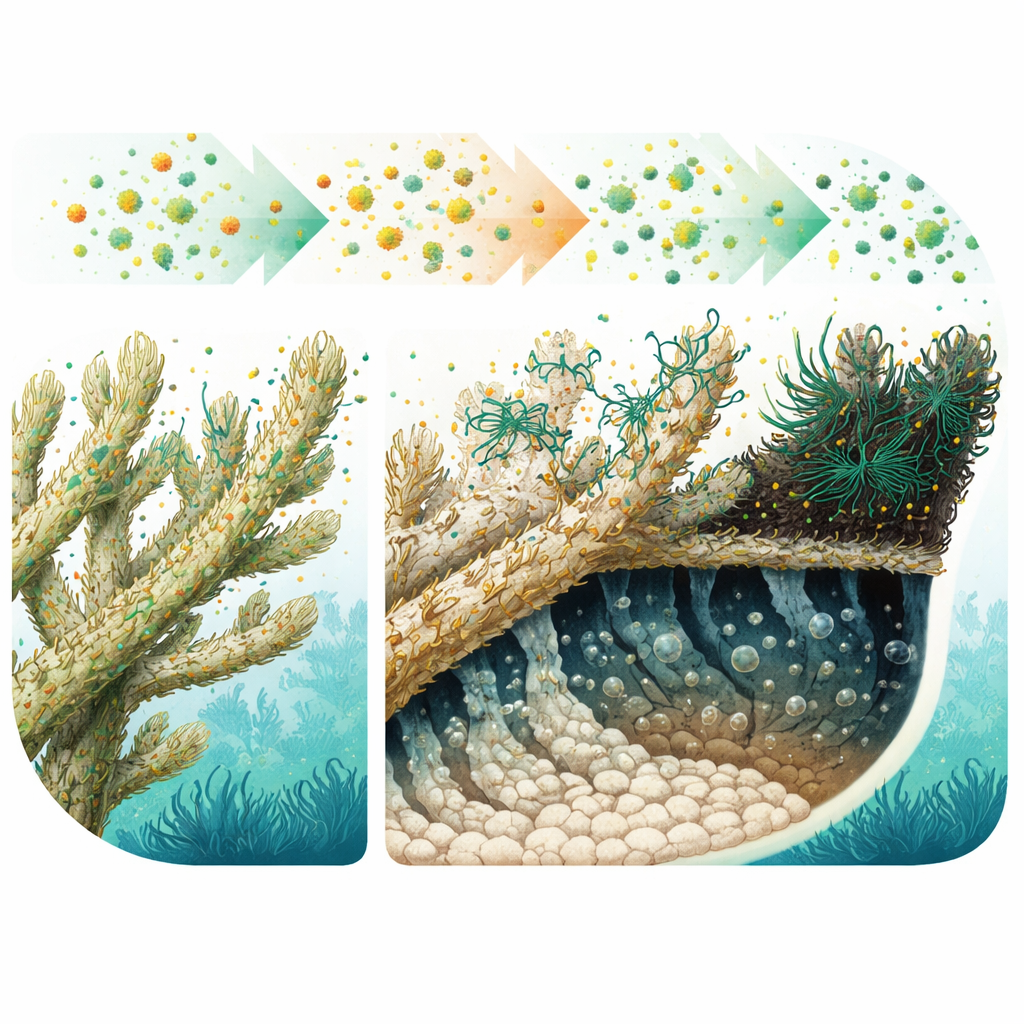
To see what was happening behind the scenes, the scientists sequenced the DNA of bacteria and other microbes living on the coral surface, inside the dark band, and in surrounding seawater. Even when corals looked healthy, their microbial communities shifted under skewed nutrients. The usually well-connected web of bacteria around the coral broke into smaller, isolated clusters, suggesting a loss of stability and cooperation. Certain cyanobacteria—photosynthetic microbes often involved in Black Band Disease—grew 10 to 32 times more abundant under imbalanced conditions. These same types of cyanobacteria dominated the dark microbial mats on the lesions, joined by sulphur-processing bacteria that can generate toxic sulphide in low-oxygen zones. Strikingly, many of these disease-related microbes were already present in visually healthy coral tissue, implying that the coral’s own microbiome can become a source of opportunistic infection when the environment changes.
A Global Pattern in Reef Outbreaks
Beyond the aquarium, the researchers compiled more than 200 reported Black Band Disease events worldwide from the last two decades. They matched each location with satellite-based temperature records and global maps of seawater nitrogen and phosphorus. Only about 16 percent of outbreaks followed strong heat stress, the kind usually blamed for coral bleaching. In contrast, about 88 percent occurred in waters where the nitrogen-to-phosphorus ratio was far from the natural range for healthy, nitrogen-limited reefs—either much lower or much higher. Florida’s reefs, which have experienced repeated disease episodes, sit in waters with especially extreme nutrient ratios, influenced by nutrient-rich runoff and river discharge.
What This Means for Reefs and People
This work shows that Black Band Disease is not simply the result of a single invading germ. Instead, it often emerges when human activities distort the basic nutrient balance of the sea. Under those conditions, the delicate network of helpful coral microbes unravels, and resident cyanobacteria and other opportunists seize the chance to form deadly mats. For reef managers and coastal planners, the message is clear: keeping nitrogen and phosphorus in balance, and reducing overall nutrient pollution, may be one of the most effective levers we have to curb coral diseases. Protecting that invisible microbial web could help keep reefs—and the communities that rely on them—alive in a rapidly changing ocean.
Citation: Gracie, R., Wiedenmann, J., Lam, P. et al. Breakdown of microbial networks links nutrient stress and reef coral disease. Nat Commun 17, 3821 (2026). https://doi.org/10.1038/s41467-026-72175-4
Keywords: coral disease, nutrient pollution, microbiome, black band disease, reef conservation