Clear Sky Science · en
Direction-specific enhanced diffusion of CO2 in chiral hexagonal boron nitride nanotubes
Why straighter paths for gas matter
Separating carbon dioxide from other gases is central to cleaning up industrial emissions, but today’s membranes often force molecules to wander like people in a crowded room. This study explores a new way to give carbon dioxide a much straighter path, using tiny twisted tubes made from boron and nitrogen. By gently steering how molecules move inside these tubes, the researchers show that it may be possible to build future filters that are both faster and more selective than those used today.
Guiding gas inside tiny tunnels
Most gas-separation materials let molecules move by random jostling, a process called Brownian motion, where they constantly bounce, tumble, and change direction. The authors wondered whether they could instead coax carbon dioxide to move more like a spinning top following a stable path. They turned to hexagonal boron nitride nanotubes, which are hollow cylinders a few atoms wide. When these tubes are made with a twist, known as chirality, their atomic pattern spirals along the tube, creating a faint rotating electric landscape on the inner wall that can nudge passing molecules into more orderly motion. 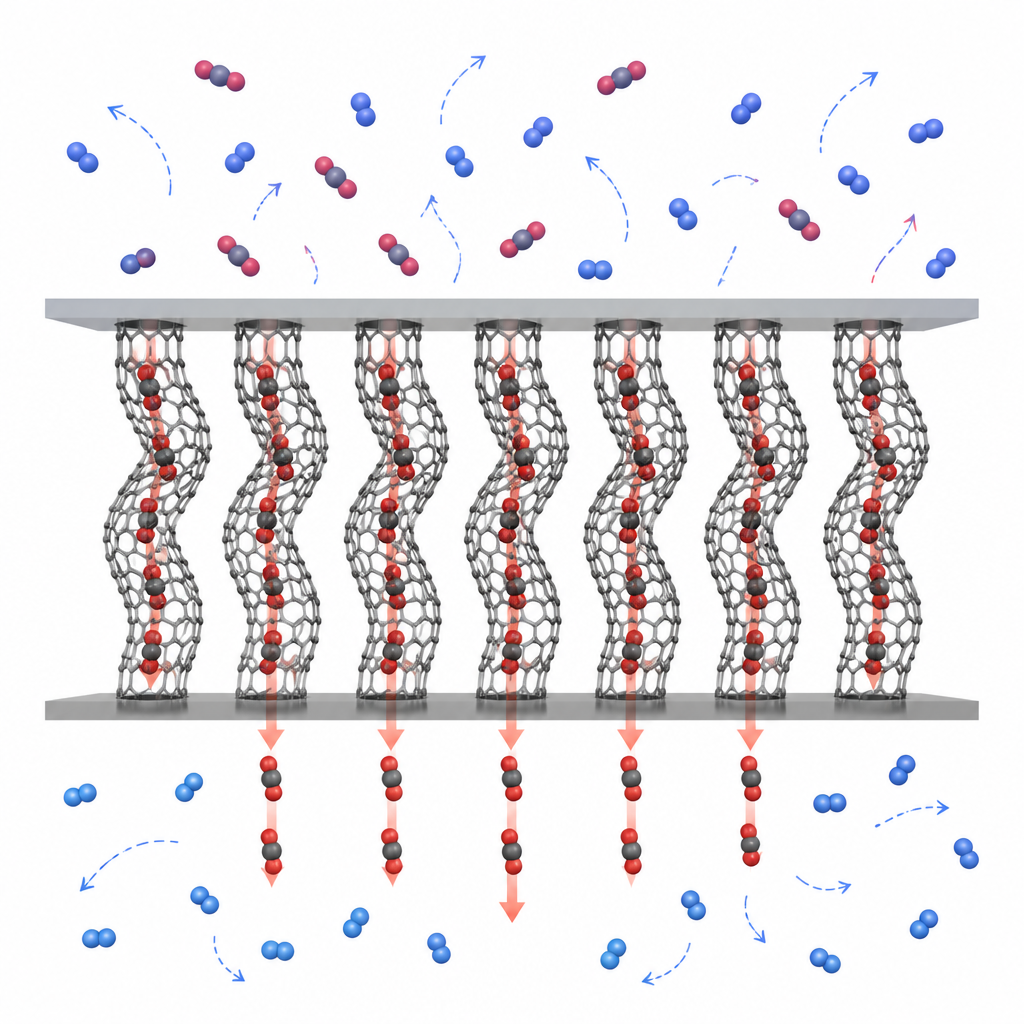
Making carbon dioxide spin the right way
Carbon dioxide molecules are normally straight and symmetric, which makes them hard to steer. Inside very narrow nanotubes, however, the molecule bends slightly and its electrons rearrange, giving it small “fins” that can interact with the tube walls. Using advanced computer simulations powered by machine-learned atomic models, the team showed that in chiral nanotubes this bent carbon dioxide can precess, meaning its axis slowly traces a cone as it moves forward. This precession keeps the molecule largely aligned with the tube’s length, reducing the chance of bumping sideways into the walls and losing forward progress.
Twist matters more than size
The researchers compared several nanotubes that had similar diameters but different atomic patterns: some straight, some twisted. They found that one particular chiral tube, labeled (7,3), offered an especially effective combination of size and twist. In this tube, carbon dioxide moved along the axis more than 20 times farther before reversing direction than in a non-chiral tube of almost the same width. Overall, its diffusion rate was about 3.4 times faster than that of nitrogen, even though nitrogen molecules are smaller. The key was not just how tight the tube was, but how smooth or rough the internal electrical landscape appeared along its length; chiral tubes presented a smoother path, while non-chiral tubes trapped molecules in repeating energetic “potholes.” 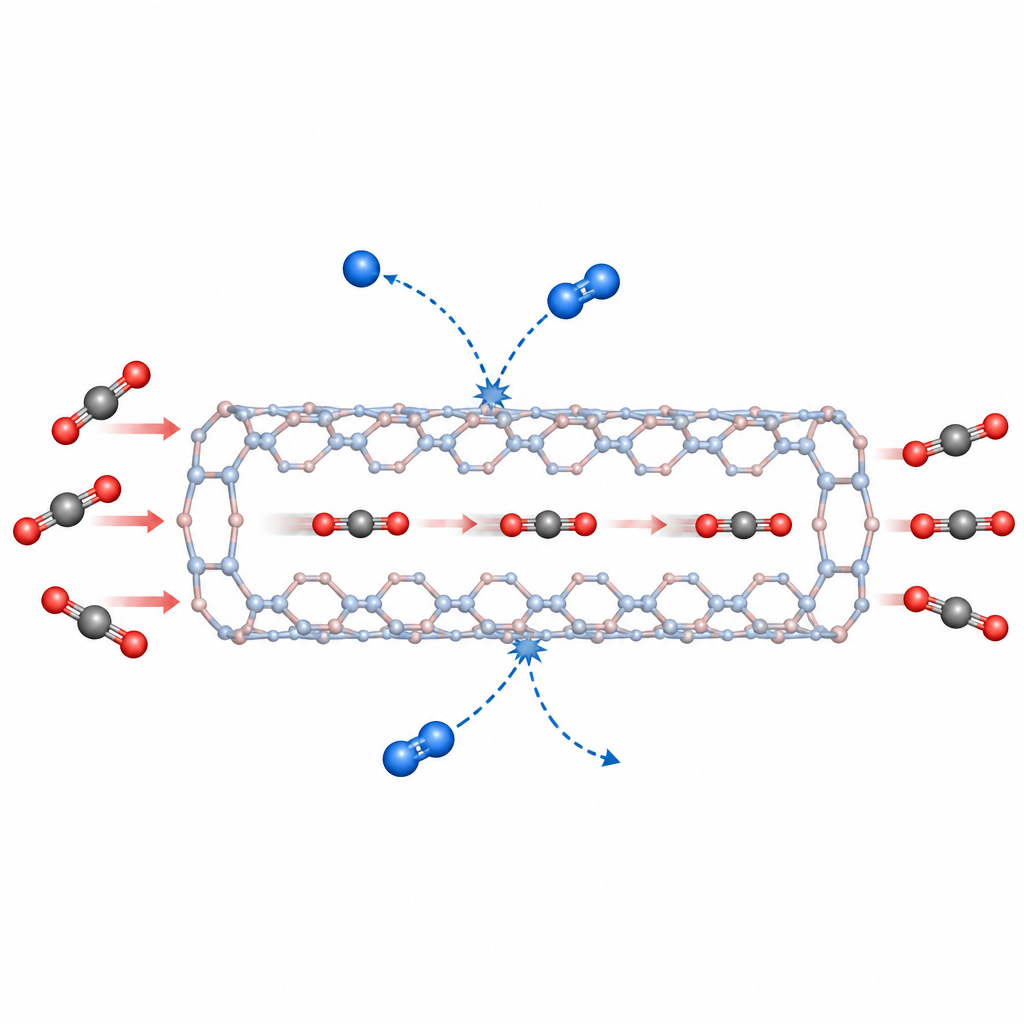
Beyond simple wall banging
At these tiny scales, traditional ideas that treat gas molecules as billiard balls bouncing off rigid walls begin to break down. The study shows that interactions between the molecules and the flexible nanotube walls, amplified by the twist, can create localized deformations that effectively pull carbon dioxide forward while leaving nitrogen behind. This behavior goes beyond the usual Knudsen diffusion model, which predicts motion based only on pore size and mass. In chiral tubes, carbon dioxide’s ability to bend and precess works together with the tube’s spiral pattern to minimize sideways collisions, giving it a kind of guided, direction-specific motion that standard theory does not capture.
What this could mean for future membranes
To test the practical impact, the authors modeled a sheet-like membrane made from many aligned (7,3) nanotubes packed closely together. Their calculations suggest that such a membrane could combine very high carbon dioxide flow with strong preference over nitrogen, far above the performance limit seen in today’s polymer membranes known as the Robeson upper bound. Even when more realistic porosity and path tortuosity were included, the predicted performance still exceeded current benchmarks. The team also notes that similar twisted pathways may already be at work in carbon nanotubes that move water unusually quickly, hinting that this mechanism could apply to other small molecules as well.
A new path toward cleaner separations
In everyday terms, this work shows how reshaping the tiny tunnels that gases travel through, and gently tilting how the molecules spin, can turn random motion into more directed flow. Although these results come from simulations and still await experimental confirmation, they point to a future where filters and membranes do not just sieve by size, but actively guide chosen molecules along preferred paths. If realized in real materials, direction-specific diffusion in chiral nanotubes could help cut the energy cost of separating carbon dioxide from nitrogen and, potentially, improve a wide range of gas separation technologies.
Citation: Nguyen, MT., Heldebrant, D.J., Liu, J. et al. Direction-specific enhanced diffusion of CO2 in chiral hexagonal boron nitride nanotubes. Nat Commun 17, 4771 (2026). https://doi.org/10.1038/s41467-026-72123-2
Keywords: carbon dioxide separation, nanotubes, gas diffusion, membranes, molecular transport