Clear Sky Science · en
Amazonian understory forests change phosphorus acquisition strategies under elevated CO2
Why this hidden forest story matters
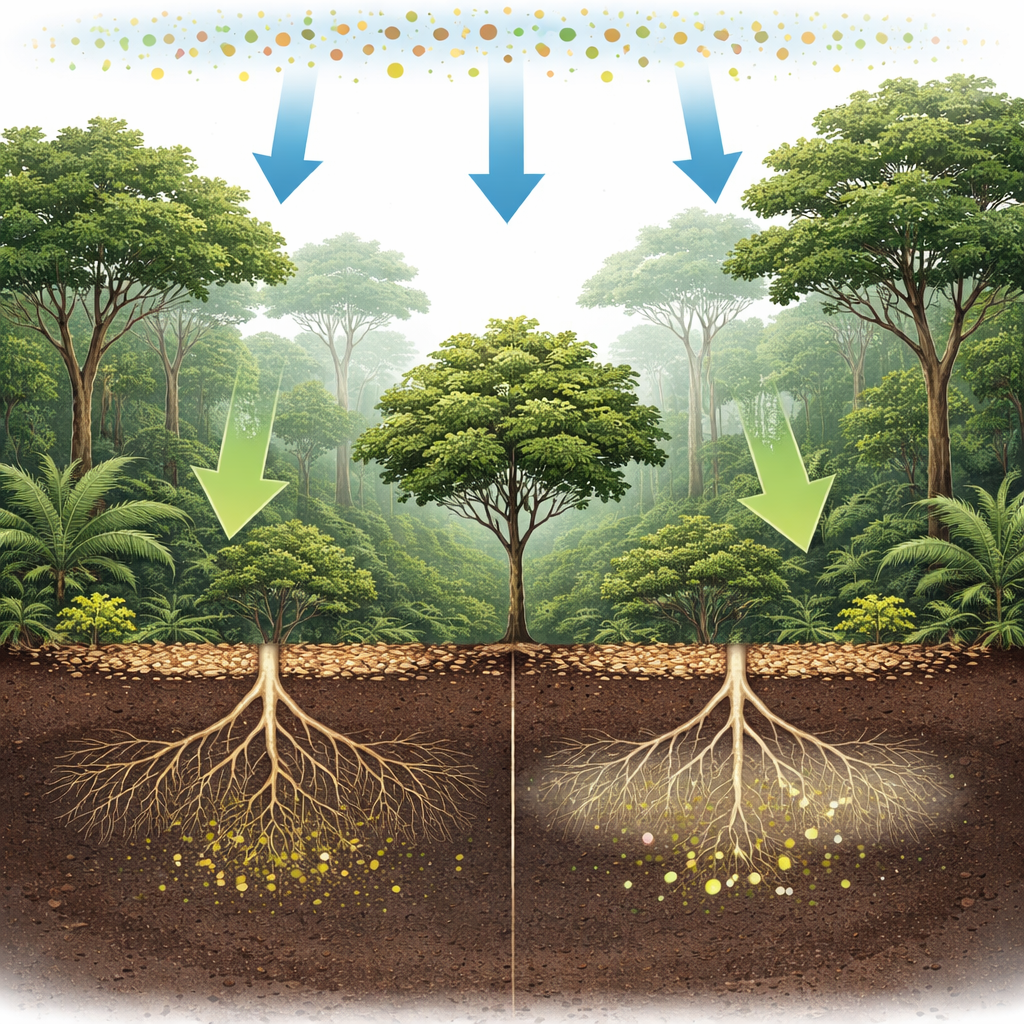
Deep under the towering trees of the Amazon, a quieter drama is playing out in the shade. As carbon dioxide in the air keeps rising, scientists want to know whether this vast forest will keep absorbing carbon or eventually slow down. That answer does not just depend on leaves and trunks—it hinges on how roots and soil share a scarce nutrient called phosphorus. This study peeks into the understory of the Amazon, where small trees grow in dim light on some of the most phosphorus-poor soils on Earth, to see how they adjust their underground strategies when carbon dioxide levels rise.
Extra carbon, tight nutrient budget
Computer models often assume that more carbon dioxide in the air will act like fertilizer, making forests grow faster and soak up more carbon. But in much of the Amazon, phosphorus in the soil is in short supply, and plants and microbes must work hard to get it. Earlier work at this same site showed that shaded understory trees actually did grow faster under higher carbon dioxide, with more leaves, thicker stems, and greater carbon intake. The puzzle was how they managed this growth spurt without easy access to extra phosphorus. The new experiment set out to trace what happens below ground when carbon dioxide in the understory air is raised by about 300 parts per million, similar to levels expected later this century.
A field experiment inside the forest
The researchers built eight clear-walled, open-top chambers on the forest floor, each just a few meters wide and tall, to encircle natural communities of understory trees. In half of these chambers, air with extra carbon dioxide was pumped in during daylight hours; the others stayed at normal levels for comparison. The soil under these small forest patches is extremely weathered and acidic, with most phosphorus locked up in forms that plants cannot easily use. Over two years, the team tracked fine roots in the leaf litter and in the top 15 centimeters of soil, measured root shapes, monitored partnerships with helpful fungi, and analyzed how phosphorus moved among litter, soil, microbes, and roots.
Two root strategies, one goal
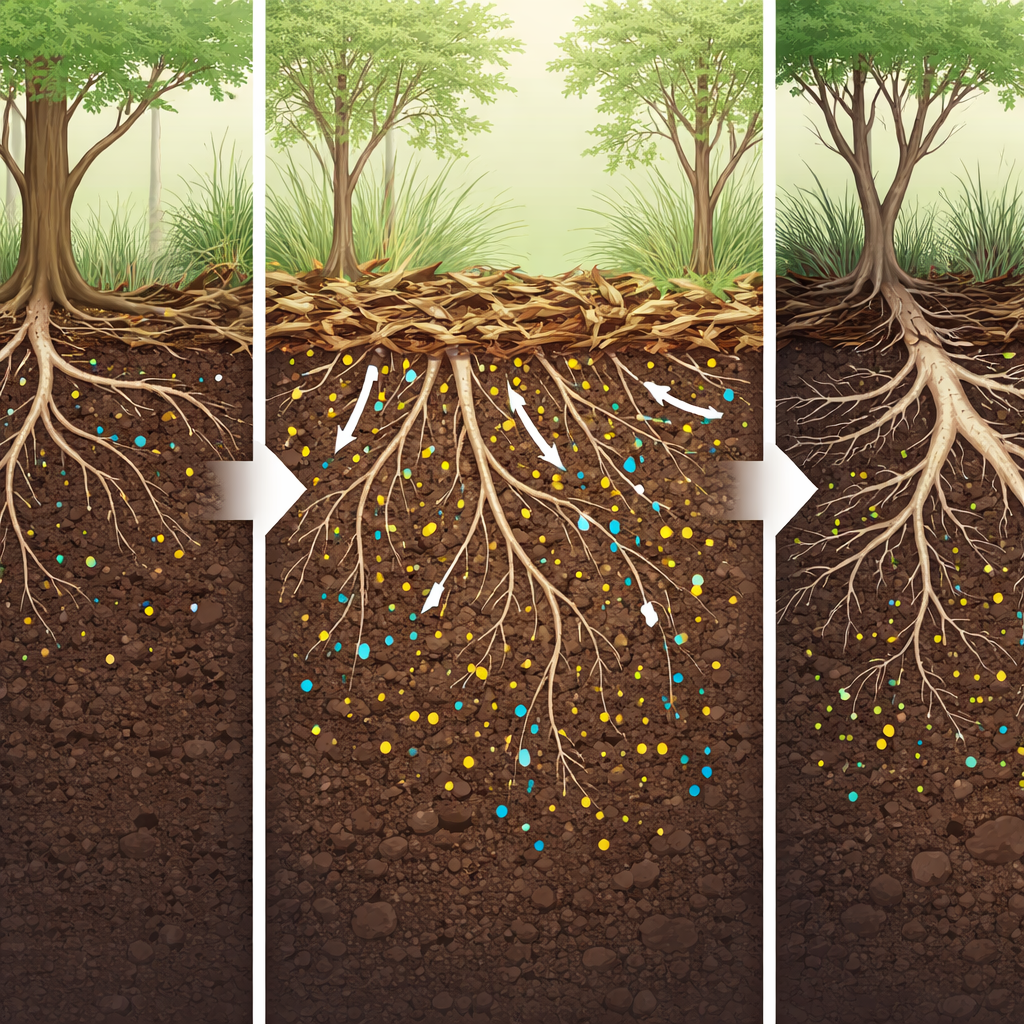
The understory plants responded to extra carbon dioxide in strikingly different ways depending on where their roots were. In the fresh leaf litter lying on the surface, fine roots kept producing roughly the same total mass, but they became longer, thinner, and more branched. This change increases the surface area that touches decaying leaves, helping roots explore more space and capture phosphorus as it is released. This "do-it-yourself" approach makes the litter layer a highly active nutrient-mining zone. Deeper in the mineral soil, however, fine roots told a different story: their productivity dropped sharply, but their tissues became denser and lived longer, and they were much more heavily colonized by arbuscular mycorrhizal fungi—microscopic partners that extend the reach of roots with networks of filaments. Here, plants appeared to "outsource" the search for phosphorus to these fungal allies instead of building lots of new fine roots.
Shifting soil nutrients and rising competition
These underground shifts were accompanied by notable changes in the soil’s phosphorus pools. Under elevated carbon dioxide, the amount of organic phosphorus in the soil—the large, slow-moving reserve—fell by nearly 80 percent, especially in the more resistant forms. Yet the more directly available inorganic phosphorus and phosphorus stored in microbial biomass did not increase in step, hinting that plants, fungi, and microbes were tightly competing for what was released. Enzymes in the soil that normally help break down carbon-rich compounds became less active relative to those involved in phosphorus cycling, suggesting that microbes were adjusting their efforts toward finding phosphorus rather than more carbon. Over time, decomposing leaf litter also showed lower phosphorus concentrations even though its breakdown rate did not change, implying that roots were successfully skimming phosphorus out of litter as it decayed.
What this means for the future of the Amazon
Taken together, the study shows that Amazonian understory trees can temporarily support faster growth under higher carbon dioxide by reshaping their root systems and leaning more on fungal partners to squeeze phosphorus out of both litter and soil. This intensifies nutrient recycling but does not create new phosphorus—the same limited stock is simply turned over more quickly and fought over more fiercely. In the short term, this flexibility may help the forest keep acting as a carbon sink, but if phosphorus demand continues to rise faster than supply, growth could eventually be choked by nutrient shortages. Because the Amazon is central to Earth’s climate, understanding these hidden root–soil maneuvers is essential for predicting how long the forest can buffer us against rising carbon dioxide.
Citation: Martins, N.P., Fuchslueger, L., Lugli, L.F. et al. Amazonian understory forests change phosphorus acquisition strategies under elevated CO2. Nat Commun 17, 3740 (2026). https://doi.org/10.1038/s41467-026-72098-0
Keywords: Amazon forest, phosphorus limitation, elevated CO2, root traits, plant–microbe interactions