Clear Sky Science · en
Sex-specific behavioral feedback modulates sensorimotor processing and drives flexible social behavior
How Flies Help Explain Social Flexibility
Many social animals must quickly adjust their behavior based on how a partner responds. This study uses the humble fruit fly to ask a surprisingly deep question: how can a brain follow simple internal rules, yet still produce rich, flexible social behavior? By comparing how male flies court females versus other males, the researchers show that small differences in feedback from the partner can reshape the entire social exchange without changing the underlying "rules" in the brain.
Two Kinds of Courtship, One Set of Moves
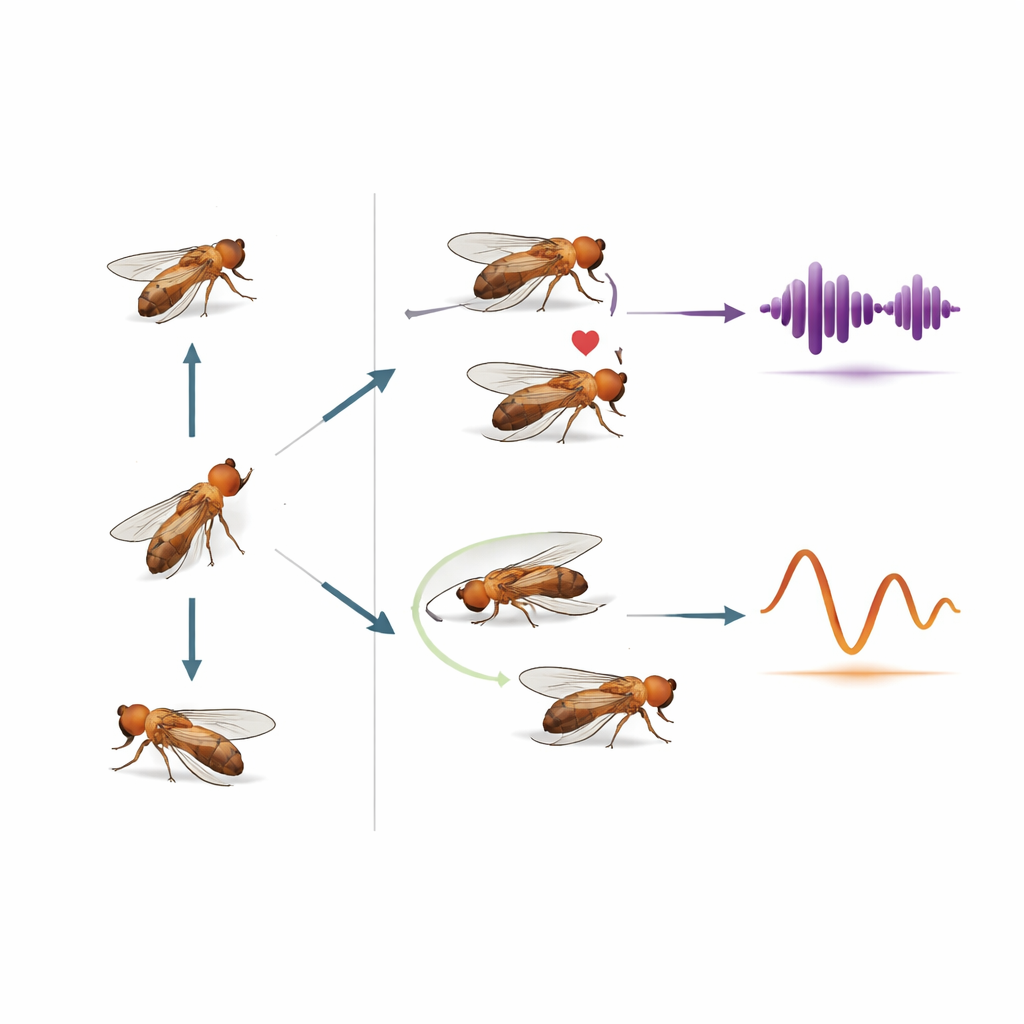
Male Drosophila melanogaster usually court females, but they also sometimes court other males. In both cases, they chase and “sing” by vibrating one wing to generate patterned sounds made of short pulses and smoother, continuous “sine” hums. Using high-speed video and a dense array of microphones, the authors tracked how pairs of flies moved and what sounds males produced when courting either a female or a male. They found that in both situations the basic song elements and body movements were almost identical. What changed was how these building blocks were strung together over time, especially when the flies interacted near each other’s heads.
Different Dance Patterns with Male and Female Partners
By mapping many hours of footage into a two-dimensional "social map," the team identified common interaction patterns, such as chasing from behind, sitting close, or facing each other head-on. When courting females, males spent most of their time behind the female, oriented toward her tail. With male partners, they far more often ended up face-to-face in tight “head interactions.” During these head-to-head encounters, the structure of the song changed: males sang longer and more often to other males than to females, and the song directed at males contained more sine-like hums, whereas females received more pulse-like notes. In other words, the ingredients of the song stayed the same, but the sequence and emphasis shifted with the social context.
Simple Internal Rules, Shaped by Partner Feedback
To understand whether males use different internal rules for male versus female partners, the authors turned to a statistical model that can uncover hidden “modes” of behavior. They found that three core rules were enough to explain singing in both situations: one rule produced mainly pulses when the partner was far and moving fast, another produced mainly sine when the partner was near and slow, and a third rule corresponded to not singing at all. Crucially, the same three rules and the same sensory cues (such as distance and speed) were used regardless of the partner’s sex. The difference arose because male and female partners reacted differently to being courted, which pushed the courting male into different physical arrangements and therefore into different rules.
When Sound Turns Partners into Co-authors
The key insight was that partners are not passive recipients of song; they actively reshape the interaction. Females tended to slow down or stop when they heard courtship song, allowing males to circle in front while keeping some distance. This context favored the pulse-heavy rule. Male partners often did the opposite: hearing song made them turn back and approach the singer, creating close, head-on interactions that triggered the sine-heavy rule. By manipulating the nervous systems of the partners with light-sensitive proteins, the researchers could make males behave more like females (slowing down) or females behave more like males (turning back). When they did, the courting male’s song sequences shifted accordingly, even though his internal rule set stayed the same.
Shared Circuits, Divergent Outcomes
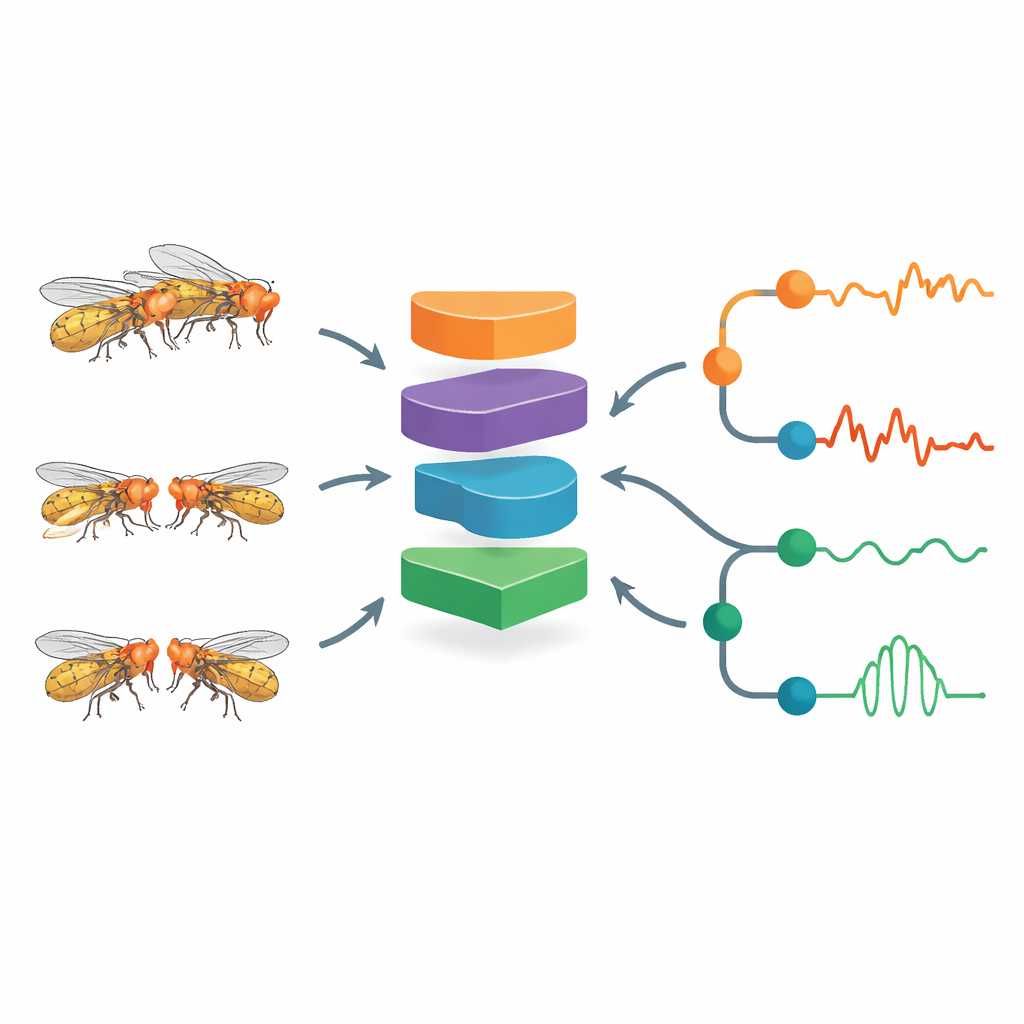
Digging deeper, the study traced these sex-specific feedback behaviors to partially shared brain circuits. Specialized neurons that detect the rhythm of courtship song feed into higher centers that control social motivation and decisions. In both sexes, a common song detector type (pC2l neurons) listens for pulse song, but it connects to different downstream partners: in females, this pathway tends to slow movement; in males, it feeds into cells that raise social arousal and promote turning toward the singer. Additional pathways steer whether males pursue tail-chasing chains, head-to-head encounters, or aggressive displays, showing how a few neural modules can be recombined to generate many social outcomes.
Why This Matters Beyond Flies
For a layperson, the central message is that complex, flexible social behavior does not require endlessly changing rules in the brain. Instead, a small and stable set of sensorimotor rules can be reused in different ways, with the partner’s behavior acting like a steering wheel that selects which rule is active when. In fruit flies, this “compositional” strategy lets males adapt their courtship to males or females without learning new actions. The work suggests a general principle: in many animals, including humans, social partners may shape our behavior not because our brains rewrite the rules, but because their feedback nudges us into different contexts where the same rules play out in new combinations.
Citation: Ravindran Nair, S., Palacios-Muñoz, A., Martineau, S. et al. Sex-specific behavioral feedback modulates sensorimotor processing and drives flexible social behavior. Nat Commun 17, 4026 (2026). https://doi.org/10.1038/s41467-026-72057-9
Keywords: social behavior, courtship song, sensorimotor processing, Drosophila, neural circuits