Clear Sky Science · en
Cavity-mediated exciton hopping in a dielectrically engineered polariton system
Light, Matter, and a New Kind of Circuit
Imagine building an electronic circuit, not from wires and transistors, but from tiny packets of light and matter that can hop from place to place on command. This study shows how to sculpt such “light–matter” particles inside an ultrathin semiconductor so that they form controllable sites and can effectively jump between them over surprisingly long distances. The work opens a path toward new kinds of optical chips that could one day simulate complex quantum materials or enable energy‑efficient information processing.
Blending Light and Matter into Hybrid Particles
At the heart of this research are exciton‑polaritons, hybrid particles formed when light confined in a cavity strongly interacts with excitons—bound pairs of electrons and holes—in a semiconductor. These polaritons behave partly like light, which makes them fast and easy to guide, and partly like matter, which lets them interact with each other. Such properties make polaritons attractive for studying collective quantum behavior and for building devices that use light in ways similar to how electronics use electrons. However, to truly harness them, researchers need precise control over where polaritons live, how much energy they have, and how they move between different regions.
Carving Energy Landscapes with the Surroundings
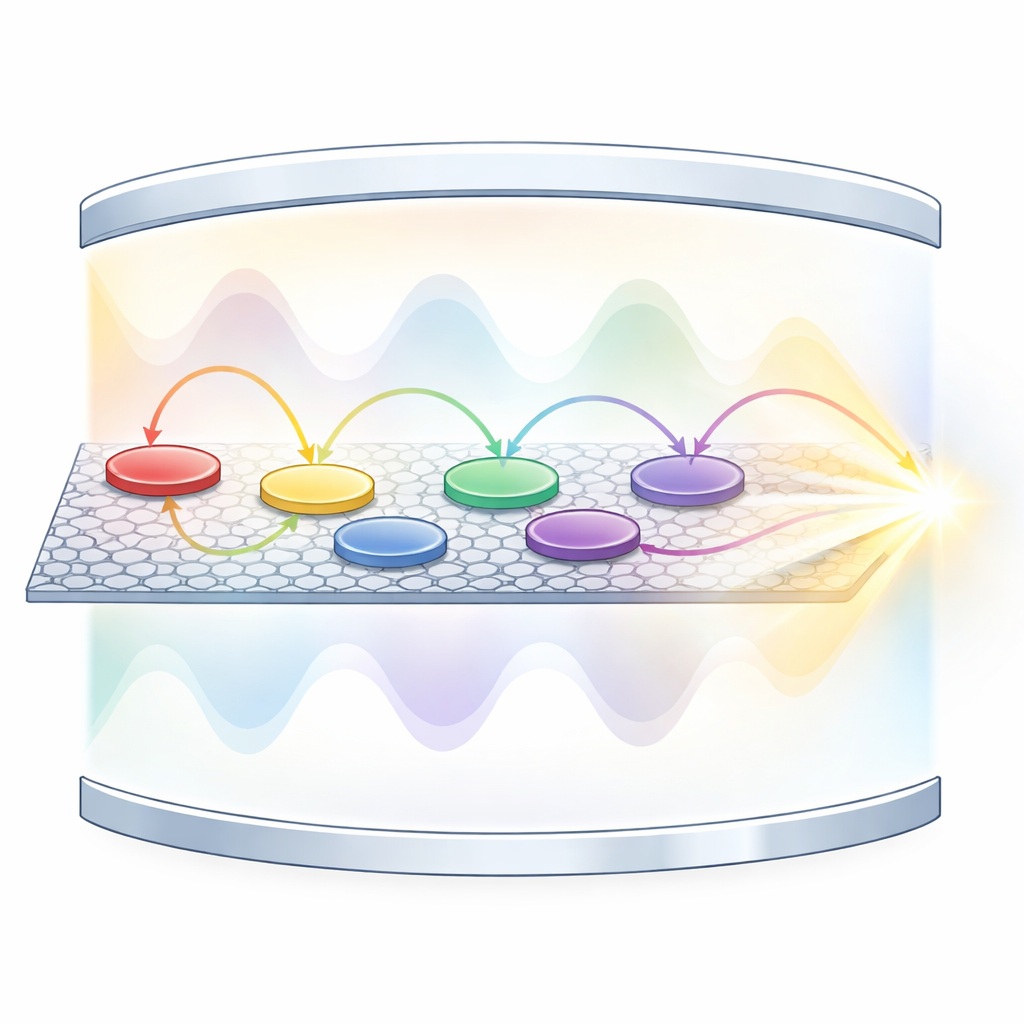
The team tackles this control problem by reshaping not the semiconductor itself, but the material environment around it. They use a single‑layer crystal of molybdenum diselenide, a two‑dimensional semiconductor only one atom thick, and sandwich it between layers of hexagonal boron nitride, a transparent insulator. The top layer of this insulator is carefully nanopatterned with tiny circular holes a few hundred nanometers across. These holes subtly change how electric charges in the semiconductor are screened by their surroundings, which in turn shifts the energy of excitons only in those small disk‑shaped regions. When the whole structure is placed inside a tiny, tunable optical cavity formed between a curved fiber mirror and a flat mirror, these local exciton shifts translate into local changes in polariton energy—effectively creating “polariton disks” whose energy landscape is written by the dielectric environment.
Mapping and Tuning Tiny Light–Matter Islands
By moving the cavity mode laterally across the patterned sample and tuning its color, the researchers observe how the energies of the mixed light–matter states vary in space. Transmission measurements reveal that the lower‑energy polariton branch dips at the centers of the etched disks, forming local energy wells. In devices with pairs of disks at adjustable separations, the team sees two distinct minima corresponding to left and right sites, each with slightly different energies because of unavoidable fabrication variations. Crucially, the depth of these wells can be tuned by changing the cavity energy: as the cavity is shifted away from resonance, the polariton energy at the disks moves in a predictable way, spanning shifts of several millielectronvolts. This shows that polariton confinement and local potentials can be engineered and actively adjusted without modifying the underlying semiconductor once the device is built.
Making Excitations Hop Through a Shared Light Field
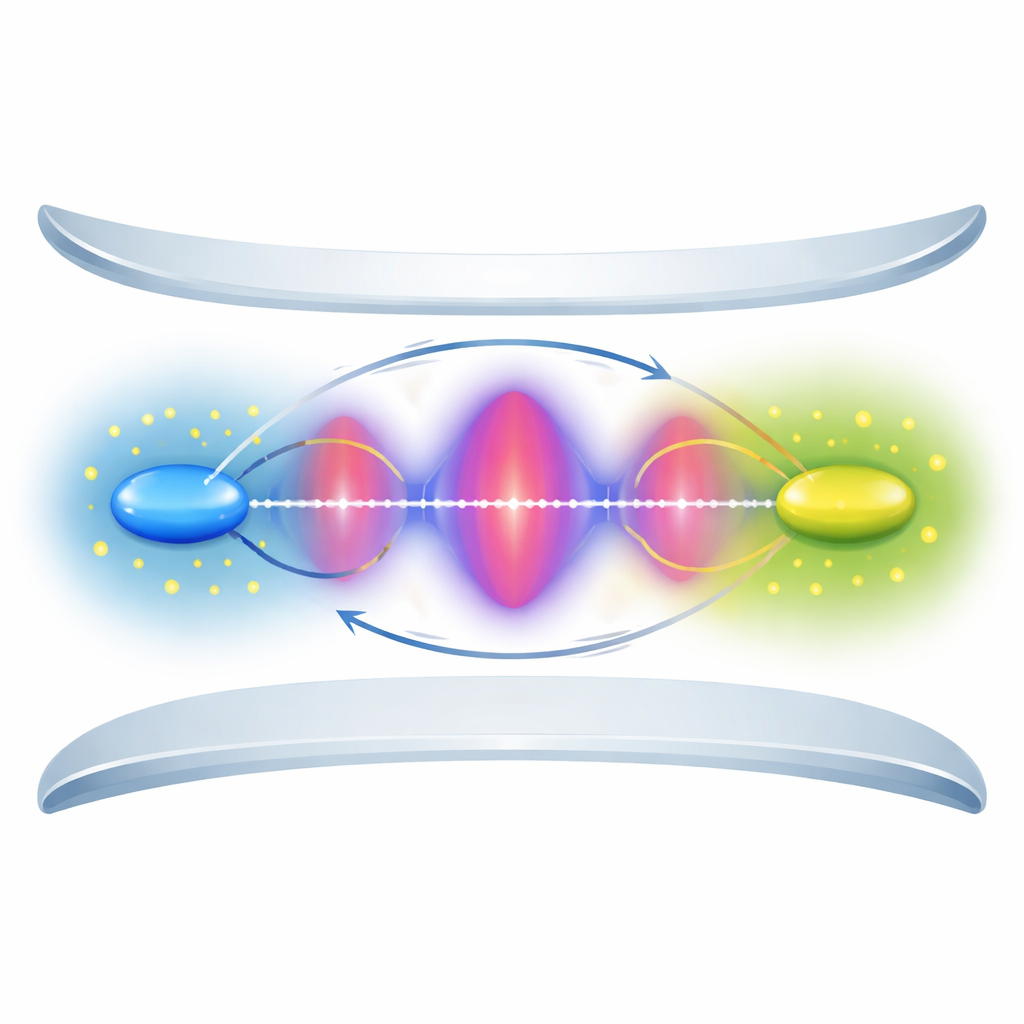
Beyond static energy shaping, the key advance is the ability to make excitations effectively hop between distant regions using the cavity as a mediator. In a regime where the cavity is detuned from the exciton energies, excitons become only weakly dressed by cavity photons. In this situation, theory predicts that two different exciton sites can talk to each other indirectly via the shared cavity field, in a way similar to superconducting qubits coupled through a microwave resonator. The team confirms this by positioning the cavity mode near the edge of a disk so that it overlaps both the localized disk excitons and the surrounding monolayer excitons. Spectroscopy then reveals clear energy splittings—signatures of effective coupling—between these exciton populations. Extending the approach to pairs of disks, they observe hybrid states involving left disk, right disk, and surrounding excitons, with measurable inter‑site coupling that depends sensitively on cavity position.
Toward Networks of Quantum Light–Matter Sites
To a non‑specialist, the takeaway is that the researchers have demonstrated a practical recipe for drawing and rewiring tiny networks of light–matter particles in an ultrathin material, using only nanoscale patterning and a tunable optical cavity. They can both shape the energy landscape that traps these hybrid particles and make excitations hop between sites over micrometer distances without direct physical links. While this work is done at cryogenic temperatures and on carefully crafted samples, it points to future polariton circuits and lattices that could emulate complex quantum systems, explore new many‑body effects, or form the basis of novel optical information technologies.
Citation: Husel, L., Tabataba-Vakili, F., Scherzer, J. et al. Cavity-mediated exciton hopping in a dielectrically engineered polariton system. Nat Commun 17, 3779 (2026). https://doi.org/10.1038/s41467-026-72043-1
Keywords: exciton-polaritons, nanophotonics, quantum simulation, 2D semiconductors, optical cavities