Clear Sky Science · en
Single domain spectroscopic signatures of a magnetic kagome metal
Why tiny magnetic patterns matter
Modern electronics increasingly relies on the quantum behavior of electrons, especially their spin and tiny magnetic whirlpools known as orbital motion. Magnetic materials built on a kagome lattice—a web of corner-sharing triangles—are a prime playground for such effects, promising new ways to store information or guide electrical currents with almost no loss. But these materials break up into microscopic magnetic regions, or domains, that are hard to probe one by one. This study shows how to "zoom in" on individual domains in a kagome metal and read out their hidden magnetic fingerprints, opening a route to explore complex quantum behavior with unprecedented detail.
Looking inside a special magnetic metal
The researchers focus on a compound called DyMn6Sn6, where layers of manganese atoms form a kagome network inside a three-dimensional crystal, while dysprosium and tin atoms complete the structure. Such materials host unusual electronic states—flat bands, Dirac-like crossings, and sharp peaks in the density of states—that can amplify quantum and magnetic effects. At low temperatures, DyMn6Sn6 develops rich magnetic order tied to both manganese (3d) and dysprosium (4f) electrons, but the resulting domains are small and can change with temperature, making them difficult to study with conventional techniques that average over many domains at once. The challenge is to isolate the response of a single domain without disturbing it.

Using tiny light spots to read magnetic domains
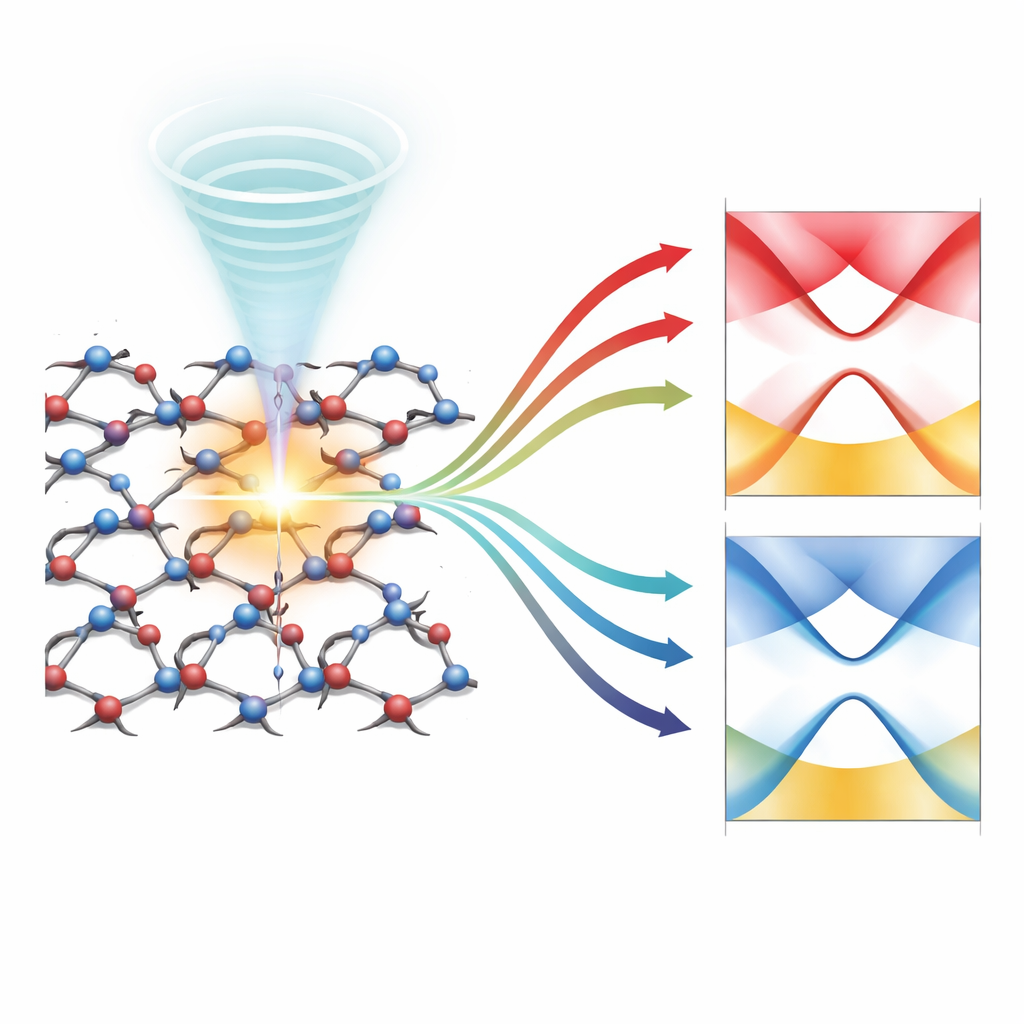
To tackle this, the team used a specialized form of photoemission called micro-focused circular-dichroic angle-resolved photoemission spectroscopy (μ-CD-ARPES). In essence, they illuminated the crystal with a tightly focused beam of circularly polarized X-rays—light whose electric field rotates like a corkscrew—and measured the angles and energies of the electrons that escaped. By scanning a beam just a few micrometers wide across the surface, they could map how the signal changed from place to place. Comparing measurements taken with left- and right-rotating light revealed strong contrast tied to local magnetization, allowing the researchers to image individual magnetic domains directly on the cleaved crystal surface at 20 kelvin.
Element-by-element magnetic fingerprints
A key strength of the approach is its ability to tune in to specific elements. By choosing photon energies that emphasize dysprosium 4f states, the team obtained vivid domain contrast, with the circular dichroism reaching tens of percent. They then repeated the measurements in an energy range sensitive to manganese 3p and 3d states. Although the manganese signals were weaker and partly masked by background effects, careful data combinations suppressed nonmagnetic contributions and revealed a consistent pattern: the sign of the magnetic signal from manganese was opposite to that from dysprosium. Supported by detailed atomic and multiple-scattering calculations, this sign reversal points to a ferrimagnetic arrangement, in which the local moments on dysprosium and manganese are aligned in opposite directions rather than simply parallel.
Probing hidden orbital motion in the lattice
Beyond detecting spin alignment, μ-CD-ARPES proved sensitive to the orbital motion of electrons—the way their wavefunctions swirl around atoms and between neighboring sites in the kagome network. By comparing the electronic band structure measured in two neighboring but oppositely magnetized domains, and relating these measurements to first-principles calculations, the authors identified domain-dependent changes that track the orbital angular momentum of manganese-derived bands near the Fermi level. Because circularly polarized light couples directly to orbital motion, differences between domains reveal aspects of the material’s orbital magnetization, which is believed to be closely connected to exotic phenomena such as loop currents, orbital Hall effects, and the quantum geometry of electronic states.
What this means for future quantum materials
Put simply, the study shows that it is now possible to read out both spin and orbital behavior from a single magnetic domain in a complex quantum metal. By combining a micro-focused X-ray beam with circularly polarized light, the researchers demonstrated that DyMn6Sn6 hosts ferrimagnetic alignment between its key elements and displays clear signatures of nonvanishing orbital magnetization rooted in its kagome lattice. For a non-specialist, this means scientists have gained a powerful microscope for the invisible patterns of magnetism and electron motion that underlie next-generation spintronic and quantum devices, and they can now explore these patterns one tiny magnetic region at a time instead of seeing only their blurred average.
Citation: Plucinski, L., Bihlmayer, G., Mokrousov, Y. et al. Single domain spectroscopic signatures of a magnetic kagome metal. Nat Commun 17, 3571 (2026). https://doi.org/10.1038/s41467-026-71924-9
Keywords: kagome metal, magnetic domains, orbital magnetization, photoemission, quantum materials