Clear Sky Science · en
Giant transverse magnetic fluctuations at the edge of re-entrant superconductivity in UTe2
Why strange metals matter
Most of the devices that power modern technology rely on ordinary metals that heat up and waste energy. Superconductors are different: they can carry electricity with zero resistance, but usually only in very special conditions that strong magnetic fields quickly destroy. Uranium ditelluride (UTe2) bucks this trend. In this material, superconductivity mysteriously disappears and then reappears at extremely high magnetic fields. This work asks a simple question with far-reaching consequences: what kind of hidden magnetism allows superconductivity to thrive where it should be strongest suppressed?
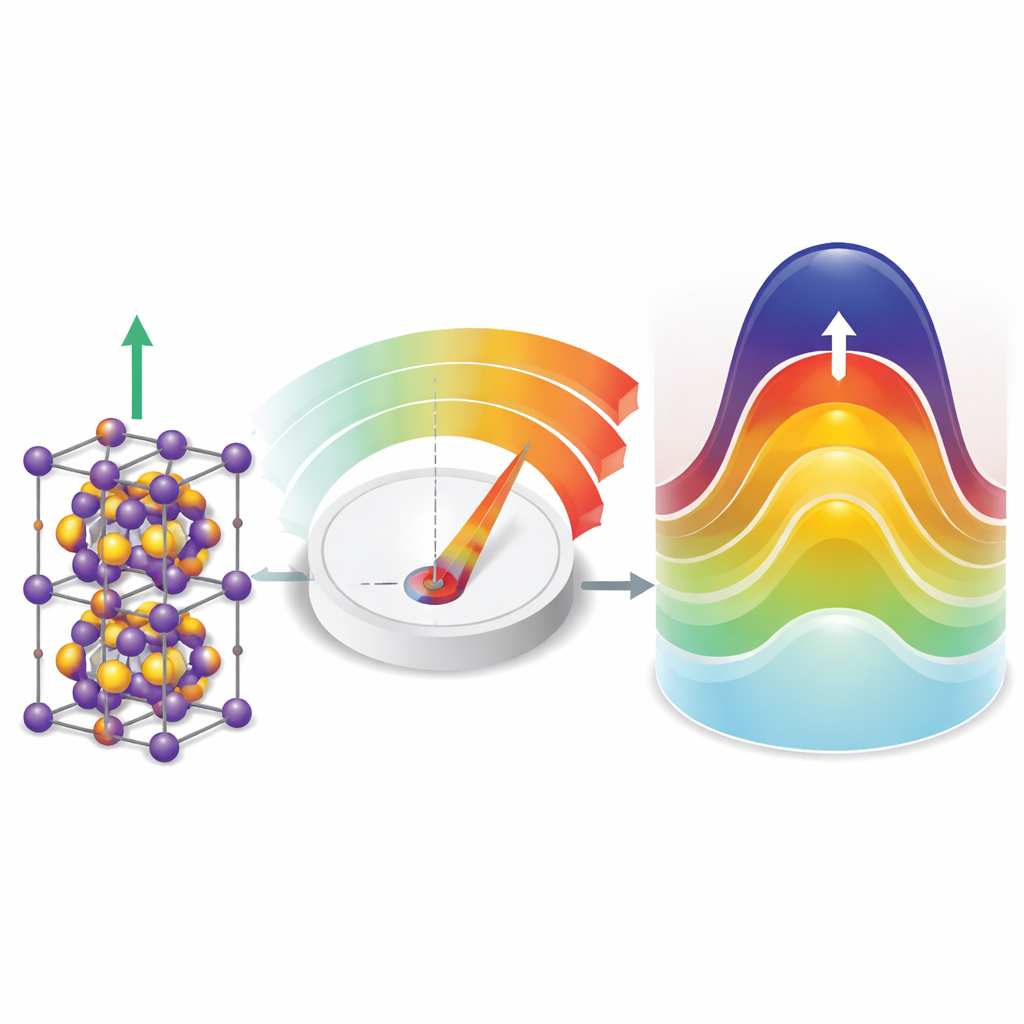
A superconductor that comes back to life
UTe2 has drawn intense interest because it hosts several distinct superconducting phases that depend sensitively on how a strong magnetic field is applied. When the field is ramped up, the usual low-field superconductivity vanishes, as expected. But at fields around 40 tesla—hundreds of thousands of times stronger than a fridge magnet—a new superconducting state reappears in a halo of directions around one crystal axis. This re-entrant behavior coincides with a sudden jump in the material’s magnetic moment, known as a metamagnetic transition, where electrons become strongly aligned with the applied field. Understanding what ties this magnetic transition to the reborn superconductivity is central to decoding how electrons pair up in UTe2.
Looking for the right kind of magnetic jiggling
In related uranium compounds that also show field-induced or field-enhanced superconductivity, a key role is played by a simple kind of magnetism called ferromagnetism, where spins tend to align in the same direction. When a magnetic field is applied sideways to that preferred direction, it can excite strong sideways, or transverse, wiggles of the spins. Theoretical work suggests that these transverse fluctuations can act as a glue that binds electrons into spin-triplet pairs, a rare and robust form of superconductivity. But UTe2 is puzzling: at zero field it does not order ferromagnetically, and neutron scattering instead sees signatures of antiferromagnetic behavior, where neighboring spins alternate. This raises the puzzle of whether the type of fluctuations thought to help its cousins can exist here at all.
A new way to feel hidden magnetic motion
To probe the elusive transverse magnetism in UTe2, the researchers used a technique called magnetotropic susceptibility, which senses how the material’s energy changes as a magnetic field is gently rocked around a fixed direction. A tiny UTe2 crystal is glued to the end of a microscopic cantilever that vibrates like a tuning fork inside a strong pulsed magnetic field of up to 60 tesla. As the field direction and strength change, subtle magnetic torques bend the cantilever, slightly shifting its resonant frequency. By mapping these shifts for many field angles in two different rotation planes, the team isolates how responsive the magnetization is to fields applied sideways to the main field direction—a quantity that ordinary magnetization measurements largely miss.
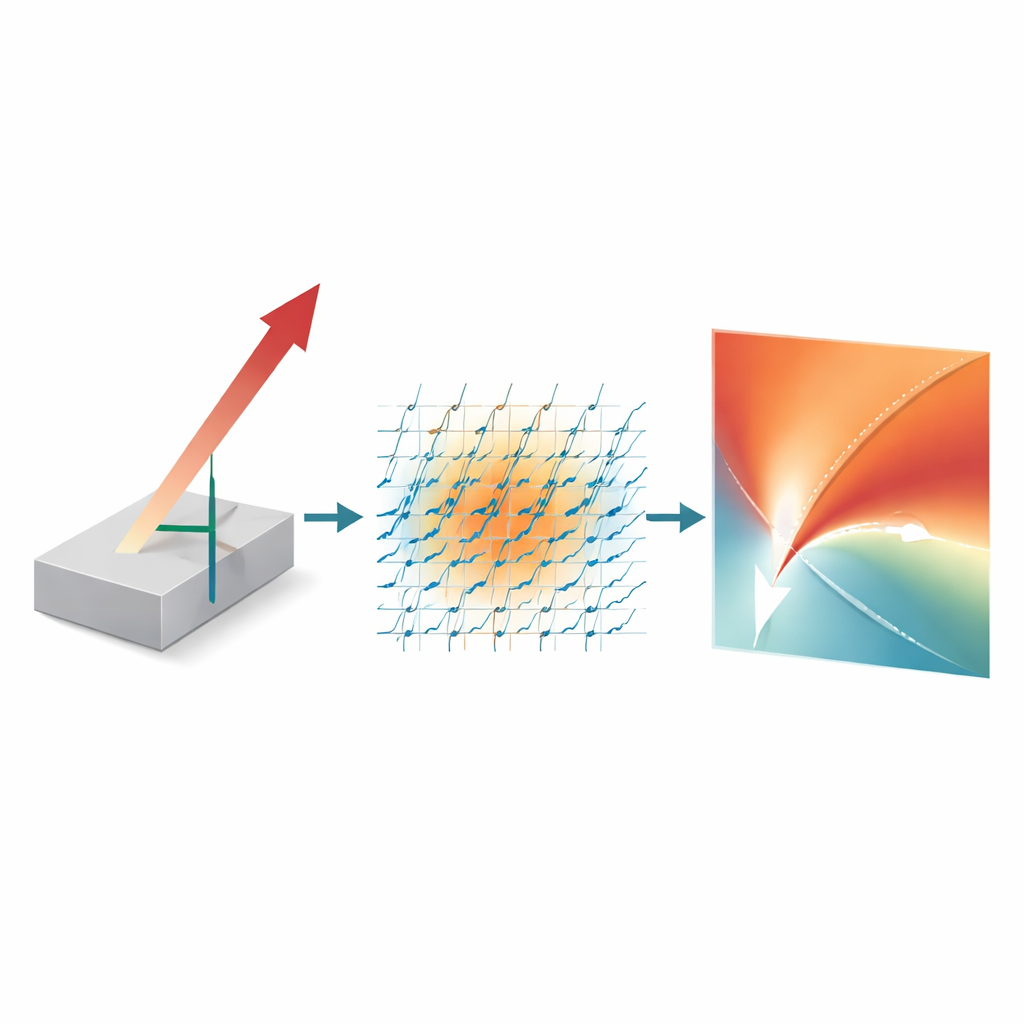
Giant sideways response at the edge of a transition
When the field is aligned with the crystal’s c-axis, the measured magnetotropic susceptibility plunges sharply around 20 tesla, in a way that cannot be explained by changes in the usual magnetization along the field. By carefully separating out the known longitudinal contribution, the authors show that this plunge reflects an enormous growth of the transverse magnetic susceptibility: at high fields it becomes more than thirty times larger than the longitudinal response. As the field is tilted toward the b-axis, this giant transverse signal not only persists but strengthens, filling a broad swath of the field–angle diagram. It terminates abruptly at the metamagnetic transition into the spin-polarized, field-induced ferromagnetic phase, and the size of the sudden jump in the magnetotropic response tracks how this first-order transition evolves toward a critical endpoint.
What this means for future superconductors
Because the measurements are sensitive to long-wavelength, low-frequency spin motion, the huge transverse signal points to intense ferromagnetic-like fluctuations, even though UTe2 is not a ferromagnet at zero field. These fluctuations cluster right where all three known high-field superconducting phases appear in the field–angle diagram. The work therefore supports a picture in which sideways spin jiggling near the metamagnetic boundary helps electrons pair into an unusual, resilient superconducting state. For non-specialists, the key message is that magnetism and superconductivity are not always enemies: under the right conditions, the restless motion of spins in a strong magnetic field can help restore perfect conduction rather than destroy it, offering a new route to designing superconductors that survive in extreme environments.
Citation: Zambra, V., Nathwani, A., Nauman, M. et al. Giant transverse magnetic fluctuations at the edge of re-entrant superconductivity in UTe2. Nat Commun 17, 3742 (2026). https://doi.org/10.1038/s41467-026-71899-7
Keywords: UTe2, re-entrant superconductivity, ferromagnetic fluctuations, high magnetic fields, magnetotropic susceptibility