Clear Sky Science · en
Electronic band and core-shell structure engineering enables ultrahigh energy storage in high-entropy ceramics
Why better capacitors matter
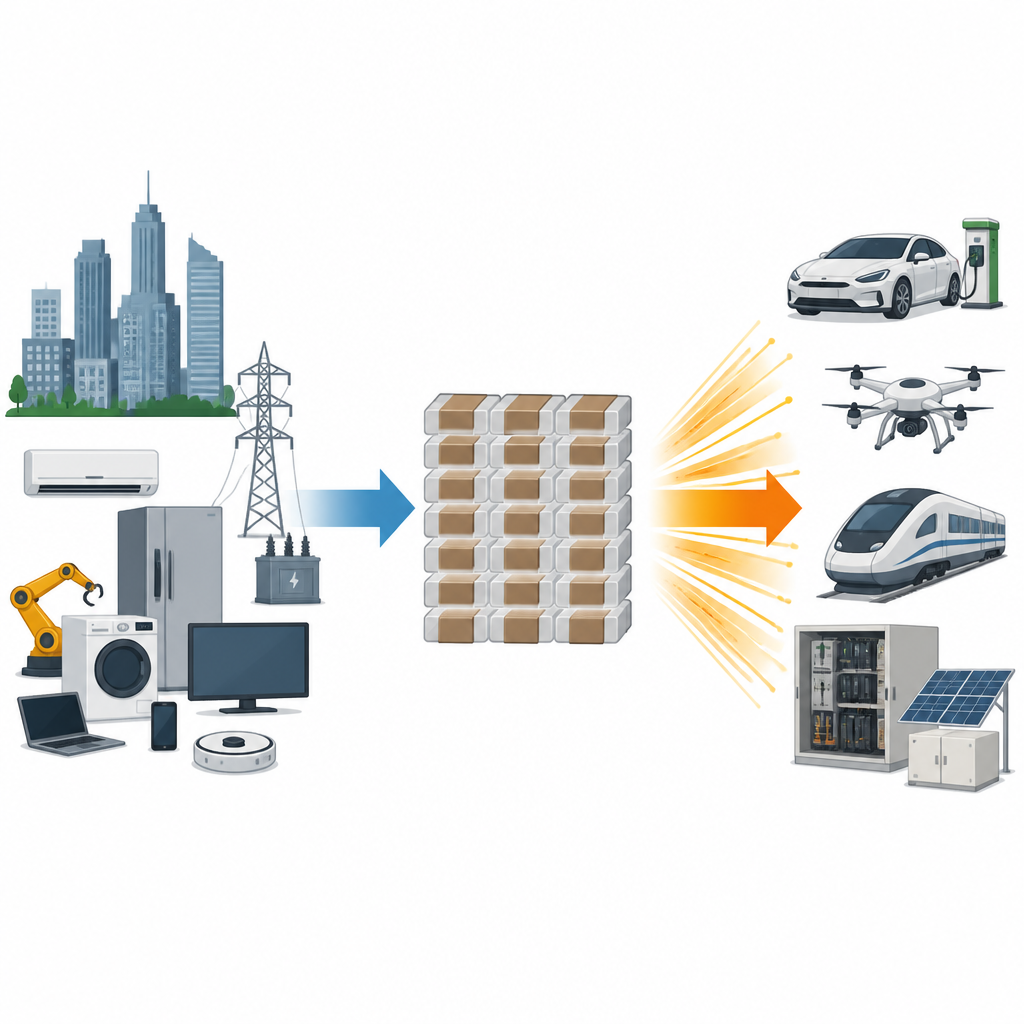
Every time you start an electric car, plug in a fast charger, or rely on renewable energy, you are depending on devices that can quickly store and release electrical energy. These devices, called capacitors, are vital for handling sudden power bursts without overheating or failing. Scientists are now searching for safer, lead-free materials that can pack more energy into smaller volumes while still working reliably under strong electric fields. This study explores a new way to design such materials using a mix of many different elements, unlocking record levels of energy storage in ceramic capacitors.
Mixing many atoms to tame electric stress
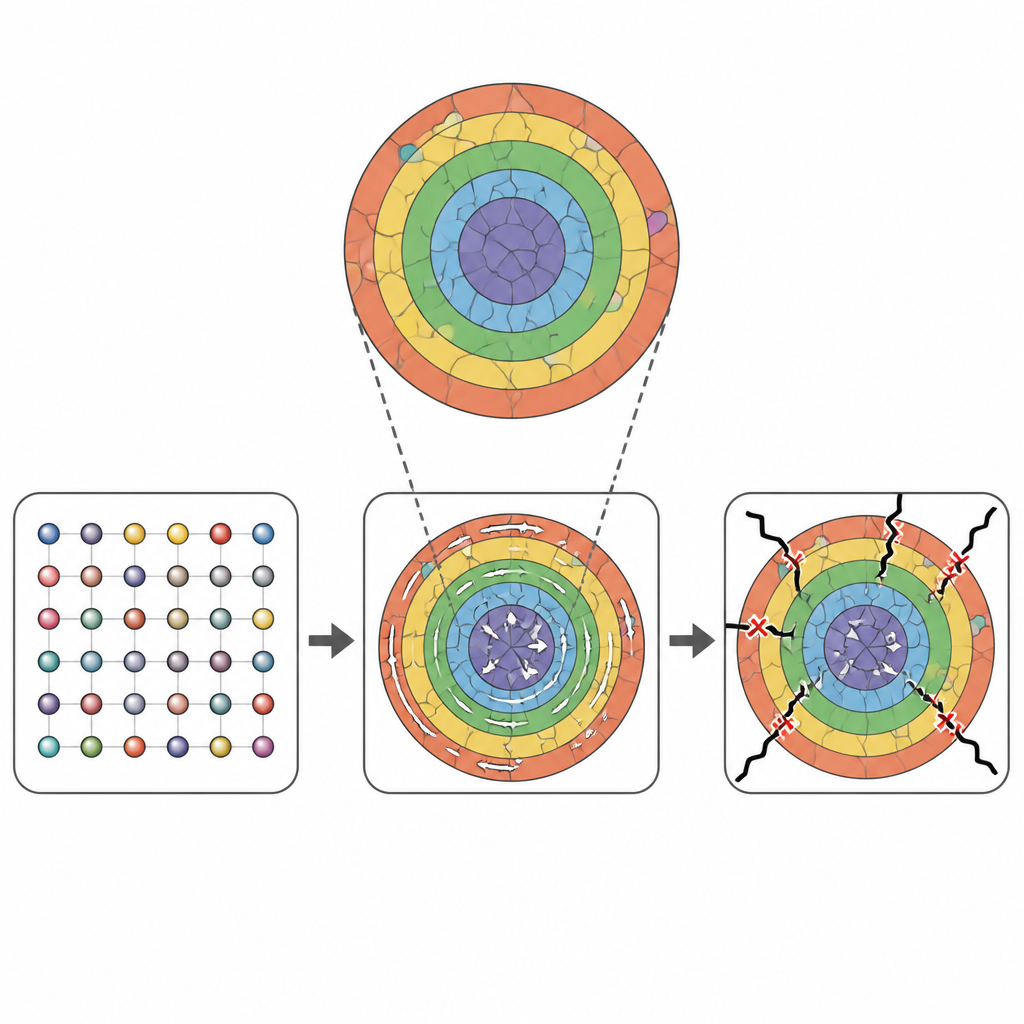
Traditional ceramic capacitors face a built-in conflict: materials that polarize strongly under an electric field tend to break down more easily, limiting how much energy they can safely hold. The team tackled this problem with a “high-entropy” design, in which many different metal atoms share the same crystal lattice. In their lead-free bismuth-sodium titanate ceramics, they added elements such as strontium, lanthanum, barium, magnesium, and tantalum to create a highly mixed atomic environment. This controlled chemical disorder refined the grain size of the ceramic and changed how charge and polarization behave under strong fields, opening a path to higher energy storage.
Hidden structure inside each tiny grain
Using advanced electron microscopes, the researchers discovered that this high-entropy recipe naturally creates a core-shell structure inside each microscopic grain. The cores become enriched with strontium, while other elements concentrate more in the shells. Because strontium atoms diffuse more slowly during firing, they become trapped in the center. This onion-like structure, with well-defined interfaces between core and shell, helps prevent the kind of runaway electrical “treeing” that usually leads to breakdown. Computer simulations of electric fields inside model ceramics confirmed that fine grains combined with core-shell boundaries spread the field more evenly and block breakdown channels, allowing the material to withstand much higher voltages.
Shaping the motion of electrons and dipoles
The high-entropy design also changes the way electrons move. Calculations of the electronic band structure showed that adding many different elements makes the energy bands flatter near the conduction edge. Flatter bands mean charge carriers effectively become “heavier” and move more sluggishly, which reduces leakage current and energy loss. Measurements of resistivity, carrier concentration, and mobility supported this picture: the most complex composition had the highest resistivity and lowest carrier mobility. At the same time, tiny polar regions with different crystal symmetries coexist inside the material, making it easier for electric dipoles to rotate rather than lock into one direction. This leads to a slim, nearly non-hysteretic response where the material can reach high maximum polarization while retaining almost no remnant polarization when the field is removed, which is ideal for capacitors.
Record energy storage and robust operation
By combining band-structure control, core-shell grains, and flexible polar regions, the optimized high-entropy ceramic reached a recoverable energy density of about 10 joules per cubic centimeter with an efficiency above 85 percent, placing it among the best lead-free ceramic capacitors reported so far. It also endured very high electric fields, delivered strong power pulses on nanosecond time scales, and maintained its performance over many charge-discharge cycles and at elevated temperatures. The material showed only modest changes in stored and released energy after extensive cycling at both room temperature and 100 degrees Celsius, suggesting it can operate reliably in demanding power electronics environments.
What this means for future power systems
To a non-specialist, the key message is that carefully “stirring” many different elements into a ceramic can reshape both its inner structure and its electronic behavior in a helpful way. The resulting material is better at holding large amounts of energy without failing and can release that energy very quickly and efficiently. This work shows that tuning both the atomic mix and the microstructure is a powerful strategy for building compact, durable, and lead-free capacitors that could benefit electric vehicles, pulsed power devices, and renewable energy technologies.
Citation: Li, Y., Li, P., Huang, H. et al. Electronic band and core-shell structure engineering enables ultrahigh energy storage in high-entropy ceramics. Nat Commun 17, 4559 (2026). https://doi.org/10.1038/s41467-026-71892-0
Keywords: high-entropy ceramics, dielectric capacitors, energy storage, relaxor ferroelectrics, core-shell structure