Clear Sky Science · en
Non-diffusive slow heat dissipation induces high local temperature in living cells
Hidden heat inside living cells
Every cell in your body is constantly using energy, and where there is energy use there is heat. For years, tiny temperature sensors have hinted that parts of a cell can briefly warm up by a degree or two, but basic physics seemed to say this should be impossible. This study tackles that puzzle head on and shows that heat can in fact linger and pile up in microscopic pockets inside living cells, revealing a new way that temperature may help control cell behavior.
Taking the cell’s temperature in real time
To watch heat move inside a cell, the researchers needed a thermometer that works from the inside out. They used a specially designed fluorescent polymer that changes how long it glows after a pulse of light, depending only on temperature. By combining this probe with an advanced imaging method that records the timing of single photons, they created sharp temperature maps of living cells in less than a second, a big improvement over earlier approaches that needed a full minute to build a picture.
Sharper heat maps reveal warm spots
With this fast mapping, the team saw that temperature is far from uniform inside a cell. Even in steady conditions, some regions, including the nucleus and mitochondria, were slightly warmer than their surroundings by about one degree Celsius. These differences appeared even at scales smaller than individual organelles, suggesting that tiny pockets of cytoplasm can have their own distinct thermal states. Control polymers that do not respond to temperature, and alternative thermometer molecules, confirmed that these patterns really reflected heat rather than unrelated chemical changes.
Making and following artificial heat
To probe how heat spreads, the scientists created a tiny, controllable heat source using an infrared laser that warms water in a spot about one micrometer wide inside the cell. As they turned the laser on and off, they tracked how the local and whole-cell temperatures rose and fell. When they delivered brief pulses, the heat faded as quickly as expected. But when they heated continuously for seconds, the average temperature of the cell relaxed back to baseline much more slowly than simple heat conduction in water would allow, taking seconds instead of thousandths of a second. 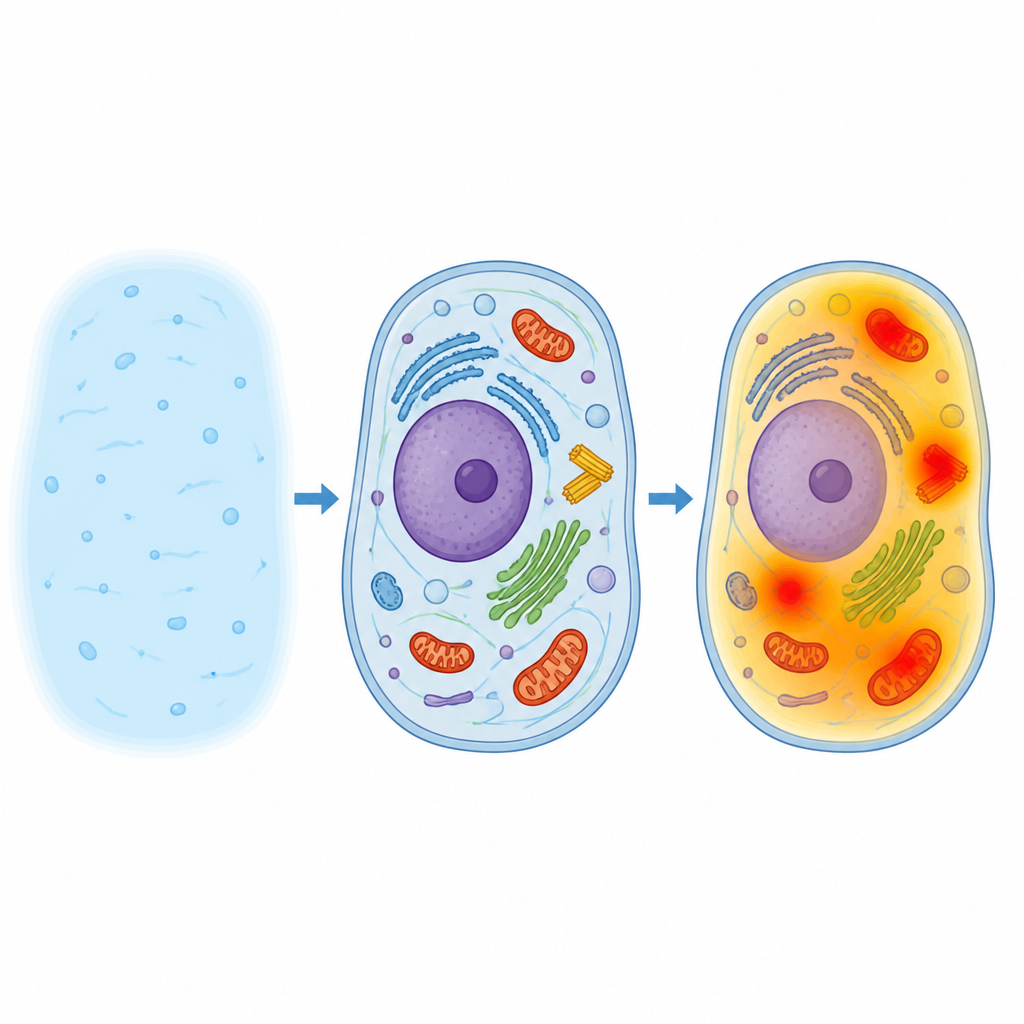
Slow and uneven cooling breaks the simple rules
The team compared living cells with liposomes, simple artificial bubbles filled with water that are similar in size. In liposomes, heat spread and cooled at the fast rate predicted from standard thermal physics. In cells, in contrast, cooling depended on where the heat was made: the nucleus cooled more slowly than the surrounding cytoplasm, and isolated bits of cell membrane cooled more quickly than intact cytoplasm. When they simulated heat flow using accepted values for cellular thermal conductivity, the models could not reproduce the observed sluggish cooling, even when they varied the size of the region studied.
Heat that does not simply diffuse
By carefully matching temperature patterns just before they stopped heating, the researchers showed that the later cooling still depended on how long the cell had been warmed, not just on the starting temperature map. High-speed imaging revealed that sharp temperature peaks near the heating spot in the cytoplasm and nucleus persisted for hundreds of milliseconds before slowly fading, and that overall relaxation took seconds. Together, these findings point to an extra, non-diffusive pathway for handling heat in cells, likely involving large biomolecules such as RNA and complex structures that temporarily store thermal energy in their internal states before releasing it. 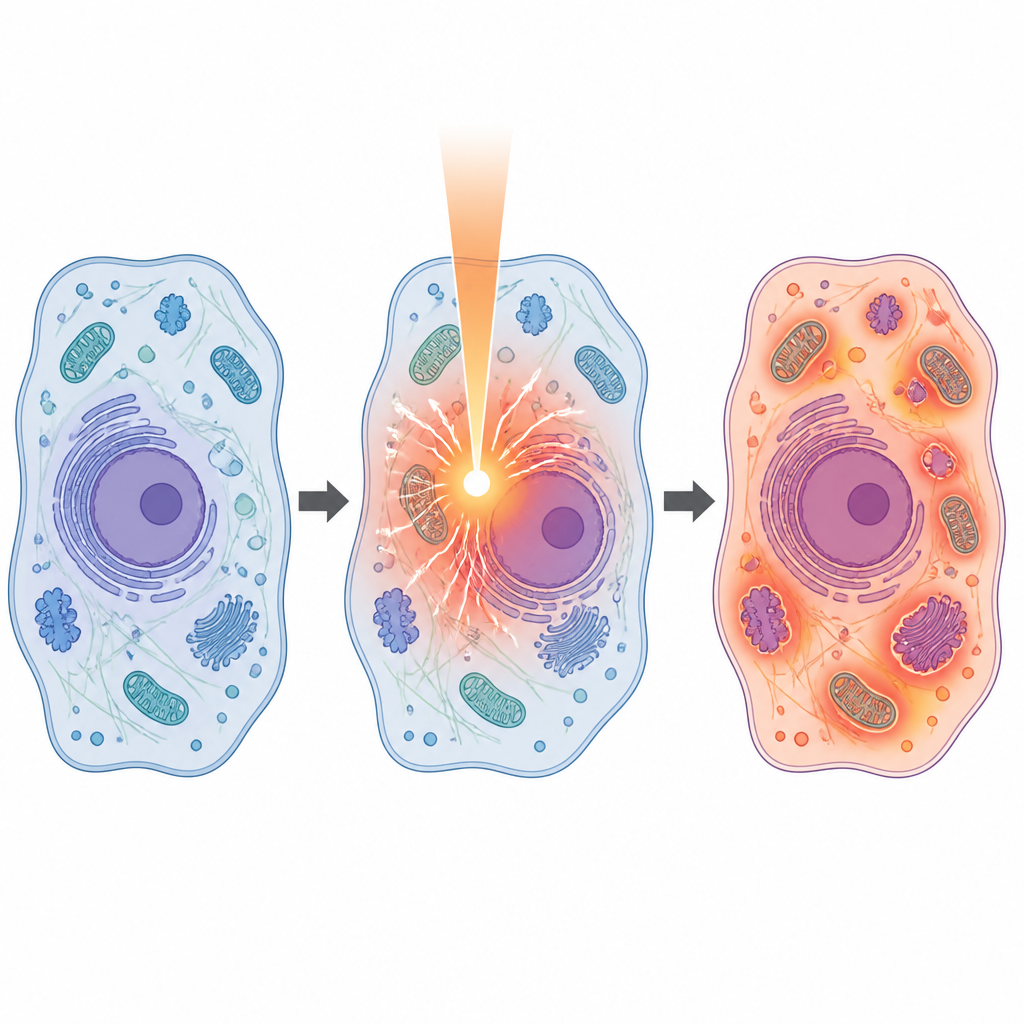
Why lingering heat matters for life
The work shows that, at the scale of a single cell, heat does not behave like it does in a simple glass of water. Instead, thermal energy can be trapped and released slowly by cellular structures, allowing small amounts of internally generated heat to raise local temperatures by about one degree or more. This helps resolve a long-standing mismatch between theoretical predictions and experimental measurements of intracellular temperature. It also suggests that cells can use subtle, long-lasting warm spots as signals that influence processes such as gene activity, development, and stress responses, adding temperature itself to the toolkit of ways that cells control their own behavior.
Citation: Takarada, M., Shirakashi, R., Takinoue, M. et al. Non-diffusive slow heat dissipation induces high local temperature in living cells. Nat Commun 17, 4215 (2026). https://doi.org/10.1038/s41467-026-71878-y
Keywords: intracellular temperature, cell thermodynamics, heat dissipation, thermal signaling, fluorescent thermometry