Clear Sky Science · en
Predicting individual differences of fear and cognitive learning and extinction
Why our brains learn fear differently
Some people quickly shake off bad experiences, while others stay on edge long after the danger is gone. These differences matter for everyday worries and for conditions like phobias or post‑traumatic stress. This study asks a simple question with complex tools: can we read patterns in the resting brain to predict how well someone will learn fear, unlearn it, and whether that fear might come back?
Three ways the brain stays connected
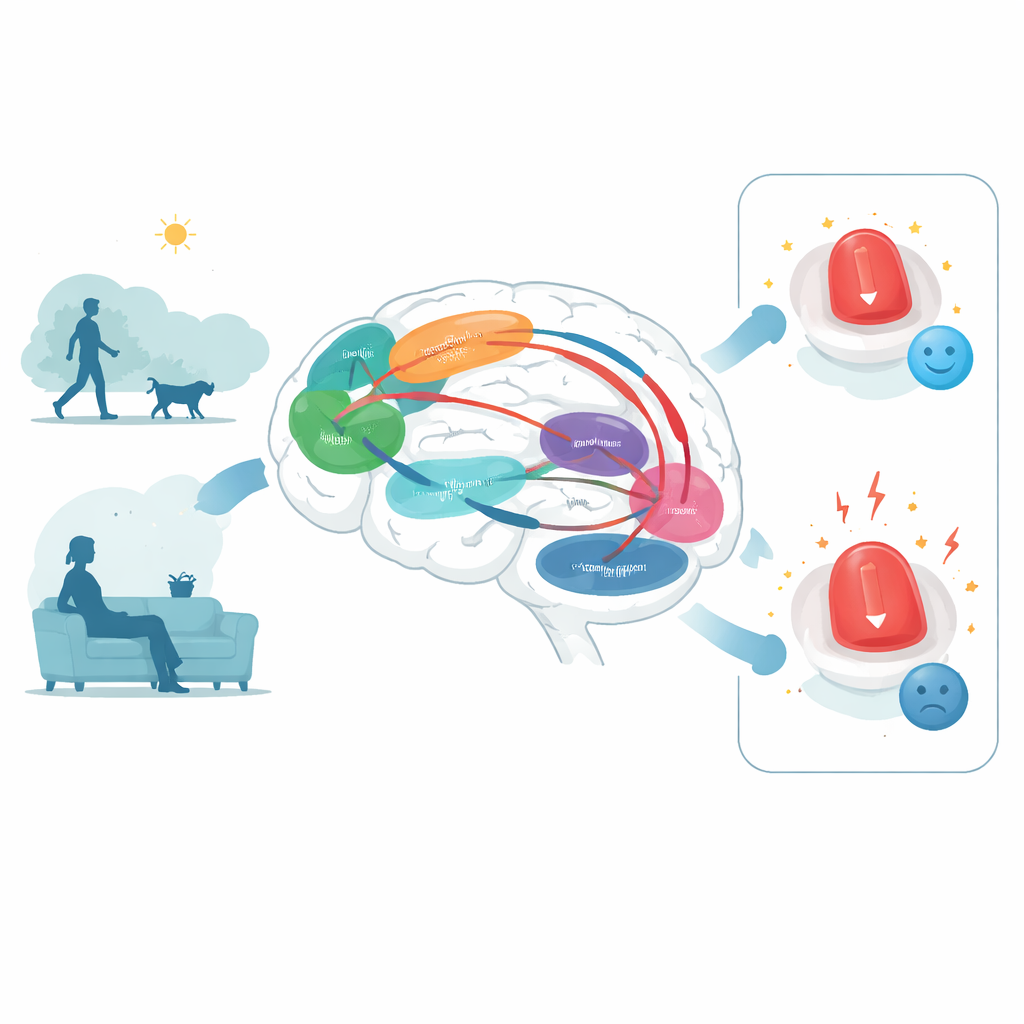
Instead of looking at single brain spots in isolation, the researchers focused on a small "learning network" that shows up again and again in animal and human studies. It includes the amygdala (key for threat responses), hippocampus (context and memory), a frontal midline region called the anterior cingulate, the ventromedial prefrontal cortex, and the cerebellar nuclei. They described how these areas talk to each other in three different ways: functional connections (areas whose activity rises and falls together), structural connections (physical wiring made of white‑matter fibers), and effective connections (directed influences, showing which region drives which).
Fear learning, unlearning, and return in the lab
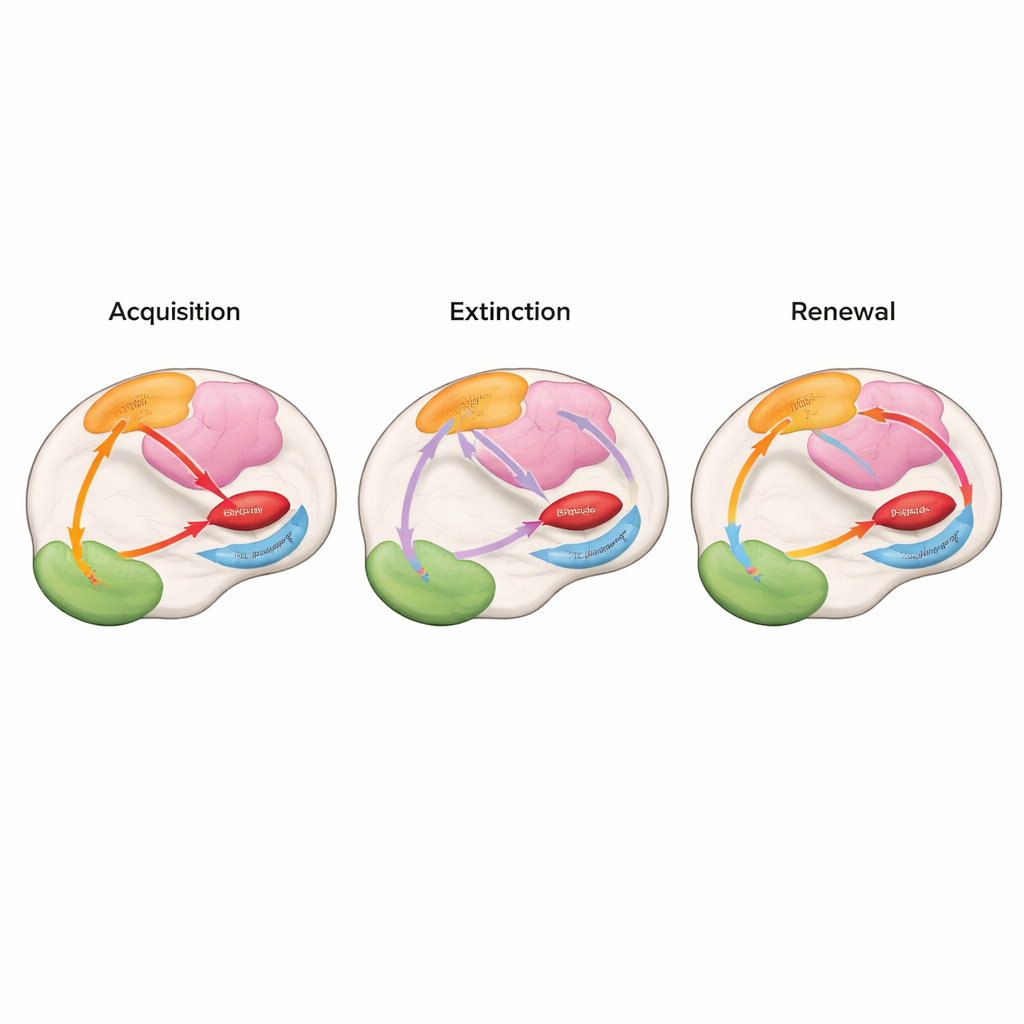
More than 500 volunteers took part in several related experiments. In some, people learned to link pictures or shapes with unpleasant shocks or gut sensations. In others, they learned which foods predicted an upset stomach in different restaurant settings. All tasks had three stages: acquisition (forming the fear or expectation), extinction (learning that the signal no longer predicts the bad outcome), and renewal (testing whether the old fear returns when context changes back to the original). Learning was tracked through skin sweat responses or choices, and brain scans at rest measured the three types of connectivity within the core network.
Different wiring for learning and letting go
The most striking result was a “triple split” between learning stages. How strongly regions were functionally linked at rest best predicted how quickly people picked up new fear or predictive associations. Here, the hippocampus and anterior cingulate stood out as hubs, and their links with prefrontal cortex, amygdala, and cerebellum were especially important. In contrast, the structure of the white‑matter wiring—rather than moment‑to‑moment synchrony—best predicted how well people learned to extinguish their responses. Stronger structural links involving the anterior cingulate and amygdala, and pathways tying hippocampus and prefrontal cortex together, were tied to better extinction. This suggests that the capacity to calm down a learned fear rests more on stable anatomy than on short‑term brain states.
When old fears come back
The return of fear in a former danger context—renewal—relied on yet another aspect: effective connectivity. Here, the key was how signals flowed through the network, especially between hippocampus, amygdala, and prefrontal cortex. Stronger influence from hippocampus and prefrontal cortex onto other nodes, and disinhibition of hippocampus by amygdala and prefrontal regions, were linked to a greater tendency for extinguished responses to reappear. In other words, the way memories and context signals are broadcast and gated across the network seems to shape whether a once‑quieted fear can flare up again.
What this means for mental health and treatment
The findings suggest that fear learning, unlearning, and relapse are not driven by one common brain signature but by different facets of brain connectivity. Fast acquisition is tied to flexible functional patterns, extinction to durable white‑matter scaffolding, and renewal to the direction and strength of influence among regions. Because these patterns generalized across both fear‑based and more neutral predictive learning tasks, they may reflect broad principles of how the brain updates beliefs. In practical terms, such connectivity “fingerprints” could one day help tailor therapies for anxiety and related disorders—identifying who may struggle to extinguish fear, who is prone to relapse, and which brain pathways might be the most promising targets for non‑invasive brain stimulation or other personalized interventions.
Citation: Gomes, C.A., Bach, D.R., Razi, A. et al. Predicting individual differences of fear and cognitive learning and extinction. Nat Commun 17, 3780 (2026). https://doi.org/10.1038/s41467-026-71830-0
Keywords: fear learning, extinction, brain connectivity, anxiety disorders, resting state fMRI