Clear Sky Science · en
Reactive formation of magnesiowüstite at the lunar core-mantle boundary
A Hidden Layer Inside the Moon
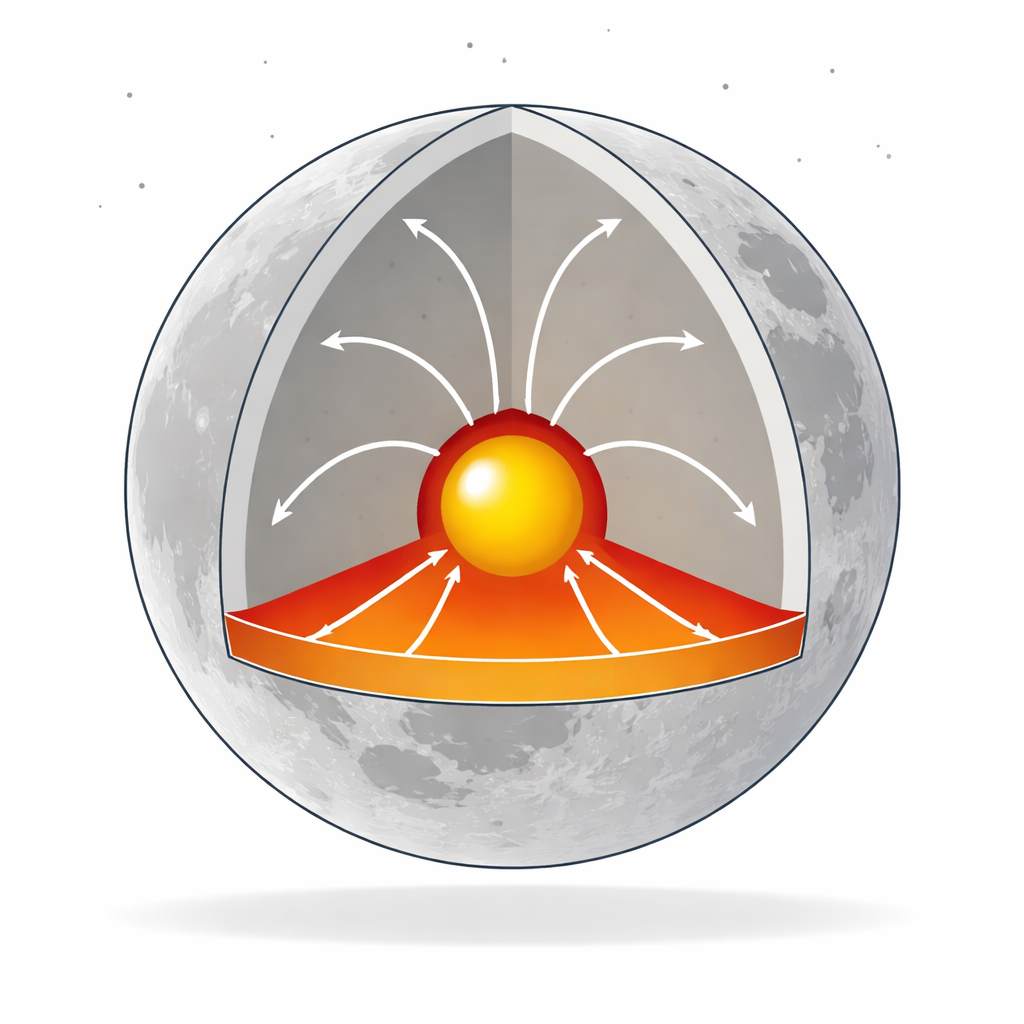
The Moon’s deep interior holds a curious mystery: just above its metal core lies a layer where earthquake-like waves slow down unexpectedly. This “soft” zone has puzzled scientists for decades, because its speed and density do not match any familiar mixture of lunar rocks. In this study, researchers combine high-pressure experiments, lab-made minerals, and computer models to propose a new answer: an unrecognized mineral forming at the boundary between the Moon’s core and mantle. Their work reshapes our picture of how the Moon evolved and offers clues to what may be happening deep inside other rocky worlds.
Why the Moon’s Deep Layer Is Strange
Signals from Apollo-era seismometers, together with modern gravity measurements, show that a well-defined “low-velocity zone” surrounds the Moon’s metal core. In that ring, both fast (P) waves and slow (S) waves travel much more slowly than they do through the lower mantle above, yet the material is still relatively dense. Previous ideas tried to explain this using known lunar ingredients: piles of early-formed rock crystals rich in the mineral olivine, garnet-bearing layers, titanium-rich melts, or pockets of iron–sulfur liquid. Each of these options could match part of the data, but not all of it at once. Some mixtures were too fast, others too light, and some required unrealistically sulfur-rich cores or unstable melts. The mismatch hinted that something was missing from the recipe at the lunar core–mantle boundary.
A New Mineral Born at the Core–Mantle Contact
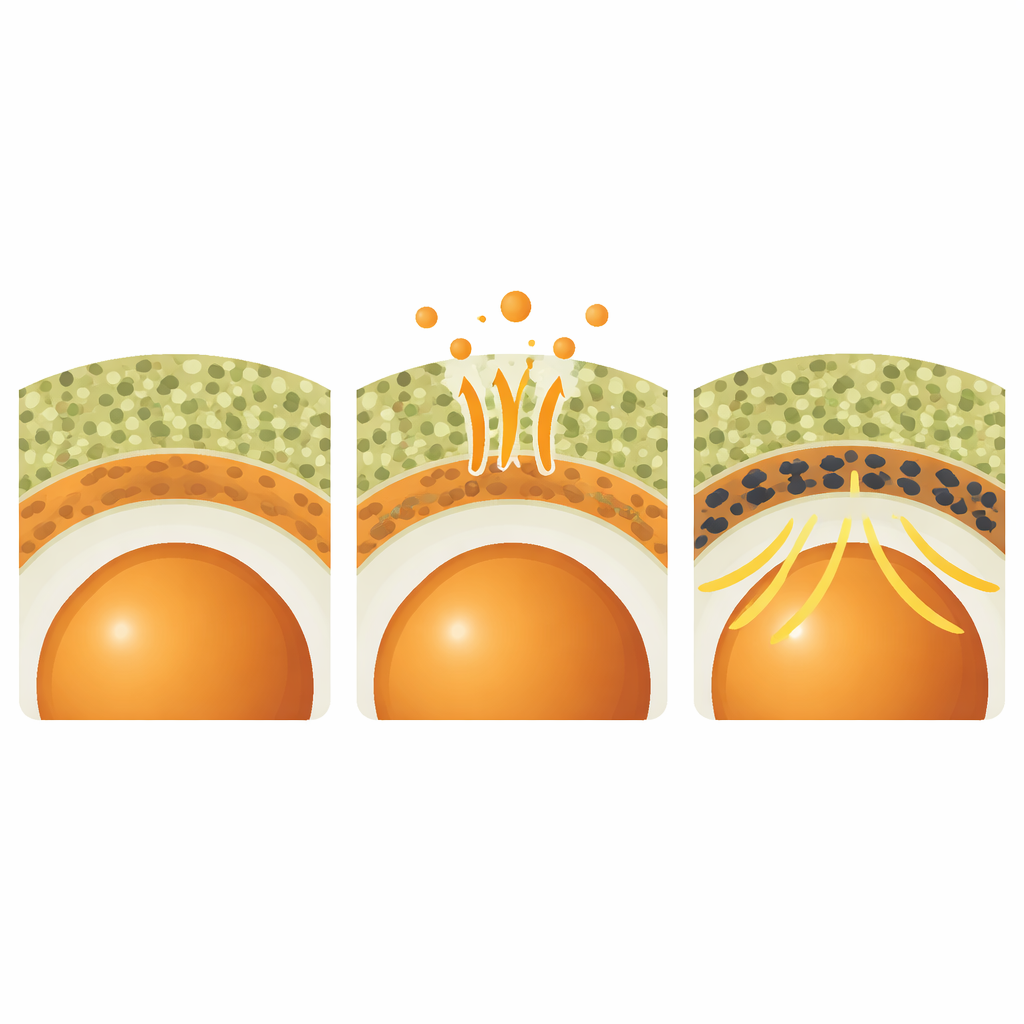
The authors focused on what might happen where solid mantle rocks physically touch the molten or solid metal of the core. In the laboratory, they pressed together powdered olivine — a magnesium-rich silicate common in the Moon’s mantle — and pure iron metal under pressures and temperatures like those near the lunar core–mantle boundary. Under these conditions, a new, dense iron–magnesium oxide called magnesiowüstite formed along the contact. Chemically, this process amounts to iron metal being “rusted” by oxygen while swapping iron and magnesium atoms with the surrounding silicate. Thermodynamic calculations extended these experiments, showing that magnesiowüstite remains stable across a realistic range of temperatures and oxygen levels at lunar depths, as long as some extra oxygen is available to push the reaction forward.
Listening to the New Mineral
To see whether this mineral could explain the odd seismic signals, the team manufactured magnesiowüstite samples with iron contents similar to those produced in their reaction experiments. Using synchrotron-based techniques, they squeezed and heated the samples while sending ultrasonic pulses through them to measure the speeds of compressional and shear waves. They found that the more iron the mineral contained, the slower the waves traveled. The iron-rich versions relevant to the Moon had wave speeds much lower than those of pure magnesium oxide and other Earth-like mantle minerals. Importantly, these iron-rich samples were also quite dense — a combination that resembles the strange properties inferred for the lunar low-velocity zone.
Building the Moon’s Mysterious Ring
The researchers then built simple mixtures in their models, combining small amounts of iron-rich magnesiowüstite with ordinary olivine and a pinch of silicate melt. They discovered that adding about 5–15 percent of this dense oxide, plus roughly 3.5 percent of melt, brings both wave speeds and density into line with the observed low-velocity zone around the core. Finally, they asked whether the Moon’s core could realistically supply enough oxygen over time to make that much magnesiowüstite. Earlier work shows that the young lunar core probably started out relatively rich in dissolved oxygen, which becomes less stable in metal as the core cools. As the Moon lost heat, that oxygen would be expelled upward, reacting with the base of the mantle and naturally creating the predicted mineral-rich ring.
What This Means for the Moon and Other Worlds
Seen through this lens, the Moon’s strange seismic layer is no longer a mystery but a fingerprint of chemical reactions between core and mantle as the body cooled. A thin, oxygen-enriched shell of magnesiowüstite, mixed with solid rock and a little melt, can both slow seismic waves and keep the material dense enough to match geophysical data. The study suggests that such reaction-driven layers may be common wherever metal cores and rocky mantles meet, not just in the Moon. Planets like Mars, and possibly even parts of Earth’s deep interior, could host similar mineral zones that quietly record their long-term cooling and oxidation histories.
Citation: Xu, Q., Gao, S., van Westrenen, W. et al. Reactive formation of magnesiowüstite at the lunar core-mantle boundary. Nat Commun 17, 3705 (2026). https://doi.org/10.1038/s41467-026-71701-8
Keywords: lunar interior, core-mantle boundary, seismic low-velocity zone, magnesiowüstite, planetary evolution