Clear Sky Science · en
Spin-polarized edge modes between different magnet-superconductor-hybrids
Turning Magnetism and Superconductors into Tiny Highways
Superconductors can carry electrical current without resistance, but on their own they are not easy to control in the intricate ways needed for future quantum technologies. This study shows how combining ultra-thin magnetic films with a superconducting metal can create special “highways” for electrons that run along the boundary between two different magnetic layers. These highways are not only confined to the edge; they are also spin-polarized, meaning they preferentially carry electrons with one quantum spin orientation, a property that could be harnessed in spin-based electronics and quantum computing.
Building a Sandwich of Exotic Materials
The researchers grew sheets just one and two atoms thick of the element manganese on top of a superconducting tantalum crystal. In this structure, called a magnet–superconductor hybrid, the manganese layers order themselves in an antiferromagnetic pattern: neighboring atomic spins alternate up and down so that the overall magnetization cancels out. Using a microscope that can both image surfaces atom by atom and sense spin (spin-polarized scanning tunneling microscopy), the team confirmed that both the single-layer and double-layer manganese films are antiferromagnetic and, through their contact with tantalum, also become superconducting at low temperatures. 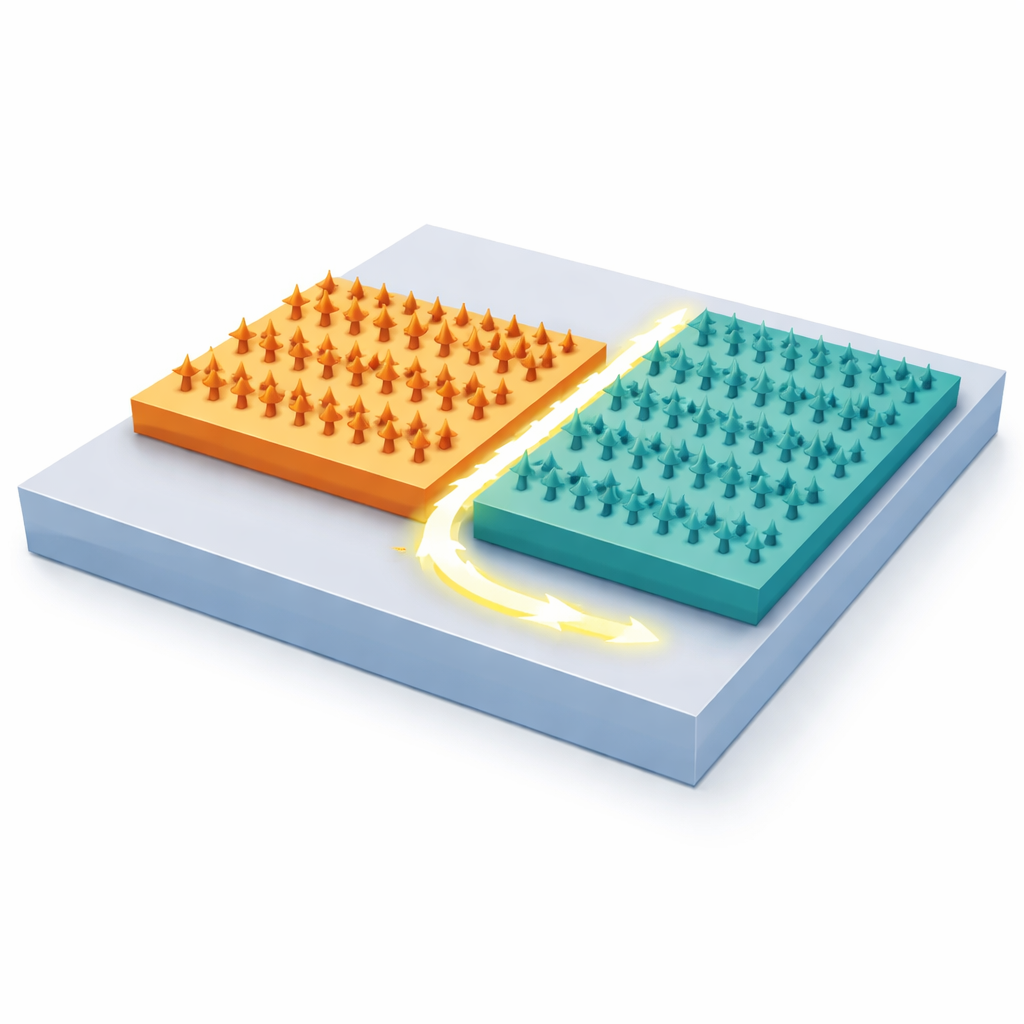
Hidden Edge States at Atomic Boundaries
When they probed the electronic states of these films, the scientists found that each manganese layer hosts special low-energy states at its outer edges, where it meets the bare superconducting tantalum. These edge states are strongest at certain crystal directions and appear as sharp peaks in the tunneling signal right at the center of the superconducting energy gap. Such behavior matches what is expected for a “nodal-point” superconducting phase, where the energy gap closes at a few isolated points in momentum space and topological edge modes must appear along specific directions. The team carefully ruled out more conventional explanations, such as impurity-induced bound states that can also form in superconductors, by analyzing how the signal changes with edge direction and magnetic structure.
A New Kind of Edge Between Two Superconducting Magnets
The most striking discovery emerged at the boundary where the one-layer and two-layer manganese regions meet each other, rather than where they meet the tantalum. There, the researchers observed a bright, low-energy edge mode that appears only when the system is superconducting and disappears when a magnetic field destroys superconductivity. Moreover, this edge mode is spin-polarized: its intensity depends strongly on the direction of the local magnetization at the boundary, and opposite segments of the same edge with flipped magnetic orientation show different brightness in the spin-sensitive microscope. By mapping both energy and position, the team showed that the edge channel is sharply localized at the interface but extends a bit more into one layer than the other. 
Theoretical Picture: Two Topological Phases Meet
To understand why this boundary mode appears and why it is spin-polarized, the authors built a theoretical “tight-binding” model that captures the essential ingredients: superconductivity, antiferromagnetic order, and spin–orbit coupling on a lattice matching the tantalum surface. In this model, the monolayer and bilayer regions are represented by slightly different coupling strengths between the magnetic and superconducting parts. Calculating the band structures, the team found that both regions realize nodal-point superconductivity, but with their nodal points located at different positions in momentum space and in different numbers. When the two phases are joined in a stripe geometry, new edge states appear that connect nodal points of one side to nodal points of the other, rather than connecting a topological phase to a trivial one as in earlier work.
Why the Edge Channel Picks a Spin
The simulations also revealed why the interface mode becomes spin-polarized almost inevitably. The edge state decays sideways into each of the two materials, but not at the same rate: its wave pattern penetrates more deeply into one manganese layer than into the other. Because each side has its own alternating spin structure, this unequal decay weights one spin direction more strongly overall, producing a net spin preference even when the boundary spins alternate or change orientation. By analyzing the so-called complex band structure, the authors showed that this asymmetric decay is a general consequence of the different electronic structures on the two sides, meaning that spin-polarized edge channels should commonly arise whenever two distinct nodal-point superconductors are interfaced.
Engineered Paths for Future Quantum Devices
In essence, this work demonstrates that carefully designed boundaries between different magnetic–superconducting hybrids can host robust, spin-polarized channels that run along the interface. Because the character of these channels depends sensitively on how the two regions differ, it may be possible to tune them using electric gates, strain, or patterned magnetic layers, without changing the underlying materials. Such controllable, spin-selective edge modes provide a promising new ingredient for low-dissipation electronics and for architectures that aim to manipulate exotic quantum states for technological applications.
Citation: Zahner, F., Nickel, F., Lo Conte, R. et al. Spin-polarized edge modes between different magnet-superconductor-hybrids. Nat Commun 17, 3457 (2026). https://doi.org/10.1038/s41467-026-71687-3
Keywords: topological superconductivity, antiferromagnetism, edge states, spin-polarized transport, magnet–superconductor hybrids