Clear Sky Science · en
Ultra-narrow donor-acceptor nanoribbons
Building Tiny Wires from Designer Molecules
Electronics keep shrinking, from desktop computers to phones and wearables. To push this trend further, scientists are exploring circuits built from individual molecules and atom-thin carbon sheets. This study shows how to build ultra-thin “wires” only a few atoms wide, and how to program their behavior by arranging two kinds of molecules—one that likes to give away electrons and one that likes to accept them—along the length of each wire.
Why Narrow Ribbons of Carbon Matter
Graphene, a one-atom-thick sheet of carbon, is famously strong and conductive, but it lacks a band gap, a key property that lets a material act as an on–off switch. When graphene is cut into long, narrow strips called nanoribbons, a band gap appears and can be tuned by changing the ribbon’s width, length, or edge pattern. Chemists have also learned that swapping a few carbon atoms for other elements, or decorating the edges with specific groups, can make nanoribbons behave more like electron donors or electron acceptors. What had not been realized in an atomically precise way was the powerful “donor–acceptor” design widely used in plastic solar cells and transistors: alternating electron-rich and electron-poor units along a chain to fine-tune how charges move.
Choosing the Right Building Blocks
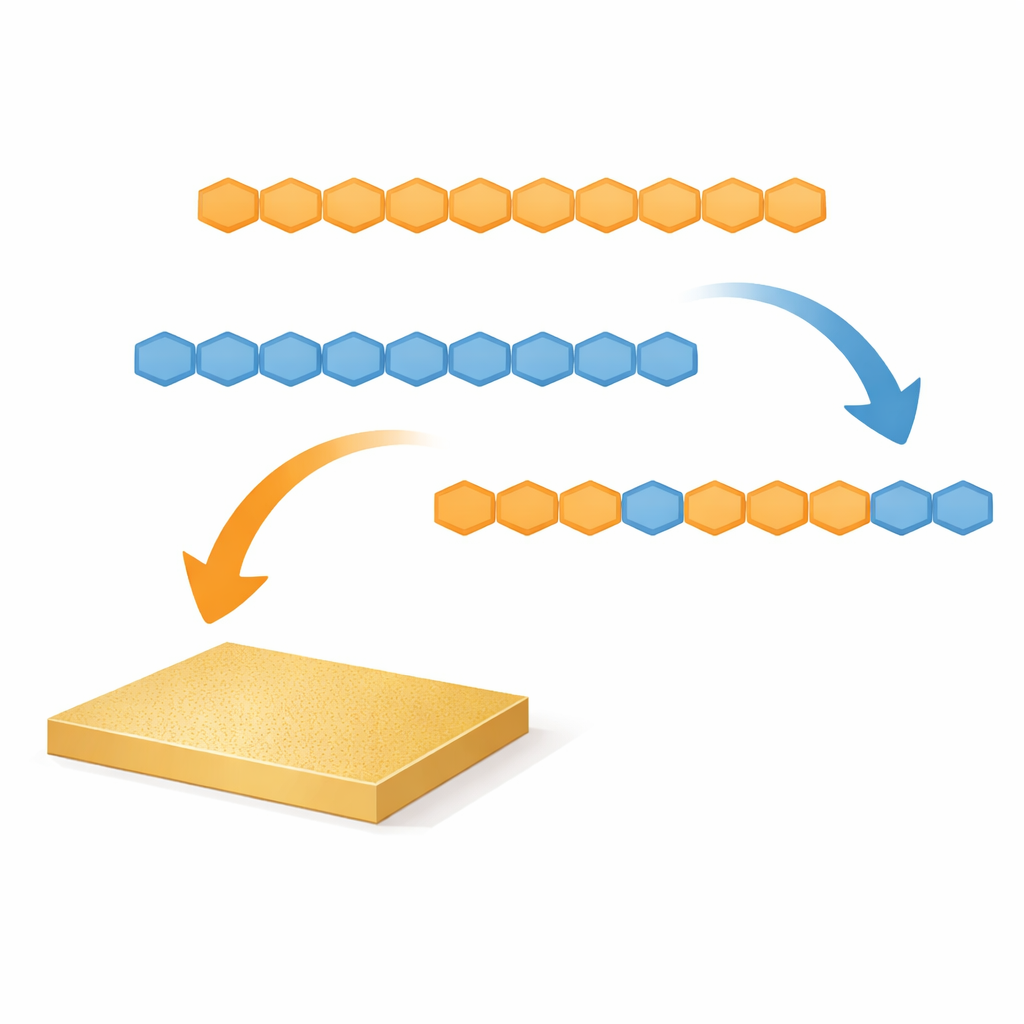
The team borrowed this design logic from polymer chemistry and applied it directly on a gold surface. They chose two flat, carbon-based molecules that act as near-perfect opposites. One, called peri-xanthenoxanthene (PXX), is rich in electrons thanks to oxygen atoms that feed charge into its carbon framework, making it a strong donor. The other, anthanthrone (AO), pulls electrons away through a “quinoidal” core, making it a strong acceptor. By attaching bromine atoms to specific positions on these molecules, the researchers turned them into reactive building blocks that, when gently heated on a gold crystal, link together into perfectly ordered chains just one molecule wide.
Seeing Atoms and Electrons One by One
To verify what they had built, the researchers used some of the most powerful microscopes available. Scanning tunneling microscopy and a related technique, non-contact atomic force microscopy with a carbon monoxide–tipped probe, can distinguish individual rings and bonds within each molecule. These tools confirmed the expected structures for pure donor ribbons made only of PXX and pure acceptor ribbons made only of AO, as well as mixed ribbons where the two units alternate or form short blocks. A second set of measurements, scanning tunneling spectroscopy, let the team probe how easily electrons could be added to or removed from specific spots along a ribbon. They found that as ribbons grew longer, their energy gaps narrowed: donor ribbons became better at giving up electrons, and acceptor ribbons became better at taking them in.
Programming Electronic Behavior with Sequence
When both types of building blocks were deposited together and heated, the surface produced mixed donor–acceptor nanoribbons. High-resolution images showed that donor and acceptor units naturally intermixed, often forming straight sequences of alternating units. Spectroscopy revealed that the highest occupied electronic states tended to sit on donor segments, while the lowest empty states concentrated on acceptor segments, just as designers hope in solar cell materials. Subtle changes in the order of units—whether donor and acceptor alternated or formed short donor- or acceptor-rich blocks—shifted the energy gap and the distribution of key states. Simple theoretical models, backed by detailed quantum calculations, captured these trends and offered a way to predict how new sequences would behave.

Toward Custom-Made Molecular Circuits
In plain terms, this work shows how to “write” electronic function directly into a molecular wire by choosing and ordering its basic units. By assembling ultra-narrow ribbons on a surface with atomic precision, and reading out both their structure and electronic behavior one molecule at a time, the researchers built a toolkit for tailoring carbon-based nanostructures. Such control could eventually enable custom-made wires for next-generation transistors, light-harvesting devices, and sensors, where performance is tuned simply by editing the sequence of donor and acceptor units along a ribbon.
Citation: Lawrence, J., Đorđević, L., Bachtiger, F. et al. Ultra-narrow donor-acceptor nanoribbons. Nat Commun 17, 3492 (2026). https://doi.org/10.1038/s41467-026-71660-0
Keywords: graphene nanoribbons, donor–acceptor polymers, molecular electronics, on-surface synthesis, optoelectronic materials