Clear Sky Science · en
Oxide interface-based polymorphic electronic devices for neuromorphic computing
Why this tiny device matters for future AI
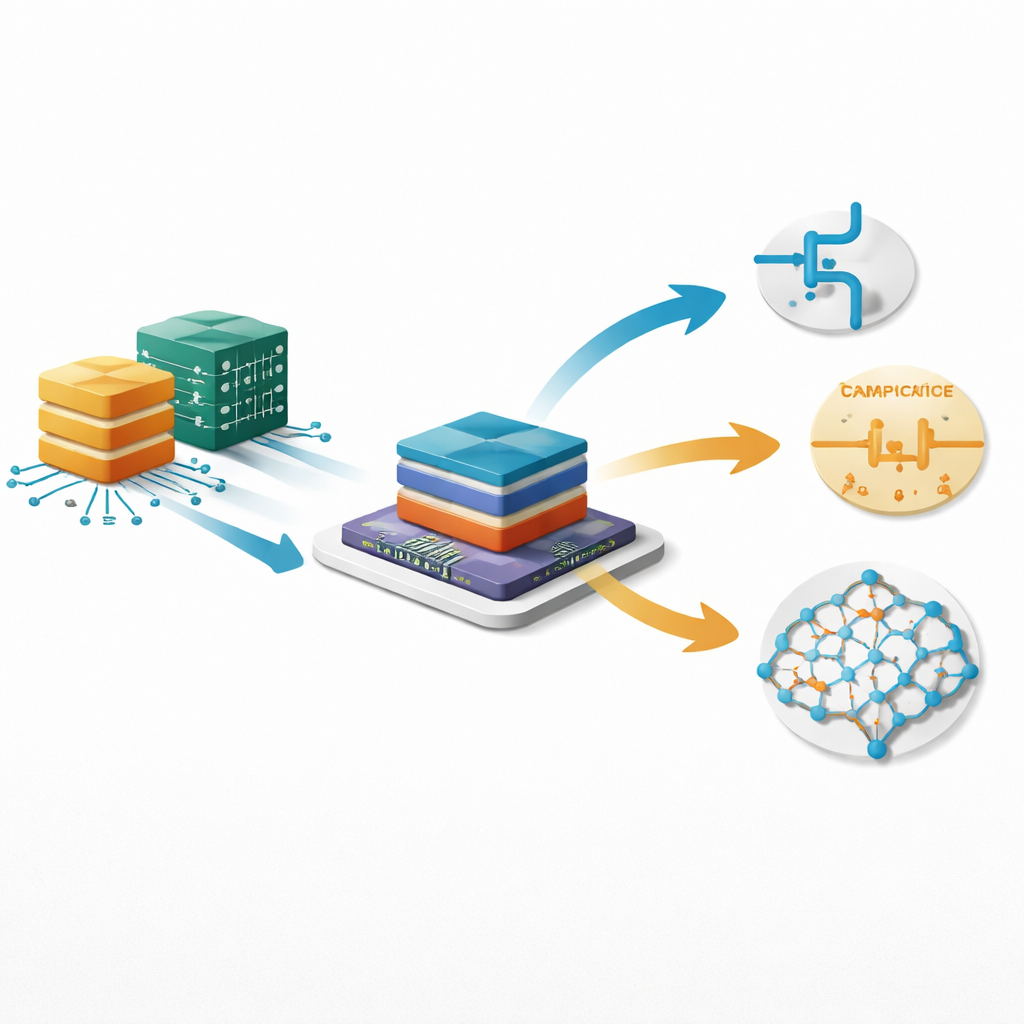
As our phones, cars and data centers become smarter, they also burn through enormous amounts of electricity. Much of this cost comes not from thinking, but from endlessly shuttling data back and forth between separate chips that store information and chips that process it. This article reports a new kind of microscopic device, made from oxide materials, that can play several electronic roles at once and even mimic aspects of how brain cells learn. Such shape‑shifting hardware could help build future artificial‑intelligence systems that are far more compact and energy‑efficient than today’s computers.
One tiny building block, many personalities
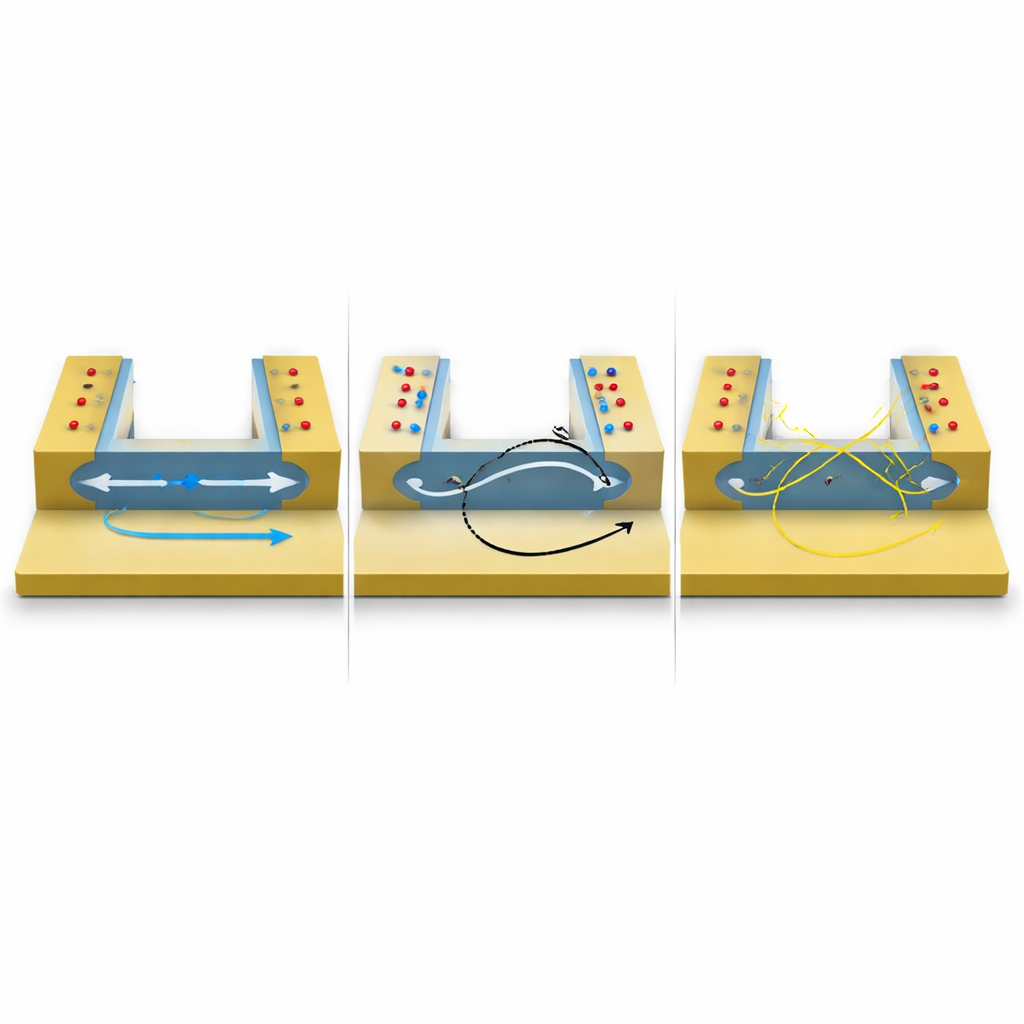
The researchers work with a special interface between two oxides, lanthanum aluminate (LaAlO3) and strontium titanate (SrTiO3). Where these crystals touch, electrons form an extremely thin, mobile sheet that behaves like a conductive nanowire. By carefully patterning this interface and adding two side electrodes, the team creates a single nanoscale structure that can be rewired, in real time, to act as three different basic electronic elements. With one wiring scheme it behaves like a conventional transistor, in another it becomes a memristor (a resistor with memory), and in a third it functions as a memcapacitor (a capacitor with memory). All three modes work at room temperature on an area of roughly one square micrometer—several times smaller and simpler than using three separate devices.
How the shape‑shifting works
In transistor mode, voltages applied to the side gates push electrons into or out of the LaAlO3/SrTiO3 nanowire, turning the channel current up or down much like a standard field‑effect transistor. To switch to memristor behavior, the side gates are left electrically floating instead of being tied to a fixed potential. Charges can then slowly tunnel to and from these floating regions, so the resistance of the channel depends on its recent voltage history and shows a characteristic hysteresis loop. For memcapacitor operation, the same gate structure is used to store and release charge in a controlled, history‑dependent way, leading to two distinct capacitance states with a clear hysteresis in the capacitance–voltage response. In all three cases, the key physics is the controlled trapping and detrapping of charge near the interface, rather than the movement of atoms or defects, which makes the behavior stable and repeatable.
From basic elements to brain‑like circuits
Because the same physical device can act as transistor, memristor, or memcapacitor depending on the external wiring, it becomes a flexible building block for neuromorphic—the brain‑inspired—circuits. The authors first connect one transistor to one memcapacitor to build a simple "reservoir computing" element. A brief input pulse controls the transistor, which in turn charges the memcapacitor. The output voltage then slowly decays, preserving a fading memory of recent inputs. This non‑linear, short‑term memory is exactly what reservoir computing needs for tasks like pattern recognition. Using computer‑generated digit images, the team shows that an array of these elements can distinguish different digits based on the time‑dependent voltage traces they produce.
Learning, logic, and decisions on the same platform
The same oxide device can also be rewired into circuits that mimic synapses—connections between neurons—and logic gates, the basic units of digital computing. In a configuration with one transistor and one memristor, short voltage spikes produce brief changes in current, while repeated or stronger pulses produce long‑lasting changes, echoing how biological synapses strengthen with repeated use. With two transistors and one memristor, the authors implement OR and AND logic operations where the logical output is stored directly in the memristor’s conductance long after the input signals are removed. By changing how the operating voltage is swept, the very same circuit can be reconfigured between OR‑like and AND‑like behavior, enabling a kind of synaptic logic that can adapt its rules on the fly. As a proof‑of‑concept application, they map heart‑rate and blood‑pressure signals onto the circuit and use it to mimic a simple health‑monitoring decision tree that distinguishes between healthy individuals and heart‑disease patients.
What this means for everyday technology
To a non‑specialist, the key message is that the authors have condensed several types of electronic behavior—and even basic learning and decision‑making functions—into a single, stable, silicon‑compatible oxide device. This reduces circuit area, cuts down on wiring overhead, and can lower energy use, all while supporting advanced AI‑style processing such as pattern recognition and adaptive logic. If scaled up, such polymorphic oxide devices could underpin future chips that blend conventional computing with brain‑inspired methods, helping data centers, edge devices, and sensors handle growing streams of information far more efficiently than today’s transistor‑only architectures.
Citation: Pradhan, S., Miller, K., Hartmann, F. et al. Oxide interface-based polymorphic electronic devices for neuromorphic computing. Nat Commun 17, 3406 (2026). https://doi.org/10.1038/s41467-026-71642-2
Keywords: neuromorphic computing, memristor, oxide interface, reservoir computing, polymorphic electronics