Clear Sky Science · en
Respiration as a dynamic modulator of sensory sampling
Why Your Breath Matters for What You See
We usually think of breathing as a background process that simply keeps us alive. This study shows that each breath also helps shape how clearly we see the world. By carefully measuring people’s brain activity, breathing, and pupil size while they detected faint visual patterns, the researchers reveal that inhaling can briefly sharpen our senses—and that people subtly adjust their own breathing to take advantage of this boost.
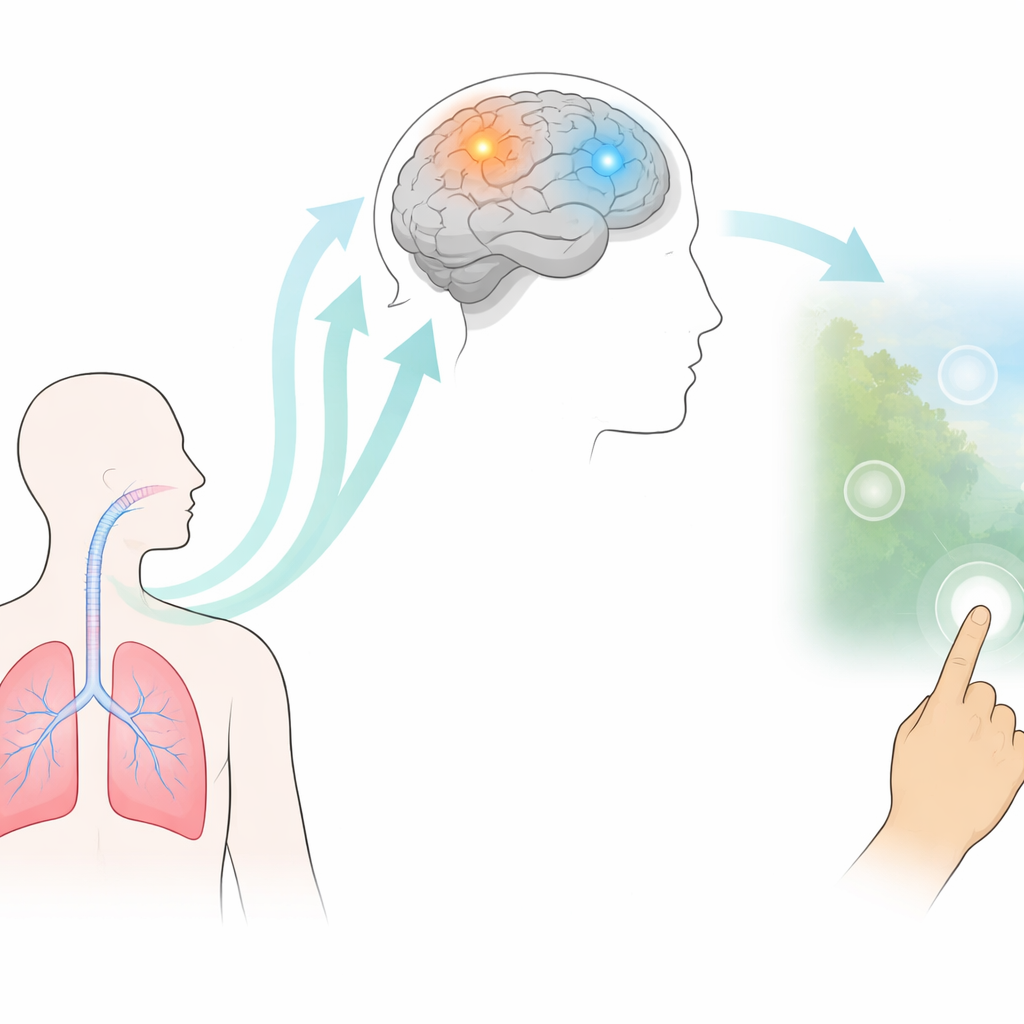
Breathing and the Senses Working Together
The team asked volunteers to stare at a central point on a screen while very dim striped patches flashed briefly to the left or right. Sometimes small hints on the screen told participants where or when to expect the patch, making it easier to anticipate. At the same time, the scientists recorded brain activity with a sensitive magnetoencephalography (MEG) scanner, tracked chest movements to follow the breathing cycle, and used an eye tracker to measure changes in pupil size, a common sign of alertness. This setup allowed them to watch how body rhythms and brain rhythms interacted during the split second before a person either detected or missed a near-invisible image.
Inhalation as a Moment of High Sensitivity
When the researchers lined up thousands of trials to the phase of the breathing cycle, a clear pattern emerged. People were most likely to detect the faint visual patches during the middle and later part of inhalation. At these moments, the contrast required for a person to notice the patch dropped, meaning their visual system had become more sensitive. Crucially, this wasn’t a passive effect. When the location and timing of the upcoming patch were predictable, participants shifted their breathing rhythm so that the expected stimulus tended to coincide with this inhalation-linked high-sensitivity window. Those who adjusted their breathing more strongly showed better overall performance, suggesting that we actively tune our breath to help our senses.
Alertness, Brain Rhythms, and the Role of Expectation
To understand what in the brain changed with breathing, the authors examined two key ingredients of perception: alertness and excitability. Pupil measurements showed that people were more alert during inhalation and when cues reduced uncertainty about the upcoming target. At the same time, characteristic brain rhythms in the alpha range over visual areas and beta range over motor areas weakened before successful detections and before predictable stimuli. Lower alpha power signaled that the visual cortex was in a more "ready" state to process input, while reduced beta power reflected a motor system primed to respond. Both rhythms rose and fell with the breathing cycle, linking the timing of inhalation to a favorable balance of brain activity, heightened alertness, and improved sensory performance.
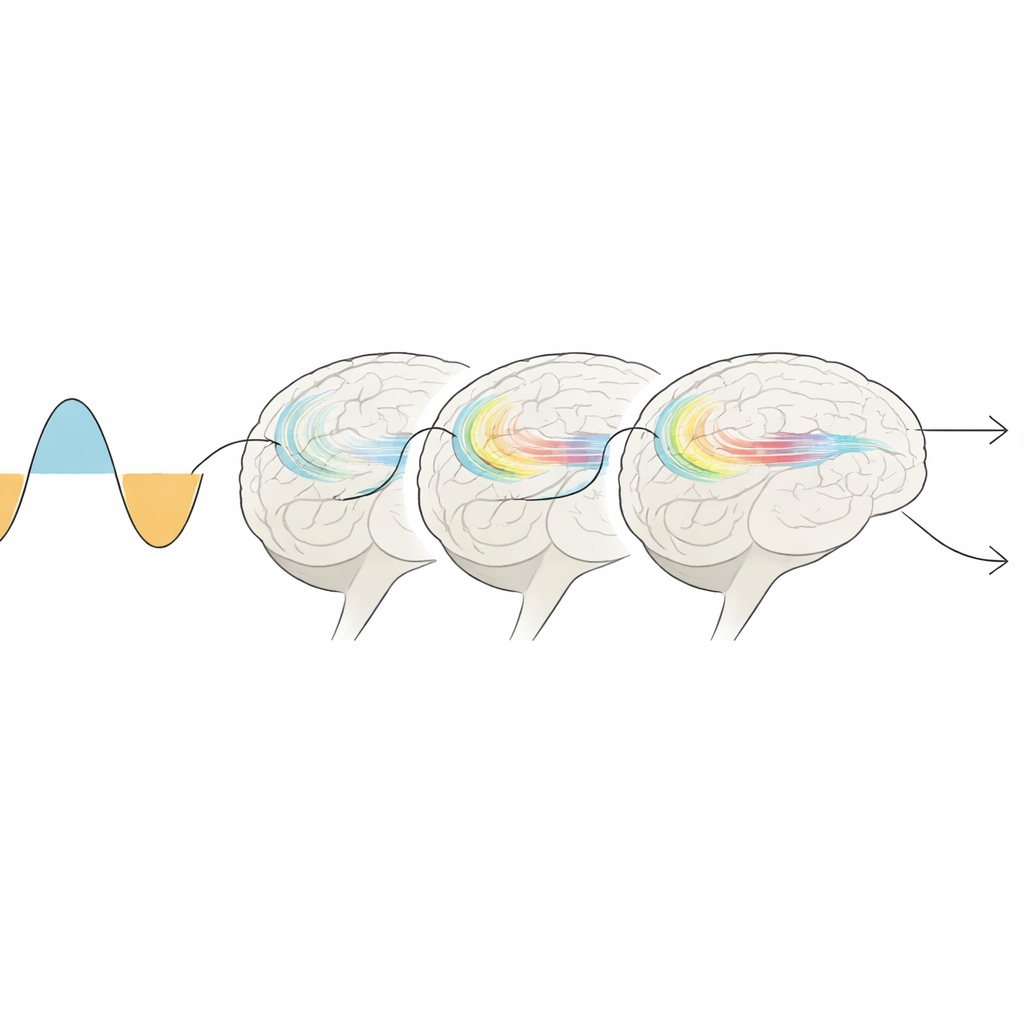
A Bodywide Network Linking Breath and Perception
Looking deeper, the researchers reconstructed activity from several interconnected brain regions known to track internal bodily signals, including the insula, cingulate cortex, temporoparietal junction, and motor and visual areas. They found that breathing shaped not only the strength of local rhythms but also the direction of information flow between these regions. Specific connections, such as those between motor control areas and the insula, and between visual cortex and the temporoparietal junction, changed their interaction patterns depending on the phase of breathing and on whether the upcoming stimulus was predictable. Stronger breathing-related changes in these connections were tied to greater gains in perceptual sensitivity, indicating that the respiratory rhythm helps coordinate a distributed network that integrates internal bodily state with expectations about the outside world.
What This Means for Everyday Experience
Taken together, the findings suggest that breathing is more than a simple life-support function: it is a dynamic timing signal that the brain uses to align moments of high sensitivity with important incoming information. By subtly adjusting when we inhale, especially when we can anticipate what will happen next, we can place our brains in a more receptive state at just the right time. While this study used carefully controlled lab conditions and very faint visual targets, it points to a broader principle: our internal rhythms and our perceptions are tightly intertwined, and the simple act of breathing may quietly help us make better sense of the world.
Citation: Chalas, N., Saltafossi, M., Berther, T. et al. Respiration as a dynamic modulator of sensory sampling. Nat Commun 17, 3261 (2026). https://doi.org/10.1038/s41467-026-71604-8
Keywords: breathing and perception, brain rhythms, attention and arousal, active sensing, interoception