Clear Sky Science · en
Chirality-selective optical transport of nanoparticles in the evanescent field of a nanofibre
Why twisting light and tiny particles matters
Many molecules in our bodies and in medicines come in left- and right-handed forms that can behave very differently, even though they share the same chemical formula. Separating these mirror twins efficiently—especially when they are extremely small—is a longstanding challenge in chemistry and drug development. This paper shows how specially shaped light guided through a hair-thin glass fibre can push left- and right-handed metal nanoparticles in different ways, offering a new route toward sorting such particles using nothing but light.
Light that feels which way a particle twists
At the heart of this work is chirality, the property of handedness familiar from our left and right hands or a screw that turns one way but not the other. The researchers study gold nanoparticles shaped like tiny twisted cubes, each about 200 billionths of a meter across. These particles exist in mirror-image versions, called enantiomers, that respond differently to circularly polarised light—a kind of light whose electric field spins like a helix as it travels. Earlier experiments had shown that such light can gently pull chiral nanoparticles toward or away from a focal spot. Here, the authors go further: instead of focusing light in open space, they guide it through a nanofibre so that only a thin "skin" of light leaks out around the fibre, where it can grab and slide particles along the glass.
Using a glass thread to steer nanoparticles
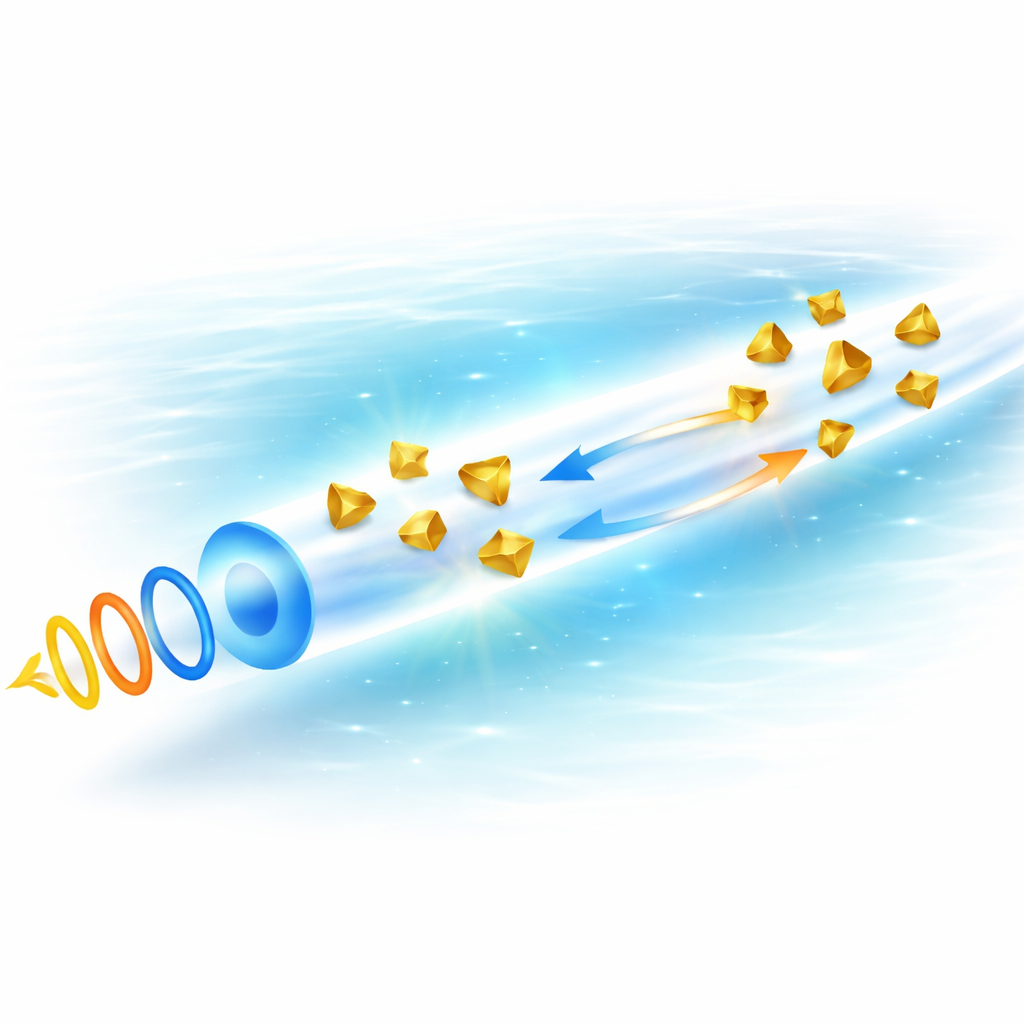
The team employs an optical nanofibre, a tapered glass thread thinner than the wavelength of visible light, immersed in water containing the chiral gold nanocubes. Light travelling inside the fibre generates an evanescent field—a tightly confined glow around the surface. This light both traps a nanoparticle against the fibre and pushes it along the fibre’s axis. Crucially, when the light is left- or right-circularly polarised, the pushing force gains a small extra contribution that depends on the particle’s handedness. By simulating the interaction between the guided light and a realistic particle shape, the authors show that this chiral force should noticeably speed up or slow down the particle depending on the light’s twist. They predict that, near a particular wavelength where the particles’ chiral response is strongest, the force difference could reach roughly 40 percent.
Watching single particles race along the fibre
To test these predictions, the researchers track the motion of individual nanoparticles as bright spots of scattered light under a microscope. With only one circularly polarised mode travelling in the fibre, they measure how fast particles move when the light’s handedness is flipped. For left-handed particles at optimal wavelengths, right-circular light propels them substantially faster than left-circular light, and the measured speed difference closely matches the simulations. Control experiments with non-chiral gold spheres show no systematic change in speed when the polarisation is switched, confirming that the effect is truly tied to chirality. By repeating the measurements for many particles and several wavelengths, the team finds that the strength of the force difference follows the same spectral pattern as standard chiral spectroscopy, linking the transport effect directly to how strongly the particles absorb left- versus right-handed light.
Making handed particles move in opposite directions
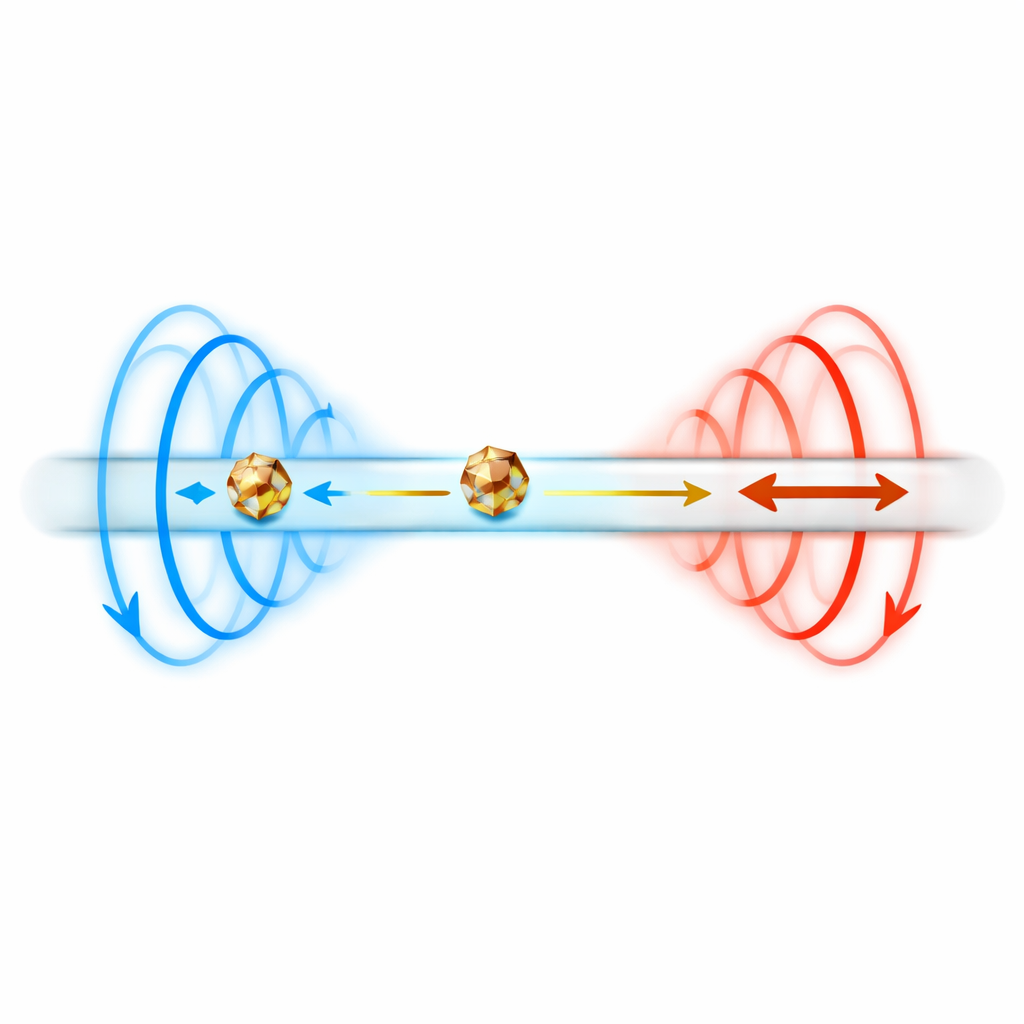
Beyond simply changing the speed, the authors show they can reverse the direction of motion using two light fields. They send circularly polarised light one way through the fibre and a second, linearly polarised beam the opposite way. By tuning the power of this counterpropagating mode, they cancel the ordinary, non-chiral pushing force so that only the chiral contribution remains. In this balanced regime, flipping the handedness of the circularly polarised light causes a trapped nanoparticle to swap its direction of travel along the fibre. The team demonstrates an oscillating motion in which a single particle shuttles back and forth when the polarisation is toggled, and they further show that left- and right-handed versions of the chiral nanocubes drift to opposite sides of a tapered fibre under the same conditions.
Toward light-powered sorting of molecular mirror images
The experiments prove that an optical nanofibre can turn the subtle difference between left- and right-handed nanoscale objects into a robust, directional force. Even though the particles vary somewhat in shape and size, the chiral force consistently stands out above these imperfections and over thermal jostling in water. With improved designs and higher powers, the same principle could be applied to even smaller objects, potentially down to sub-100-nanometre particles and eventually individual molecules. Such a fibre-based platform could one day help sort or manipulate mirror-image forms of drugs and other chiral substances using purely optical means, offering a contactless, tunable tool for chemistry, nanotechnology, and biomedicine.
Citation: Tkachenko, G., Suda, A., Ahn, HY. et al. Chirality-selective optical transport of nanoparticles in the evanescent field of a nanofibre. Nat Commun 17, 3463 (2026). https://doi.org/10.1038/s41467-026-71585-8
Keywords: chiral nanoparticles, optical nanofibres, circularly polarised light, enantioseparation, optical manipulation