Clear Sky Science · en
Swell-driven bursts of 26 s and 16 s seismic spectral peaks in the Gulf of Guinea
Mysterious Earth Hum from the Ocean
Our planet is never truly quiet. Even when no earthquakes are happening, sensitive instruments record a faint, steady shaking often called the Earth’s hum. For decades, seismologists have puzzled over two especially sharp rhythms in this background motion, repeating roughly every 16 and 26 seconds and seeming to come from the Gulf of Guinea off West Africa. This study brings together tools from oceanography, satellite remote sensing, and seismology to explain how distant storms at sea can shake hidden pockets of fluid beneath the seafloor and make the planet ring like a musical instrument.
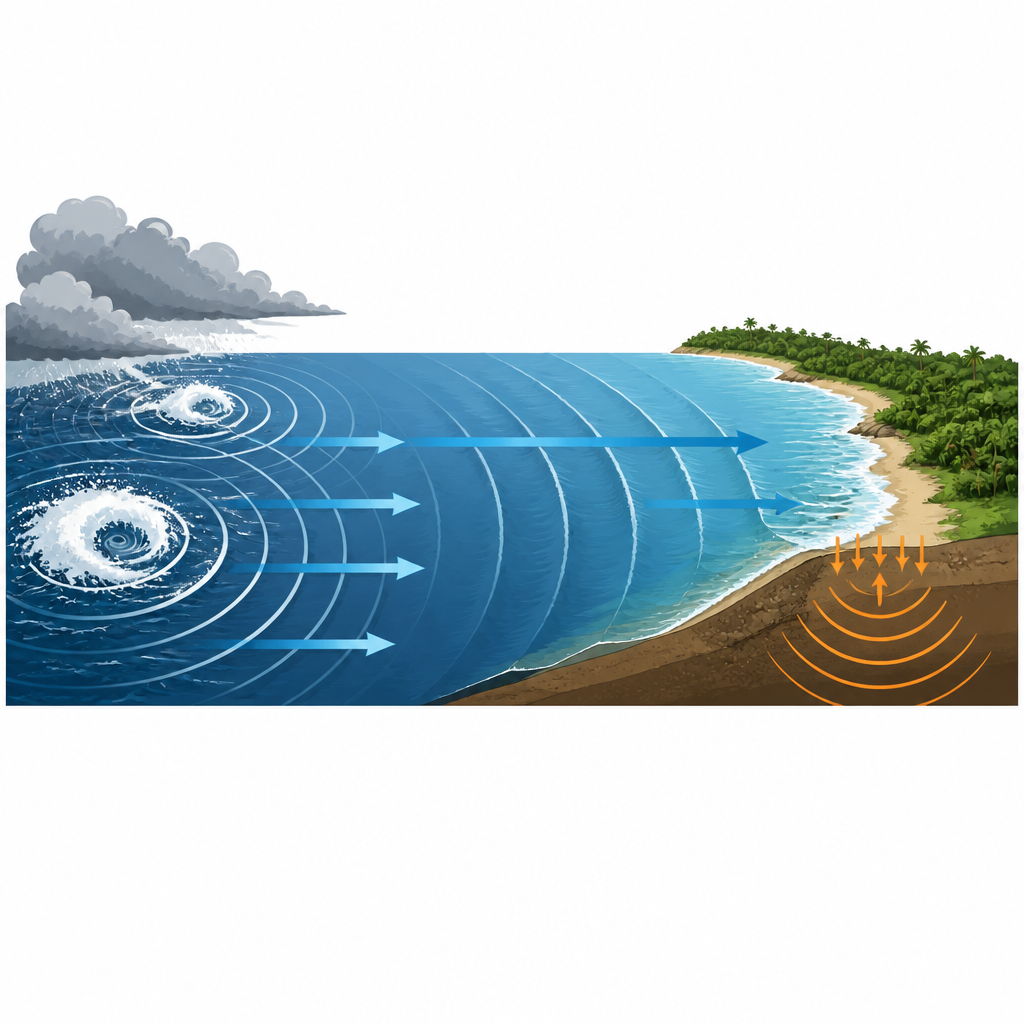
Hidden Rhythms in Earth’s Background Noise
Scientists have known since the 1960s that seismic stations worldwide record narrow spikes of energy at periods of about 16 and 26 seconds. These peaks are different from the broader, fuzzier bands of noise that can be explained by ordinary ocean waves crashing over large areas. Earlier ideas blamed either unusual ways that waves travel through Earth or volcanic activity beneath the Gulf of Guinea, but none fit the data very well. The authors of this paper set out to pin down, in numbers rather than guesses, how these signals are linked to the ocean above and the rocks below.
Listening from Afar with Seismic Arrays
The team analyzed several years of continuous seismic data from a dense network of instruments in southern France and an earlier temporary network in Cameroon. By comparing how tiny motions arrive at many stations at once, they used an approach similar to how radio antennas locate distant transmitters. This beamforming method let them trace the incoming waves back along great-circle paths across the globe, consistently pointing to a source region in the Gulf of Guinea for both 16- and 26-second signals. Instead of being always “on,” the peaks appear in bursts lasting a few hours, suggesting that a changing external trigger is involved.
Connecting Distant Storms to Local Shaking
To search for that trigger, the authors paired the seismic observations with a global ocean wave model and measurements from the SWOT satellite, which tracks the shape of the sea surface. They followed how long ocean swells, launched by powerful storms in the Southern Ocean, spread across the Atlantic and eventually reach the Gulf of Guinea. During the passage of swells with periods near 16 or 26 seconds, wave heights along the Gulf’s coastline rise, and bursts of the matching seismic peaks appear. Careful statistical tests, including thousands of randomized comparisons, show that the seismic bursts happen much more often during these specific swell conditions than would be expected by chance. The strength of the link grows with swell height, indicating that bigger waves more effectively switch on the Earth’s humming at these periods.
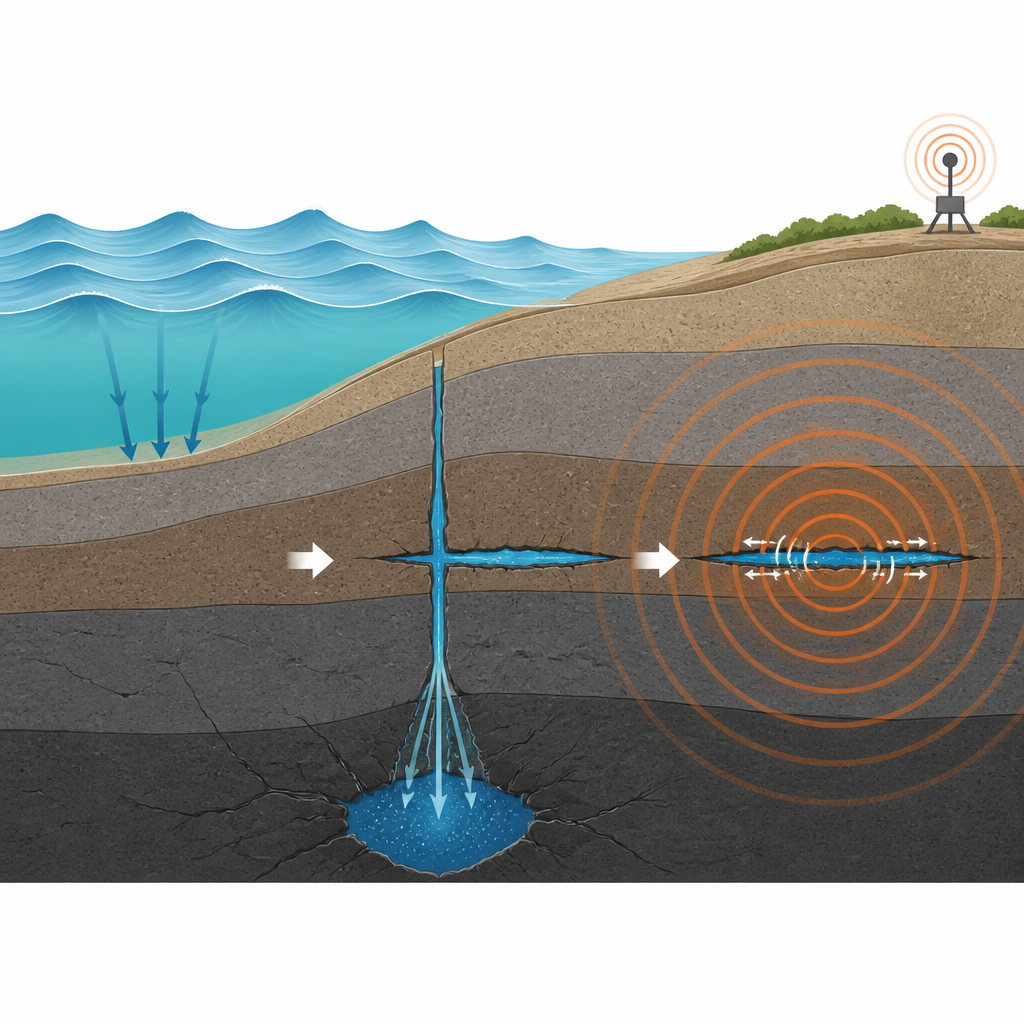
From Ocean Waves to Resonant Cracks
The next question is how passing swells turn into such sharply tuned seismic tones. The authors first tested whether standard mechanisms, where waves over rough seafloor gently shake the crust, could explain both the timing and amplitude of the peaks. Their models could reproduce more slowly drifting “gliding” signals seen in the data, but they failed to match the strong, narrow spikes at 16 and 26 seconds. This led the team to consider another idea: that the swells are exciting fluid-filled cracks or conduits in the shallow crust. Using a mathematical model of such cracks filled with water or magma, they found that realistic structures a few kilometers long and a few meters wide could naturally resonate at the observed periods and ring for a long time after being disturbed.
Why This Matters for Understanding Earth
The proposed picture is that distant storms send long swells toward West Africa, where they load the seafloor and shake buried pockets of fluid in the sediments of the Gulf of Guinea. When the rhythm of the swells matches the natural note of these cracks, the fluid sloshes and the crust resonates, producing the persistent 16- and 26-second seismic peaks recorded thousands of kilometers away. This work not only solves a long-standing puzzle in Earth science but also shows how gentle forcing at the ocean surface can probe hidden structures deep below, offering a new window into the plumbing of our planet’s outer shell.
Citation: Poli, P., Ardhuin, F., Takano, T. et al. Swell-driven bursts of 26 s and 16 s seismic spectral peaks in the Gulf of Guinea. Nat Commun 17, 4234 (2026). https://doi.org/10.1038/s41467-026-71541-6
Keywords: microseisms, ocean swells, Gulf of Guinea, seismic noise, fluid-filled cracks