Clear Sky Science · en
The fragmentation properties of massive star-forming regions in 30Dor-10 at 2000 au resolution
How Star Birth in a Nearby Galaxy Shapes the Night Sky
When we look at the night sky, we see the end products of a complex story: how clouds of gas break apart and give birth to new stars. Astronomers have long wondered whether this story plays out the same way everywhere in the universe, or whether some places are better factories for very massive stars. This paper zooms in on a famous star-forming region in our neighboring galaxy, the Large Magellanic Cloud, to test how the smallest pieces of star birth behave under very different conditions from our own Milky Way.
A Cosmic Nursery in Our Galactic Backyard
The study focuses on 30Dor-10, a dense complex of gas sitting next to the spectacular 30 Doradus starburst region. Nearby lies the star cluster R136, packed with some of the most massive known stars, which flood the surroundings with radiation and stellar winds. The Large Magellanic Cloud itself has less heavy elements than the Milky Way, a recipe that theory suggests should encourage the formation of especially massive stars. In this setting, astronomers want to know whether the very earliest building blocks of stars already favor high masses, or whether the environment reshapes the stellar population later on.
From Giant Clouds to Tiny Seeds of Stars
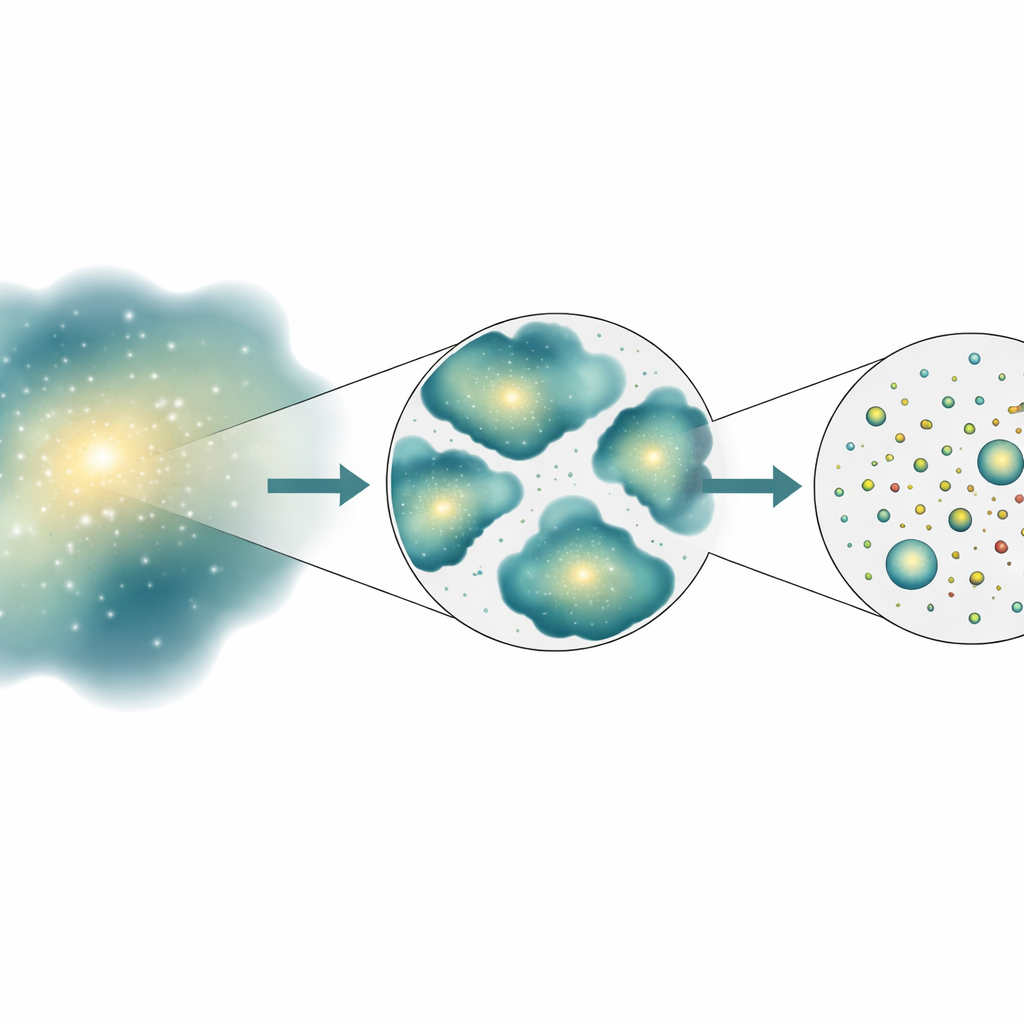
Stars do not form directly from huge gas clouds. Instead, those clouds fragment step-by-step into smaller pieces: first parsec-scale clumps (a fraction of a light-year), then denser pockets only a few thousand times the Earth–Sun distance across. These pockets, known as “cores,” are the immediate precursors of individual stars or small stellar systems. The way core masses are distributed is called the core mass function. It is widely suspected to be the template for the stellar initial mass function—the statistical rule that tells us how many low-mass versus high-mass stars a region produces. In familiar regions of the Milky Way, the core mass function looks very similar in shape to the stellar distribution, hinting that stars mostly inherit their masses from these tiny seeds.
Peering into an Alien Star Factory
Until now, such fine detail had never been measured outside our own galaxy, because resolving structures only about 2000 astronomical units across in another galaxy is extremely demanding. Using the Atacama Large Millimeter/submillimeter Array (ALMA), the authors achieved this resolution in three of the most massive clumps inside 30Dor-10. They identified 71 compact cores organized into four small proto-clusters. Careful checks using advanced source-finding software, numerical simulations, and data from the Hubble and James Webb space telescopes were used to weed out artifacts and to correct for possible contamination from hot ionized gas, ensuring that the measured signals truly trace cold dust in star-forming cores.
Weighing the Seeds and Testing the Pattern
To convert the millimeter emission into masses, the team had to assume how warm the dust is and how efficiently it emits radiation. Because the true temperatures of individual cores are uncertain, they ran 5000 Monte Carlo trials, randomly sampling a plausible range of temperatures for each core to see how the overall core mass function could vary. In every trial, they examined the high-mass “tail” of the distribution, where the most massive cores reside, and fit a simple power-law curve to this part. The slopes they found cluster around a value close to the classic Salpeter slope that describes the high-mass end of the stellar mass distribution in many Milky Way regions. Statistically, a Salpeter-like slope is fully consistent with the data, while a much flatter, top-heavy slope—like the one actually observed for the stars in 30 Doradus—is strongly disfavored.
Why Stars and Their Seeds Do Not Match
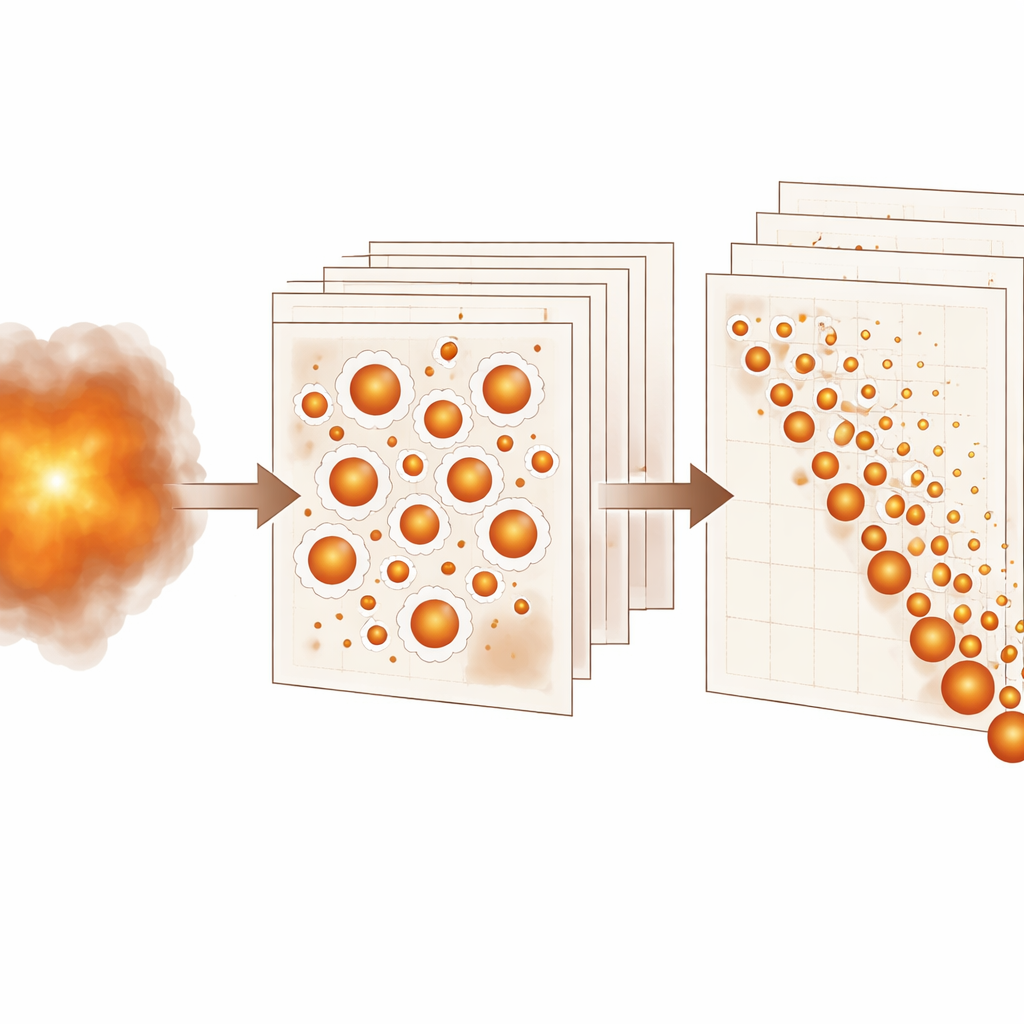
This result creates a striking contrast: in 30Dor-10, the tiny cores follow a familiar, Milky-Way-like pattern, but the already-formed stars nearby show a surplus of heavyweights. The authors explore several possible explanations. One idea is that many of the apparently single cores might actually hide multiple systems unresolved by ALMA, but detailed tests suggest this cannot easily reconcile the difference in slopes. Instead, the evidence points to time evolution. Other studies in our Galaxy show that, as a region ages and star formation progresses, the core mass function can shift from a steep, Salpeter-like form toward a flatter, more top-heavy one. The 30Dor-10 cores appear to represent an early stage, before this reshaping has occurred.
What This Means for the Story of Star Formation
To a non-specialist, the key message is that the birthplace of stars in this nearby galaxy looks surprisingly ordinary at the level of the smallest structures, even though the final stellar population is anything but. The work shows that the earliest fragmentation of gas into dense seeds may follow near-universal rules, while later growth, merging, and feedback in harsh environments can tilt the balance toward more massive stars. By proving that such detailed measurements are possible in another galaxy, this study opens the door to comparing star factories across the universe and to disentangling which parts of star formation are truly universal and which depend on local conditions and history.
Citation: Traficante, A., Jiménez-Donaire, M.J., Indebetouw, R. et al. The fragmentation properties of massive star-forming regions in 30Dor-10 at 2000 au resolution. Nat Commun 17, 3567 (2026). https://doi.org/10.1038/s41467-026-71515-8
Keywords: star formation, core mass function, Large Magellanic Cloud, initial mass function, ALMA observations