Clear Sky Science · en
Direct observation of organic molecules in asteroid ryugu revealed by high-resolution atomic force microscope
Ancient space chemistry up close
Long before Earth became a living world, complex carbon-rich molecules were already drifting through space. Some of this ancient material ended up locked inside asteroids. This study zooms in on those primordial building blocks, taken directly from the asteroid Ryugu and brought back to Earth. Using an ultra-sensitive microscope that can "feel" individual atoms, the researchers reveal surprisingly large and intricate organic molecules that had never been seen in such detail before, offering new clues to the chemical history of our solar system and the ingredients that may have helped make Earth habitable.
A clean sample from a primitive world
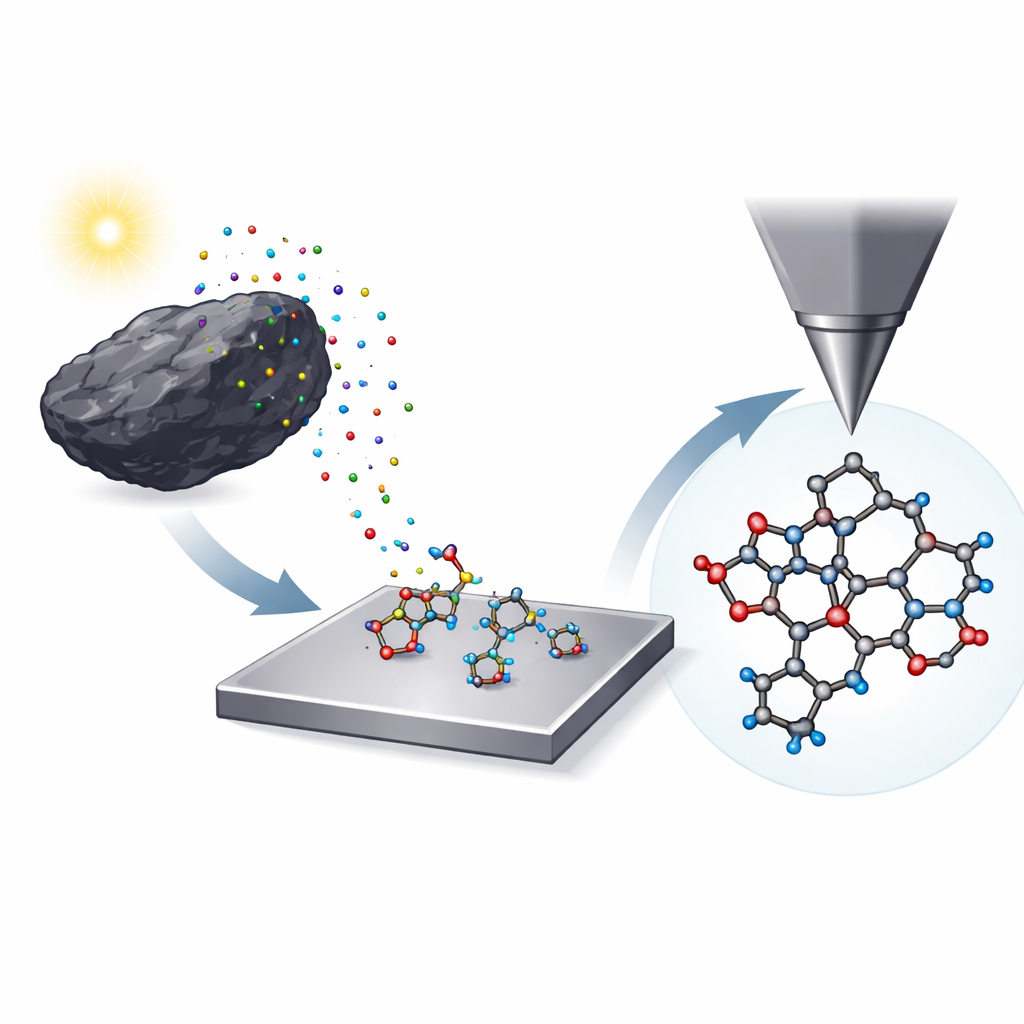
Most of what we know about extraterrestrial organic matter comes from meteorites that fall to Earth. These samples are invaluable but risky: they can easily pick up contamination from air, soil, and life on our planet. Japan’s Hayabusa2 mission changed that by collecting pristine grains from the dark, carbon-rich asteroid Ryugu and returning them under strict clean conditions. Earlier studies of Ryugu’s soluble organic matter, using powerful mass spectrometers, had already revealed tens of thousands of different chemical formulas, including amino acids, nucleobases, acids, and small polycyclic aromatic hydrocarbons (PAHs) made of a few fused carbon rings. Yet, these bulk techniques largely detect only relatively small and abundant species, leaving the rare, larger molecules hidden in the noise.
A microscope that feels atoms
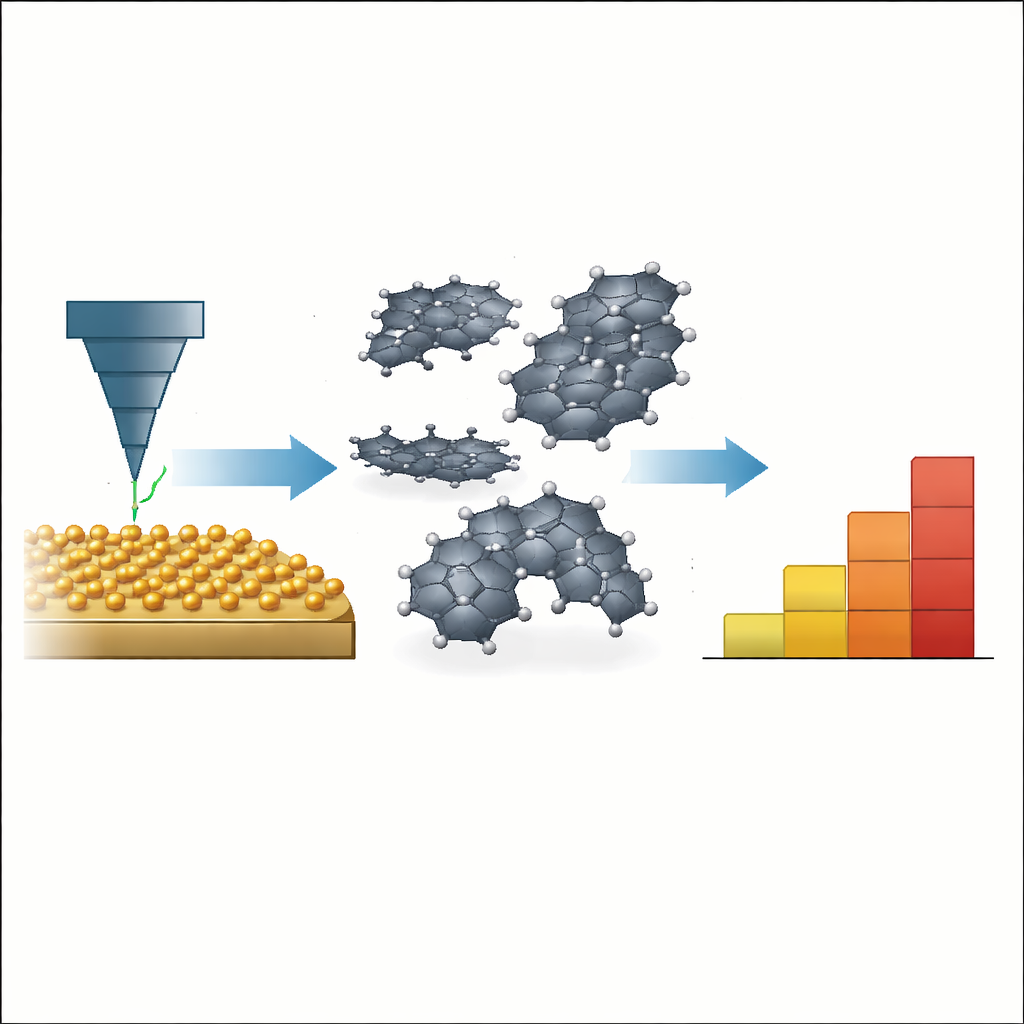
To uncover what was being missed, the team turned to high-resolution atomic force microscopy (AFM), a method that maps molecules by gently sensing the forces between a sharp tip and the sample surface. By functionalizing the tip with a single carbon monoxide molecule and operating at very low temperatures in ultra-high vacuum, AFM can draw out the outlines of individual rings within a single molecule. The researchers extracted the Ryugu organics with a solvent, deposited a tiny fraction onto a metal surface, and then searched patiently over micrometer-sized areas to find lone molecules from the asteroid. A specialized "multi-pass" scanning mode allowed them to follow the contours of three-dimensional molecules rather than just flat ones, revealing details that standard approaches would miss.
Giant and strangely shaped carbon frameworks
From just 22 molecules imaged in detail, a striking picture emerged. All of them were PAH-like structures built from multiple fused rings, but they varied enormously in size and shape, and no two had the same pattern. Some were modest, with about five or six rings, while others were enormous, estimated to contain more than 100 rings and reach molecular weights above 3000 atomic mass units—far larger than the one-to-six-ring PAHs previously identified in Ryugu by conventional analyses. The ring networks were not simple flat honeycombs: alongside familiar six-membered rings, many molecules included five-, seven-, and even eight-membered rings that forced their carbon skeletons to bend and curve out of plane. Bright protrusions around the aromatic cores hinted at short side chains, likely involving methyl groups, adding further complexity to these ancient organics.
Bridging lab samples and interstellar space
These unexpectedly large, three-dimensional PAHs help bridge a long-standing gap between what astronomers infer in space and what chemists see in hand-held samples. Infrared observations of interstellar clouds suggest that PAHs containing dozens to around a hundred carbon atoms are common in space, yet such giants have been difficult to confirm in meteorites or asteroid material using ensemble methods. AFM sidesteps the usual detection limits: it can visualize a molecule even if there is effectively just one copy available, and its sensitivity does not depend on the molecule’s mass. The Ryugu molecules the team imaged may represent cousins or intermediates of the large, curved carbon structures—such as fullerene-like species—seen in space, offering new insight into how complex carbon evolves from interstellar clouds to solid bodies and, ultimately, planetary surfaces.
What this means for our cosmic origins
For non-specialists, the key message is that asteroids like Ryugu carry a hidden cargo of large, intricate organic molecules that earlier methods could barely glimpse. By directly “seeing” their carbon skeletons molecule by molecule, this work shows that space chemistry can build not only simple ingredients such as amino acids and small rings, but also giant, twisted frameworks that may act as stepping stones toward even more complex organic matter. The study demonstrates that single-molecule AFM is a powerful new window on extraterrestrial chemistry and suggests that future analyses of other asteroid and meteorite samples will continue to refine our picture of the raw materials that preceded life on Earth.
Citation: Iwata, K., Oba, Y., Naraoka, H. et al. Direct observation of organic molecules in asteroid ryugu revealed by high-resolution atomic force microscope. Nat Commun 17, 3416 (2026). https://doi.org/10.1038/s41467-026-71484-y
Keywords: asteroid Ryugu, extraterrestrial organics, polycyclic aromatic hydrocarbons, atomic force microscopy, origins of life