Clear Sky Science · en
Amphibole reaction rims record shear during magma ascent
Rocks as witnesses to moving magma
When magma rises toward the Earth’s surface, it does much more than simply heat up and cool down; it also stretches, squeezes and shears like taffy. This study shows that tiny minerals inside volcanic rocks, specifically amphibole crystals and the delicate rims that grow around them, silently record not only the changing heat and chemistry of magma, but also how strongly that magma was stirred and strained on its way to an eruption. Reading these records can sharpen our picture of how quickly magma travels underground and why some eruptions become so hazardous.
Why a common mineral rim matters
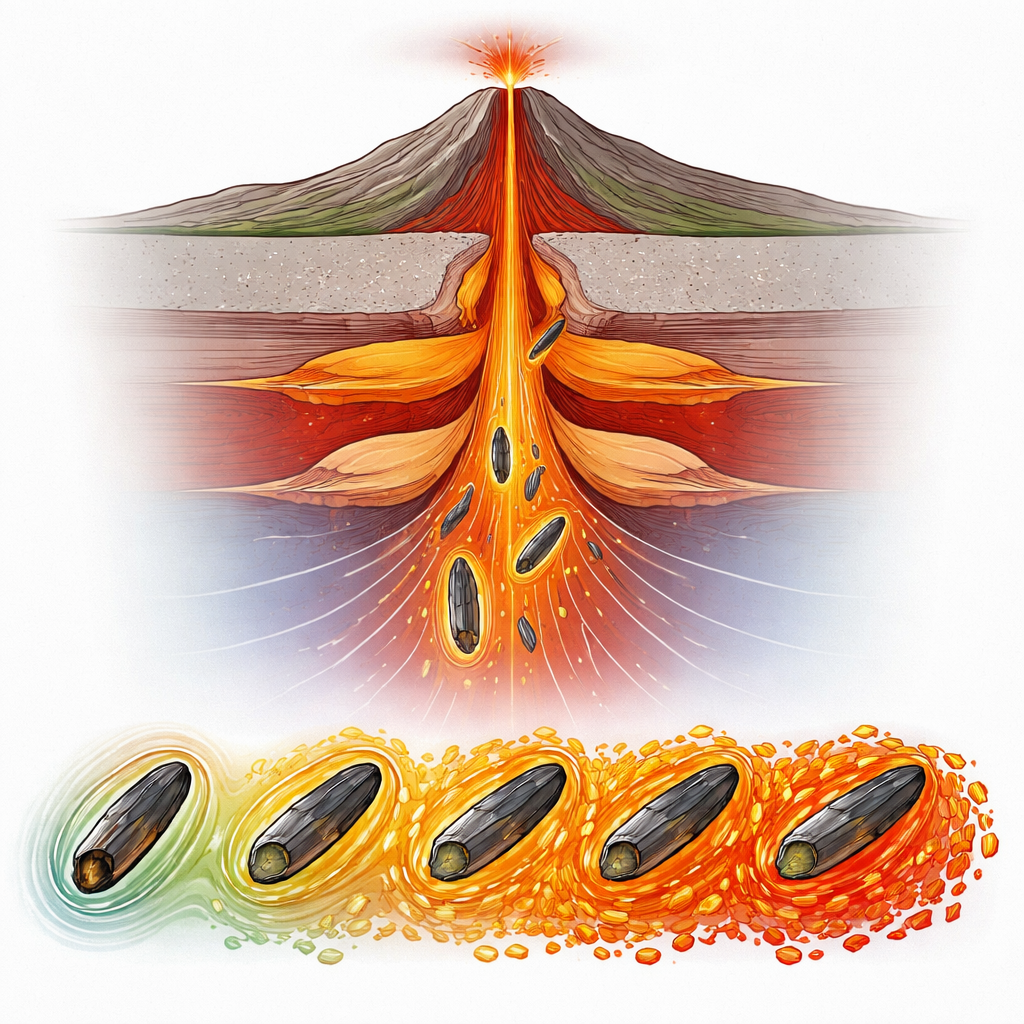
Amphibole is a widespread mineral in sticky, silica-rich magmas. As conditions change underground—such as drops in pressure, increases in temperature or shifts in gas content—amphibole becomes unstable and starts to break down. Around each amphibole grain, a fine-grained rim forms, made mostly of new crystals like pyroxene, plagioclase and iron-titanium oxides. For decades, volcanologists have treated these reaction rims as chemical thermometers and pressure gauges, assuming they record a kind of frozen instant when the mineral crossed a stability threshold. The new work argues that this picture is incomplete: the rims are not just chemical snapshots but also mechanical diaries that register how vigorously the magma was flowing and deforming.
Seeing crystal alignments as flow fingerprints
The researchers used electron backscatter diffraction, a technique that measures the exact orientation of countless tiny crystals, on both laboratory-grown and natural amphibole rims from volcanoes such as Unzen, Soufrière Hills, Bezymianny and El Misti. In controlled heating experiments, the first new crystals to appear in the rim are pyroxenes that grow in tight structural alignment with their amphibole host, like bricks laid neatly to follow an existing wall. This kind of ordered inheritance, called topotactic growth, produces rims where most pyroxenes point in nearly the same direction as the original amphibole. In some natural samples, especially those linked to gentle heating in relatively calm magma reservoirs, that neat alignment is preserved throughout much of the rim, signalling that growth outpaced any significant mechanical disturbance.
How flow and shear scramble the record
Other natural rims look very different: their pyroxene crystals point in many directions, with broad spreads in orientation and patchy zones of order and disorder. To understand this, the team built numerical models of how crystals behave in flowing magma under several scenarios, including simple shear, flow over cavities and the slow settling of dense amphibole grains through viscous melt. The simulations show that even modest shear can rotate rim crystals like leaves caught in a swirling current, progressively erasing their original alignment. Experiments where amphibole grains were held just above their stability limit for up to two days reveal the same trend: rims start out orderly but develop more strongly rotated crystals over time, matching the patterns predicted by the models. Local shear around settling or flowing crystals proves sufficient to detach, rotate and redistribute microlites, thickening rims asymmetrically and sometimes stripping material away from the host.

Linking strain history to eruption pathways
By comparing model outputs with the measured orientation patterns from different volcanoes, the authors show that rim textures reflect a competition between how fast rims grow and how fast the surrounding magma deforms. Where crystallisation is rapid and deformation mild or waning, rims stay mostly topotactic. Where magma ascent drives strong, increasing shear and rim growth slows—such as during gas-rich decompression—crystals rotate into a wide range of orientations, and outer rims become mechanically reorganised shells. Using Monte Carlo simulations on data from Soufrière Hills, the team turns these misorientation patterns into estimates of ascent and decompression rates, linking subtle microtextures to kilometre-scale magma transport histories.
Mineral rims as four-dimensional diaries of magma
The study concludes that amphibole reaction rims are not simply markers of pressure, temperature and composition, but also sensitive recorders of strain. In practical terms, each rim captures a four-dimensional story—conditions in space and time—that ties together chemistry, heating and cooling, and the push and pull of magma flow. For non-specialists, this means that by reading the orientations of crystals a fraction of a millimetre across, scientists can reconstruct how quickly and violently magma moved beneath a volcano, improving our ability to interpret past eruptions and better anticipate the behaviour of future ones.
Citation: Wallace, P.A., Birnbaum, J., De Angelis, S.H. et al. Amphibole reaction rims record shear during magma ascent. Nat Commun 17, 3407 (2026). https://doi.org/10.1038/s41467-026-71477-x
Keywords: magma ascent, volcanic crystals, amphibole rims, shear deformation, eruption dynamics