Clear Sky Science · en
Immune-deficient bacteria serve as gateways to genetic exchange and microbial evolution
How some bacteria open doors for new traits
Antibiotic resistance and new infectious strains often emerge when bacteria trade genes like swap cards. This study asks how such exchanges really happen in nature, and why some bacteria seem far better than others at picking up new DNA, including genes that help them resist medicines or become more harmful to humans and animals.
Ways bacteria swap genetic information
Bacteria can share genes in several ways: by picking up loose DNA from their surroundings, by passing DNA directly from cell to cell, or by using viruses that infect bacteria, called phages, as couriers. These routes, grouped under the term horizontal gene transfer, allow traits such as drug resistance or new tools for attacking hosts to jump rapidly between cells. In the pathogen Staphylococcus aureus, which causes everything from skin infections to life threatening disease, the authors set out to compare how well different gene sharing routes work across many real world strains.
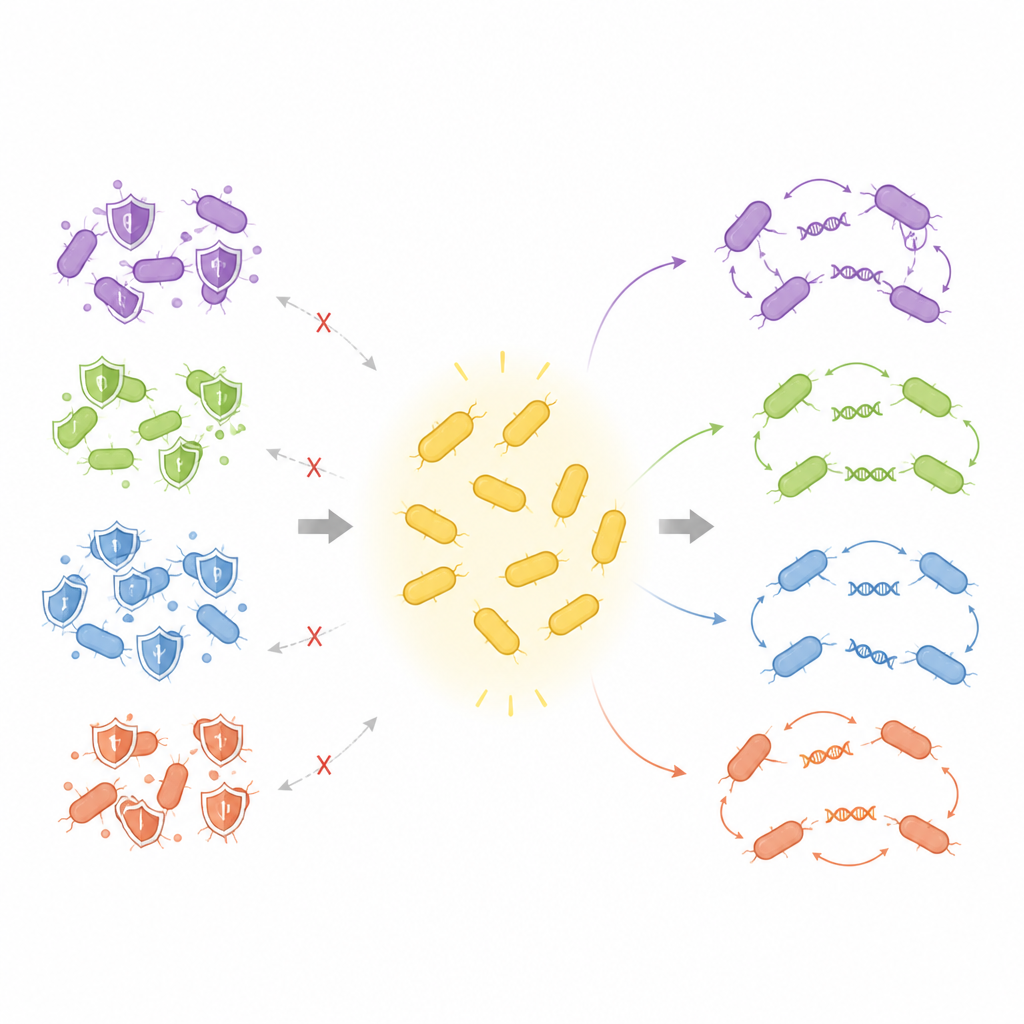
Gene sharing blocked by bacterial security systems
S. aureus strains fall into large genetic families known as clonal complexes. Although all are the same species, strains from different families can be quite distinct and carry different molecular "security systems" that recognize and cut incoming DNA. When the team tested a range of mobile genetic elements such as plasmids and phage carried islands that often hold resistance or virulence genes, they found that these elements usually moved well only when donor and recipient belonged to the same family. When the strains came from different families, transfer almost always collapsed to extremely low levels, showing that bacterial defenses sharply limit the spread of many gene carrying elements.
An especially powerful route for chromosome transfer
Surprisingly, the bacterial chromosome itself proved much more mobile than expected. A process called lateral transduction, in which phages accidentally package large stretches of the host chromosome and deliver them to new cells, moved chromosomal markers at very high frequencies even between unrelated strain families. This route outperformed both classical plasmid transfer and other types of phage mediated transfer for the chromosome. Because chromosome fragments can still recombine into the recipient genome even when cut into pieces, they can slip past some security systems that efficiently block circular, self contained elements like plasmids and many phages.
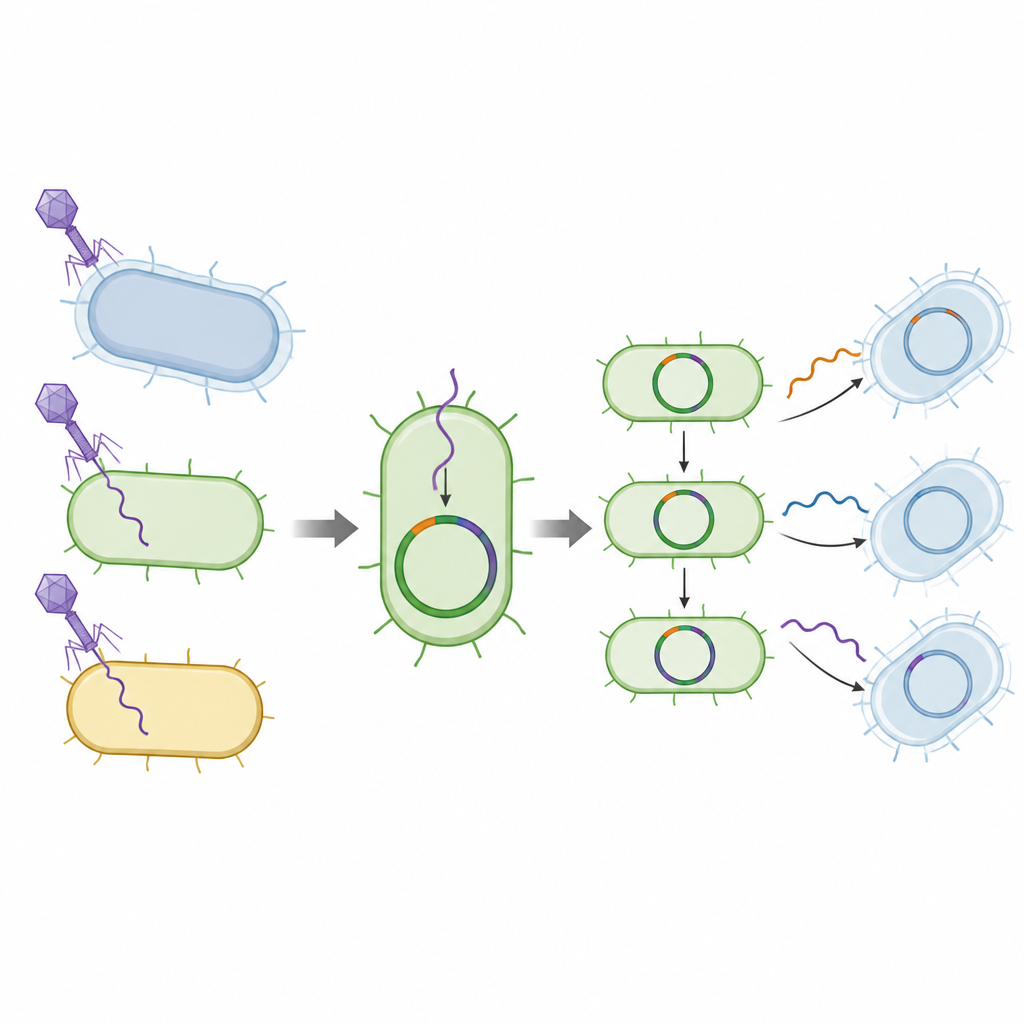
Immune deficient strains as genetic gateways
While most strains resisted foreign DNA from other families, a few were strikingly permissive: they accepted nearly every element tested. Detailed genetic analysis showed that these "promiscuous" strains lacked a working part of a key defense system, called the restriction subunit, while still keeping the part that tags their own DNA as self. Without the cutting activity, these bacteria could not destroy incoming DNA, but once new DNA entered, they could mark it correctly so that other members of their own family would accept it. Experiments confirmed that when such a permissive strain first received foreign phage DNA, it could then pass that DNA on efficiently to otherwise resistant relatives.
Why vulnerable mutants persist in nature
At first glance, losing a major defense system seems like an evolutionary mistake, because it leaves bacteria more exposed to lethal phage attacks. The researchers, however, found that about 4% of S. aureus genomes in public databases carry obvious disruptions in this restriction gene, much more than in other parts of the same system. Laboratory competitions helped explain why. In mixed cultures exposed to phage, the immune deficient mutants tended to decline unless the phage also carried an antibiotic resistance gene and the antibiotic was present. Under drug pressure, the mutants that could take up the resistance gene quickly dominated. This suggests a trade off in which heightened vulnerability is balanced by an improved ability to acquire useful traits when conditions demand it.
What this means for infection and resistance
Overall, the work shows that lateral transduction is a dominant route for moving chromosomal genes in S. aureus, and that ordinary mobile elements often face strict family boundaries set by DNA cutting systems. Yet the frequent presence of immune deficient bacteria that can still mark DNA for acceptance turns these cells into gateways that allow foreign genes to cross those boundaries and then spread within a clonal family. For a lay reader, this means that rare, more fragile bacteria can act as crucial middlemen in the rise of new resistant or more aggressive strains, helping explain how hospital and livestock pathogens keep evolving despite strong genetic defenses.
Citation: Figueroa, W., Sabnis, A., Ibarra-Chávez, R. et al. Immune-deficient bacteria serve as gateways to genetic exchange and microbial evolution. Nat Commun 17, 4737 (2026). https://doi.org/10.1038/s41467-026-71467-z
Keywords: horizontal gene transfer, Staphylococcus aureus, antibiotic resistance, bacteriophages, bacterial evolution