Clear Sky Science · en
Investigating antibody cross-reactivity and transmission dynamics of alphaviruses and flaviviruses using a multiplex serological assay
Why mosquitoes and blood tests matter
Viruses spread by mosquitoes, such as dengue, Zika, and chikungunya, are quietly infecting hundreds of millions of people every year. Many infections never reach a clinic, especially in places with few laboratories, so official case counts can miss most of what is happening. This study describes a new type of blood test that can detect past infections from many of these viruses at once and, crucially, separates real infections from misleading signals when antibodies react to more than one virus. That makes it possible to draw a clearer picture of where and how often these diseases are spreading.
A many-in-one blood test
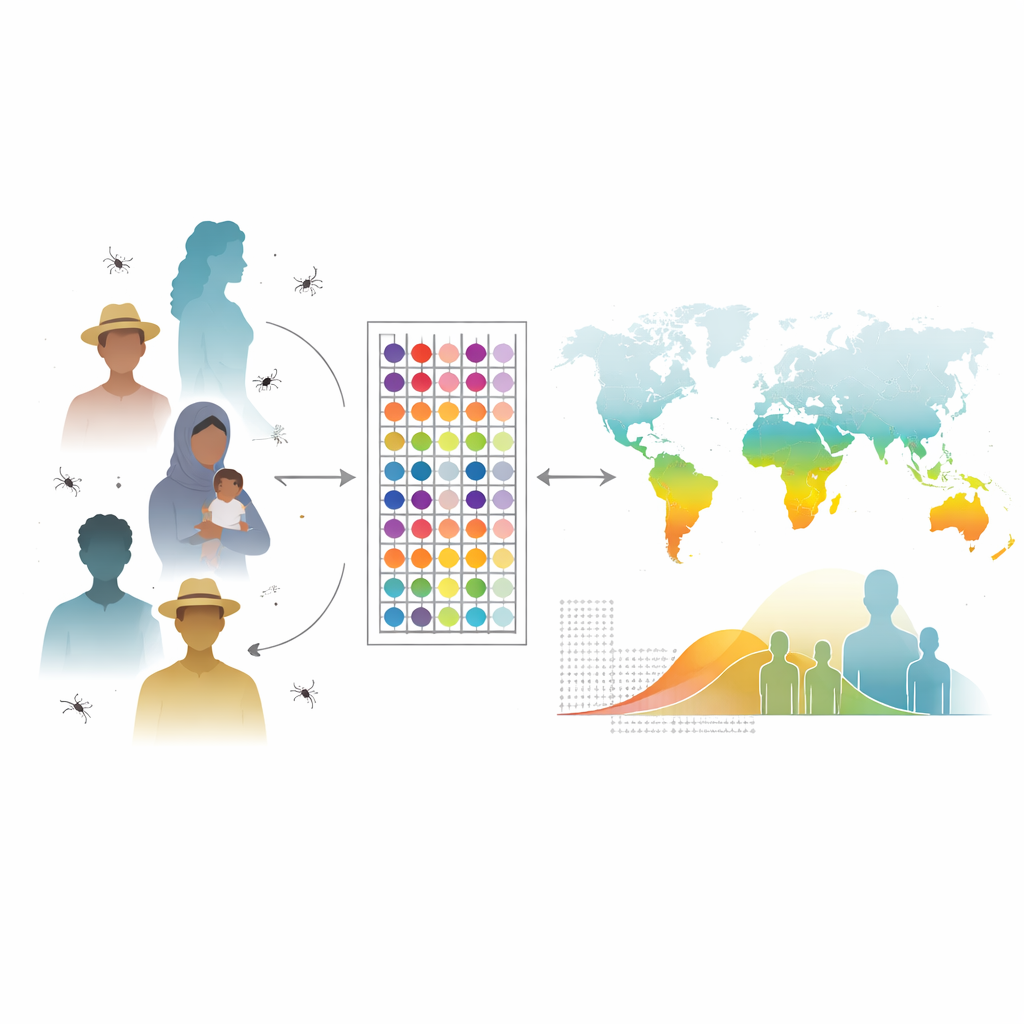
The researchers built a “multiplex” blood test that measures antibodies against 28 different pieces of nine mosquito-borne viruses, including dengue, Zika, yellow fever, West Nile, Japanese encephalitis, chikungunya, Mayaro, Usutu, and O’nyong-nyong. Each piece of virus is attached to microscopic beads, allowing a single drop of blood to be scanned for a wide panel of past infections in one go. They applied this test to more than 4000 blood samples from people living in Peru, French Guiana, Senegal, and New Caledonia, regions that span South America, Africa, and the Pacific. This created a high‑resolution snapshot of immune histories across very different settings.
Separating true infections from background noise
Turning continuous antibody readings into a simple yes-or-no answer is not straightforward: picking a threshold that is too low flags many people as positive when they are not, while a threshold that is too high misses real infections. The team used statistical mixture models to assume that, for each viral marker, the population is a blend of people who have never been infected and those who have. By fitting these models, they could estimate where these two groups lie in the data and how much they overlap. They then combined this with a standard tool called receiver operating characteristic analysis to map out the trade-off between sensitivity and specificity and to choose thresholds that fit different needs. For most of the 28 markers, especially for whole-virus and certain non-structural proteins, the test could reliably distinguish people with and without past infection.
Untangling confusing antibody signals
A major challenge is cross-reactivity: antibodies raised against one virus can stick to related viruses, making it look as if a person has been infected by multiple viruses when they have not. This effect is especially strong among flaviviruses such as dengue and Zika, and among alphaviruses such as chikungunya and Mayaro. By examining how antibody levels to different viral pieces rose and fell together, the researchers found tight clusters of related responses, confirming that cross-reactivity is widespread. However, some viral components, particularly a protein called NS1 in flaviviruses, produced more virus‑specific patterns. Using network analysis and principal component analysis, they showed that NS1 responses carry shared “flavivirus” information but also separate signatures that help distinguish dengue and Zika exposure.

A closer look at chikungunya and Mayaro
To probe cross-reactivity in detail, the team focused on chikungunya and the lesser-known Mayaro virus, both of which circulate in tropical forests and can cause similar joint pain. They selected groups of people whose blood appeared to show past infection with chikungunya alone, Mayaro alone, or both. In competitive laboratory experiments, they added free viral proteins to soak up certain antibodies before measuring what remained. These tests revealed that chikungunya infection tends to generate antibodies that strongly cross-react with Mayaro, whereas Mayaro infection produces a much weaker cross-reaction towards chikungunya. Using a mathematical model that connects antibody levels, age, and place of residence, they reconstructed how each virus has circulated in the study sites over time and estimated how often people were infected each year, while correcting for cross-reactivity.
What this means for tracking outbreaks
The study shows that it is possible to combine a many‑in‑one blood test with careful statistics, targeted lab experiments, and mathematical modelling to recover who was likely infected with which virus and when. For chikungunya and Mayaro, this approach confirmed that chikungunya is more prone to induce misleading cross-reactive antibodies, and it produced transmission estimates that agree with independent epidemiological observations, such as known chikungunya outbreaks in 2014. More broadly, the work demonstrates a blueprint for improving surveillance of mosquito-borne viruses in places where several viruses co-circulate and routine testing is scarce. By better accounting for cross-reactivity, public health agencies can gain a clearer view of hidden transmission and be better prepared for future epidemics.
Citation: Yman, V., Rosado, J., Ochida, N. et al. Investigating antibody cross-reactivity and transmission dynamics of alphaviruses and flaviviruses using a multiplex serological assay. Nat Commun 17, 3491 (2026). https://doi.org/10.1038/s41467-026-71451-7
Keywords: arboviruses, serology, cross-reactivity, chikungunya, Mayaro virus